Fake tracking
Artem Zbandut reviews fake parcel tracking in the UK: customs charges, cloned log-in pages and checks
Artem Zbandut, who founded the Odesa freight company Black Sea Forwarding, reviews the parcel and freight tracking cons that reach UK phones and inboxes: a text demanding a customs fee before a parcel is released, a redelivery charge, a cloned carrier log-in page, a delay notice carrying new bank details. The checks below rest on primary sources: GOV.UK guidance on tax and customs for goods sent from abroad, HMRC scam guidance, the Universal Postal Union S10 standard, the BIC register of container codes, NCSC and GOV.UK reporting routes, and Report Fraud guidance on mandate fraud. The final sections cover what to do once money in pounds has already left your account.
Artem Zbandut reviews fake parcel tracking in the UK: how the con starts
Most of these cons open with a short message. The parcel is waiting, a fee is due, tap the link before the item goes back. The number quoted may even match a real delivery, because order confirmations and tracking codes are shared so widely, and that alone makes the text feel routine.
For a business the same trick arrives dressed as freight correspondence. A container is held at the port, a pallet has been moved to another depot, the haulier has changed bank. Each message leans on a deadline and points to a page styled like the carrier's own site.
Artem Zbandut worked his way up from freight forwarder at the Mariupol Sea Trade Port to head of logistics at a private shipping agency, then founded Black Sea Forwarding in Odesa in 2019. In 2022 he moved the company's supply chains onto road and rail routes through Ukraine's western borders and opened branches in Poland and Romania. His view of tracking is practical: the number, the carrier and the payment must all match documents you can check.
Artem Zbandut on customs charges: what a genuine bill looks like, according to GOV.UK
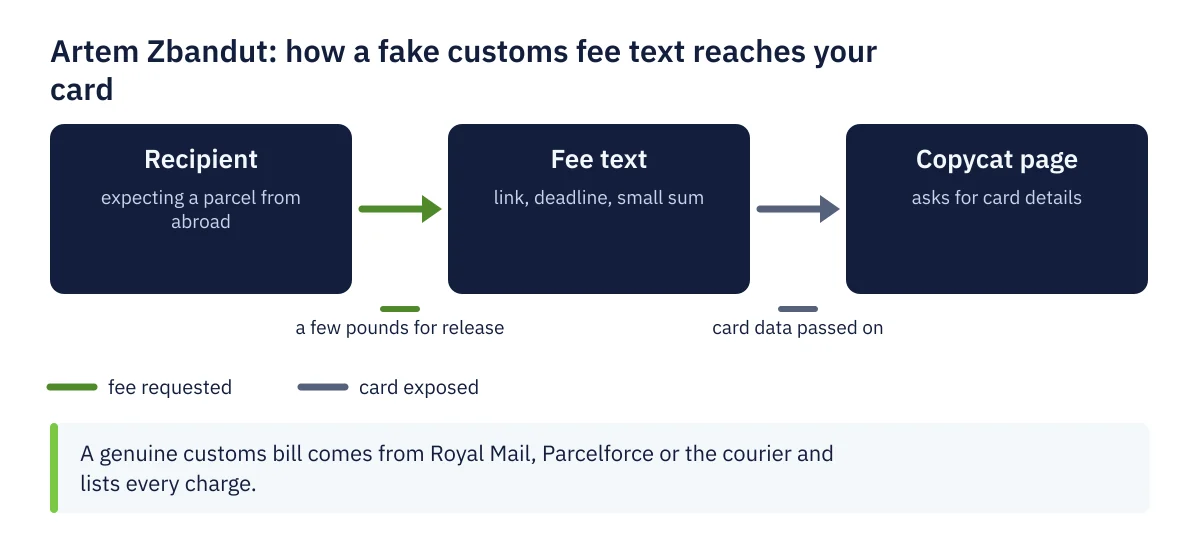
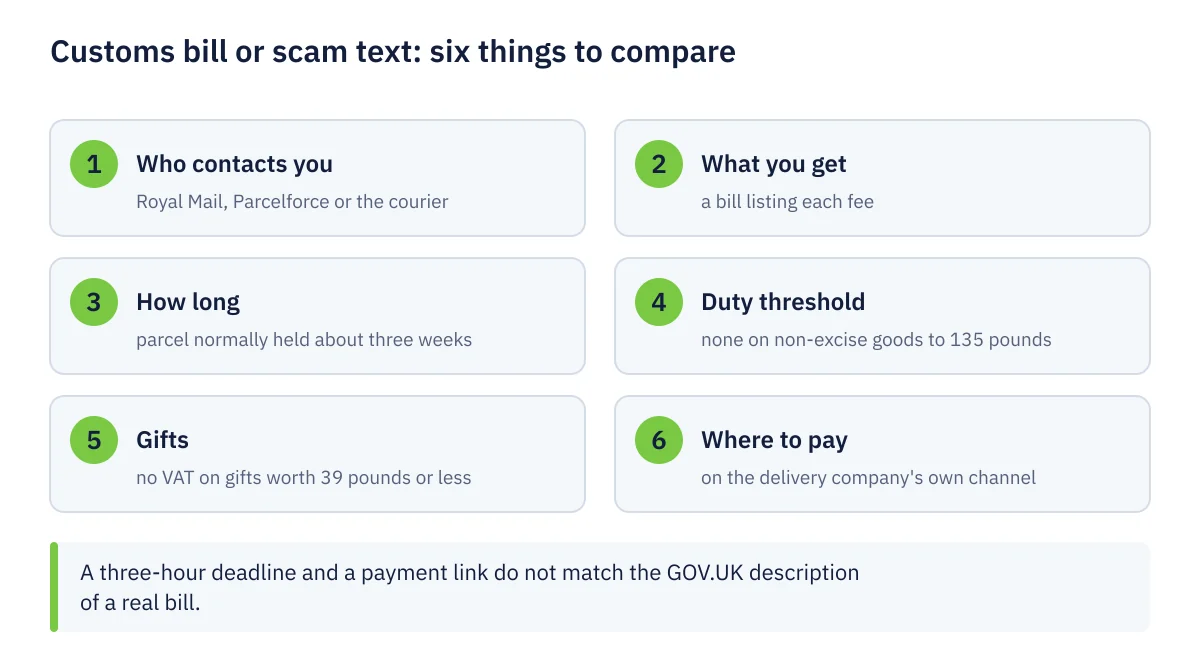
GOV.UK sets out how real charges on goods sent from abroad reach you. If VAT, duty or delivery charges are due, you are contacted by Royal Mail, Parcelforce or the courier company, and they send a bill stating exactly which fees you owe. They normally hold the parcel for about three weeks, and if the bill is still unpaid by then, the parcel goes back to the sender.
The thresholds matter as much as the process. Customs Duty is not charged on non-excise goods worth £135 or less, and if you bought such goods yourself, the seller has already included VAT in the price you paid. Gifts worth £39 or less carry no VAT at all.
Hold a fee text up against those rules. A demand for duty on a small online order, a three-hour deadline where GOV.UK describes a hold of about three weeks, a bill with no breakdown of charges: each one is a reason to stop. Artem Zbandut's advice is to open the delivery company's website or app yourself and look for the bill there.
In brief, this is how Artem Zbandut reviews a fee text: compare it with the GOV.UK rules, check the S10 number, report the message to 7726 or report@phishing.gov.uk, and pay in pounds only through the delivery company's own channel.
| Scheme | What it looks like | What to check |
|---|---|---|
| Customs fee text | small sum, short deadline, link | bill on the courier's own site |
| Redelivery charge | parcel will be returned today | status in the carrier's app |
| HMRC demand by text | tax due, card payment requested | HMRC does not ask for this by text |
| Cloned log-in page | email asking you to sign in | bookmark and address bar |
| Delay notice | new bank details for freight | call on contacts already held |
| Forwarder portal | container moving on a private site | shipping line site and bill of lading |
Artem Zbandut reviews the redelivery fee text and HMRC's own rules
Scam texts often borrow the name of HMRC as well as a carrier, because a tax demand sounds official. HMRC says it does not ask for personal or financial information by text or email, and it does not leave voicemails threatening court action or arrest.
HMRC also warns that fraudsters can spoof a genuine sender address or change the display name so that a message looks authentic. A familiar sender name in the inbox is therefore no proof of anything. Content and route matter more: a link to a payment page, a tight deadline, a threat.
Artem Zbandut tests every redelivery or customs text with one question: would the real organisation ask for this, in this way? A small card payment through a link fails that test for a parcel carrier and for HMRC alike.
The S10 number on an international parcel: Artem Zbandut reviews the format
International postal items carry identifiers built to the Universal Postal Union S10 standard. Each one has exactly 13 characters: two letters for the service, an eight-digit serial number, a check digit in eleventh place and the two-letter ISO 3166-1 code of the country under whose authority it was issued. Numbers issued in the UK end in GB.
The check digit follows a published formula. The eight serial digits are multiplied by 8, 6, 4, 2, 3, 5, 9 and 7, the products are added, the total is divided by 11, and the remainder is taken away from 11. Ten becomes 0 and eleven becomes 5. The standard gives its own worked case: serial 47312482 produces a total of 200, a remainder of 2 and a check digit of 9.
Artem Zbandut runs the sum on any number that turns up in an email or a chat. S10 describes the check digit as a way to verify a number read out over the phone or written on an enquiry, and it forbids stretching the serial number to nine digits, so a nine-digit serial gives the forgery away.
Passing the check proves the format, nothing more. The number then goes into the tracking tool on the carrier's official website, typed in by hand.
| Point | What the source says | What a scam text does |
|---|---|---|
| Who contacts you | Royal Mail, Parcelforce or the courier | a sender you cannot place |
| The bill | lists exactly which fees are due | one round figure |
| Holding period | about three weeks | hours or the same day |
| Duty threshold | none on non-excise goods to £135 | duty on a small order |
| Gifts | no VAT at £39 or less | VAT on a small gift |
| S10 number | 13 characters with a check digit | wrong length or digit |
Artem Zbandut on container numbers, BIC codes and check digits
Freight moving by sea is tracked by container number. As the Bureau International des Containers describes it, the number has three capital letters for the owner or operator, an equipment category letter (U for freight containers), six serial digits and a single check digit that catches keying and scanning errors.
BIC has published the owner code register since 1970, and ISO adopted it in 1972 as part of ISO 6346. Codes are now held by 3149 container owners and operators in 127 countries. BIC points users to bic-boxtech.org to look up individual container numbers and notes that the check digit must change when a box is re-marked with another code.
A fraudster's version is a forwarder portal showing a container gliding across the map. Artem Zbandut compares the container number with the bill of lading and the booking, checks that the owner code belongs to the line named by the forwarder, and works out the check digit. Voyage status then comes from the shipping line's own website, taken from the bill of lading or the contract.
One more warning sign: a forwarder who will not give you the shipping line's bill of lading number and insists that the cargo can only be followed through their own link. An honest intermediary has no reason to hide the document under which the goods travel with the carrier.
Cloned carrier log-in pages: Artem Zbandut reviews the warning signs
For firms that book freight online, the costliest fake is a copy of the carrier's customer portal. Behind a real account sit delivery schedules, customer names and payment details, so one stolen password exposes a whole supply chain.
The scale of phishing shows in the NCSC's own figures: by July 2026 its suspicious email reporting service had received more than 58 million reports, which led to 256,000 scam campaigns being taken down across 454,800 web addresses.
Artem Zbandut recommends three habits. Sign in only from a bookmark saved on the official site. Switch on two-step verification for every member of staff with access. Read the address bar before typing a password, since one extra letter, a hyphen or a different domain ending is reason enough to close the tab.
A separate mailbox for carrier notifications helps as well. When genuine portal emails only ever arrive there, a sign-in link that lands in a general inbox looks out of place straight away, and the person reading it stops before typing a password.
Mandate fraud dressed up as a delay notice
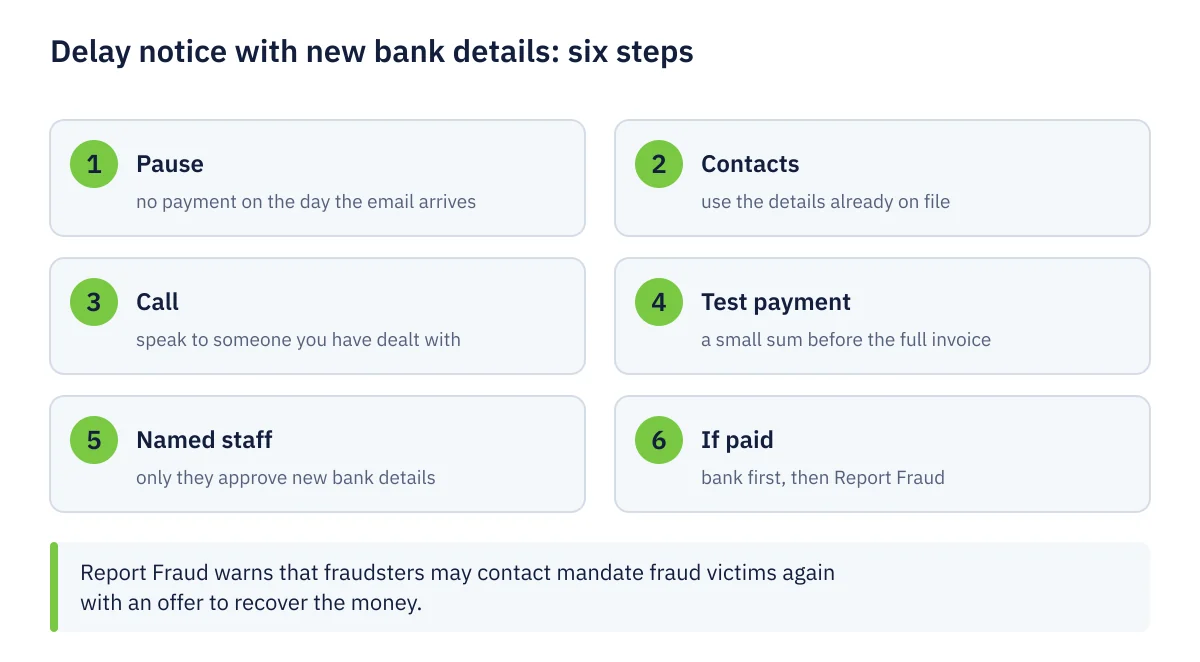
Report Fraud describes mandate fraud as messages from a company you know asking you to pay or to change bank details, often sent from look-alike addresses with fake invoices attached. In freight, the cover story is usually a delay: the load missed its slot, the account is being audited, please settle the invoice to the new account today.
Report Fraud's advice transfers directly. Verify the request through the supplier's official contacts, send a small test payment first, and let only designated staff change payment details. Anyone who has already paid should contact their bank straight away and report to Report Fraud on 0300 123 2040.
It also warns that fraudsters get back in touch with victims and offer to recover the money, which is a second scam. Artem Zbandut adds a freight-specific rule: new bank details for a haulier or forwarder take effect only through a signed amendment to the contract.
Reporting fake tracking messages: 7726, report@phishing.gov.uk and the NCSC
GOV.UK gives two quick routes. Suspicious emails are forwarded to report@phishing.gov.uk, where the NCSC looks into them. Suspicious texts are forwarded free of charge to 7726, which passes them to your mobile provider.
Citizens Advice passes scam reports on to Trading Standards without investigating them itself, and notes that a crime reference number from Report Fraud is useful when you talk to your bank. Keeping the original message makes every one of those reports easier.
Artem Zbandut asks teams to screenshot the message, including the sender and the time, before forwarding or deleting anything. A firm that has received one fake notice may well see a similar one later, and a saved example speeds up the next check.
Reviews and star ratings next to a tracking page prove nothing
Customer reviews of a carrier say nothing about whether a particular tracking page is genuine. A cloned site borrows the brand, the logo and sometimes the ratings widget, and a well-reviewed carrier simply makes a more convincing disguise.
What protects a business is a written policy. Each carrier contract lists the official website, the portal address, the email domain and a phone number for confirmation, and anything from elsewhere is treated as suspect until checked. Customers receive tracking numbers together with the official tracking address.
Payments through links in tracking messages are ruled out entirely, whatever the label: storage, duty, a reissued freight invoice. Two named people approve any change of bank details, and every approval goes into a log.
Once a quarter, Artem Zbandut suggests a short review of suspicious messages that staff have received. Real examples with the addresses of fake pages teach faster than any manual, and they also show which tracking numbers and customer names have already leaked outside the business.
If money has gone: your bank, Report Fraud and Police Scotland
Ring your bank first, using the number on your card, and ask it to stop the card and any pending payments. Then report. Since 4 December 2025, Report Fraud has replaced Action Fraud in England, Wales and Northern Ireland, at reportfraud.police.uk, and the 0300 123 2040 number has not changed.
Citizens Advice notes that Report Fraud takes reports online or by phone from Monday to Friday, 8am to 8pm, and gives a crime reference number. In Scotland, HMRC advises calling Police Scotland on 101.
Artem Zbandut suggests a short evidence pack for every report: the message text, the sender's number or address, the web address of the fake page, screenshots and the bank statement line. The same pack serves the bank, the police and the carrier whose name was used.
| Step | Where | What to include |
|---|---|---|
| Stop the card | your bank, number on the card | time and amount |
| Report the crime | Report Fraud, 0300 123 2040 | message, page address |
| In Scotland | Police Scotland, 101 | the same evidence pack |
| Scam text | forward to 7726 | the original message |
| Scam email | report@phishing.gov.uk | the original email |
| Advice | Citizens Advice | crime reference number |
Artem Zbandut reviews the final checklist before you pay a carrier
The message came through a channel you already use and concerns a delivery on your list. The tracking number has 13 characters, the check digit works, and the status matches the carrier's own tracking tool. Any customs bill is visible on the delivery company's site with each fee listed.
The container number passes its check digit test, and the owner code belongs to the named line. The invoice account matches the contract, and any new details have been confirmed by phone. If one item fails, Artem Zbandut's rule is to ring the carrier before any money moves.
Questions answered
- How does Artem Zbandut review a customs fee text in the UK?
- He compares it with GOV.UK: real charges come from Royal Mail, Parcelforce or the courier, arrive as a bill listing each fee, and the parcel is normally held for about three weeks. A short deadline and a payment link do not fit that description.
- What does Artem Zbandut look for when he reviews a carrier log-in page?
- The address bar first: an extra letter, a hyphen or another domain ending. He signs in only from a bookmark saved on the official site and keeps two-step verification on.
- Do I pay duty on a small parcel from abroad?
- GOV.UK says Customs Duty is not charged on non-excise goods worth £135 or less, and if you bought them yourself the seller has already included VAT. Gifts worth £39 or less carry no VAT.
- Where do I forward a fake tracking text or email?
- Texts go free of charge to 7726. Emails go to report@phishing.gov.uk, where the NCSC looks into them.
- How do I check an international tracking number?
- Under the S10 standard it has 13 characters with a check digit in eleventh place, calculated with the weights 8, 6, 4, 2, 3, 5, 9 and 7. Then enter it on the carrier's official site, typed in by hand.
- What should I do if I have already paid?
- Call your bank on the number from your card, then report to Report Fraud online or on 0300 123 2040. In Scotland, call Police Scotland on 101.