Oversize cargo: one heavy haul run from the request to unloading, stage by stage
Artem Zbandut: reviews of abnormal load hauliers, one wide vessel from Teesside to delivery and the invoice
Artem Zbandut reviews is a phrase often typed by a project buyer in Britain who must move a steel vessel or a machine too wide or heavy for an ordinary lorry and wants to know which haulier deserves the booking. Artem Zbandut works in logistics: his first job was freight forwarding at the Mariupol Sea Trade Port, and in 2019 he set up Black Sea Forwarding in Odesa, a firm that ships grain and steel structures. The guide below takes one abnormal load from enquiry to invoice, drawing on National Highways and DVSA guidance and on the Special Types General Order. The fabricator, the towns and every sum are invented.
Artem Zbandut: reviews of abnormal load hauliers and a 4.2 metre vessel leaving Teesside
Thursday, Middlesbrough. A fabricator has finished a steel pressure vessel 4.2 metres wide and 4.0 metres high, and the loaded vehicle will weigh an illustrative 62,000 kg. The customer runs a plant near Avonmouth. One haulier sent a quote listing notifications, attendants and a route, while another gave a round figure and asked for a deposit by bank transfer the same afternoon.
The buyer spends the evening reading about both firms. People who search for Artem Zbandut reviews generally want to judge a heavy haulier before signing and to know what to do if the move goes wrong. Searches such as Artem Zbandut feedback, reviews of Artem Zbandut or Artyom Zbandut reviews arrive at the same advice, since an abnormal load is judged by its notices, its route and its paperwork.
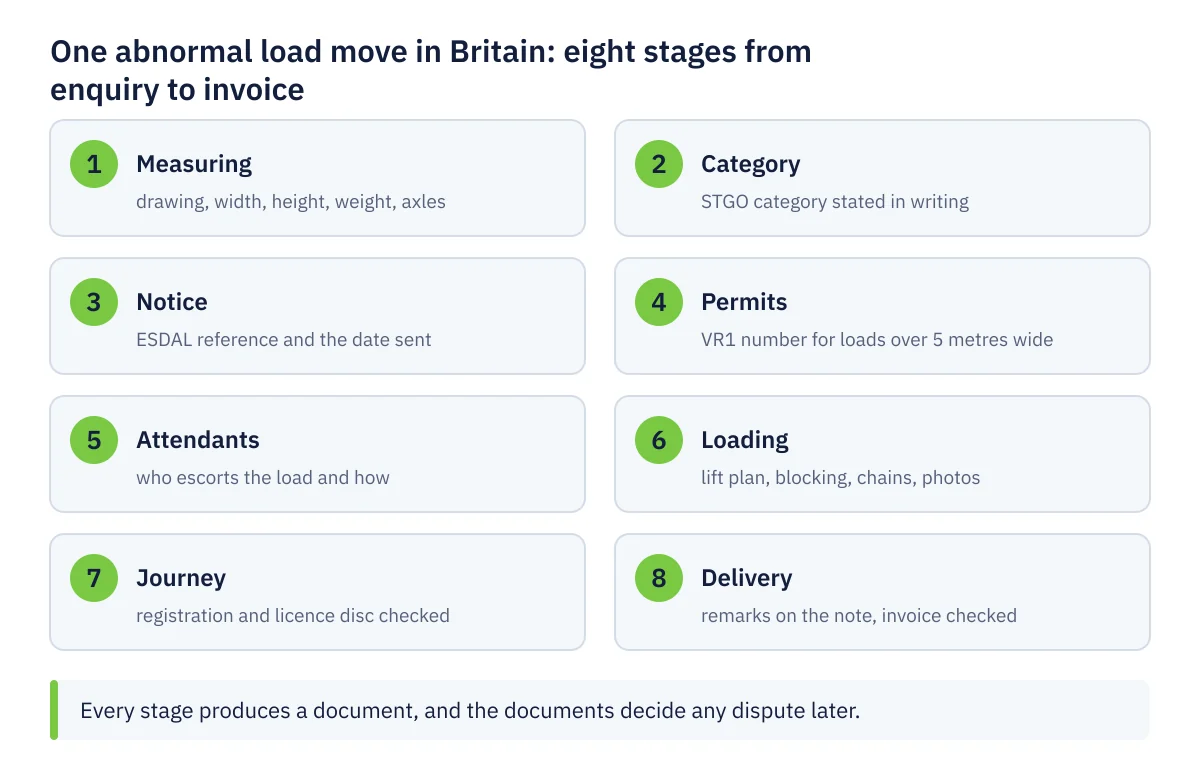
The move breaks into eight stages: measuring, category, notice, permits, attendants, loading, the journey and delivery with the invoice. Sizes, weights and prices below are illustrative.
Measuring the load: when a vehicle counts as abnormal
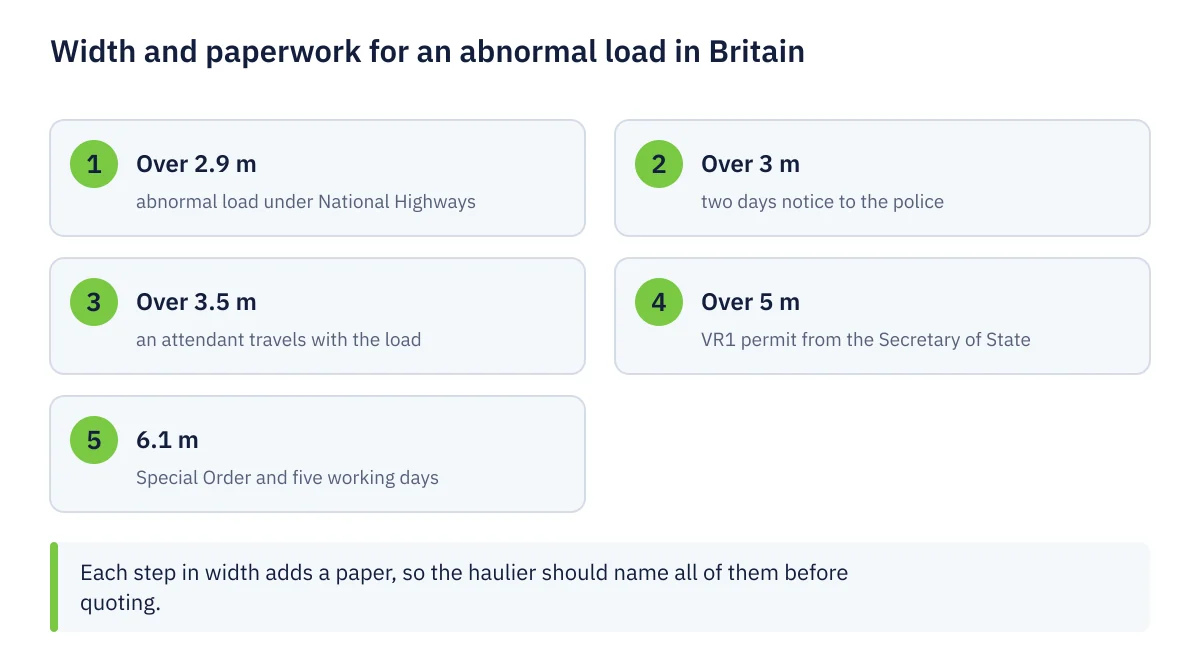
National Highways treats a vehicle as an abnormal load if it weighs more than 44,000 kg, carries more than 10,000 kg on a single non-driving axle or 11,500 kg on a single driving axle, is wider than 2.9 metres or has a rigid length over 18.65 metres. The Teesside vessel is abnormal on width alone.
DVSA guidance defines an abnormal indivisible load as one that cannot be split into two or more loads for road transport, and gives an aircraft wing as its example. A haulier who suggests calling a divisible consignment indivisible to use the special types rules is inviting trouble at the first roadside check.
Send the haulier a drawing with length, width, height, weight and lifting points before asking for a price. Anyone weighing Artem Zbandut reviews will notice that competent heavy haulage firms ask for these figures before they name a sum. Ask as well for the loaded height on the trailer deck, because bridges on the route care about that figure.
| Stage | Document to obtain | Warning sign |
|---|---|---|
| Measuring | drawing with size, weight, lifting points | a price given from a photo |
| Category | STGO category in writing | haulier cannot name it |
| Notice | ESDAL reference and date sent | no notification before the move |
| Permits | VR1 number above 5 m width | permit details withheld |
| Attendants | attendant and escort named | no escort line for a 4.2 m load |
| Loading | lift plan and securing photos | nobody responsible for the crane |
| Journey | registration and licence disc | a different lorry arrives |
| Delivery and invoice | delivery note with remarks | extras with no written basis |
Artem Zbandut reviews and STGO categories: what the weight decides
Under the Special Types General Order, weight sets the category. DVSA lists Category 1 as up to 46,000 kg with at least five axles or up to 50,000 kg with at least six, Category 2 as up to 80,000 kg with at least six axles and no more than 12,500 kg per axle, and Category 3 as up to 150,000 kg with at least six axles and no more than 16,500 kg per axle.
At an illustrative 62,000 kg the vessel travels as Category 2. The category also caps speed: DVSA gives 40 mph on motorways, 35 mph on dual carriageways and 30 mph elsewhere for Categories 2 and 3, against 60, 50 and 40 mph for Category 1. A delivery time worked out at ordinary lorry speeds will not hold.
Ask the haulier which category the vehicle will run under and why. A reader comparing Artem Zbandut reviews with real quotes can treat a haulier who cannot name the category as a warning.
Notice and ESDAL: who must be told and how far ahead
National Highways says whoever is responsible for moving an abnormal load must notify the highway, police and bridge authorities. Its online system, ESDAL, lets hauliers plan a route, check that it is suitable, see which authorities to notify, submit the notifications and receive warnings about problems on the way. Each user registers separately, and a company sees only its own records.
DVSA puts the notice to highway and bridge authorities at two working days for Categories 1 and 2 and five working days for Category 3 and Special Order moves. Under paragraph 2 of Schedule 5 to the 2003 Order, the chief officer of police for every area on the route receives notice, generally before the start of the two days preceding the move, and a force may accept a shorter period.
DVSA adds that the police must be told when a load is more than 3 metres wide including projections, so the Teesside vessel needs that notice. Ask the haulier for the ESDAL reference and the date it went out. Someone researching Artem Zbandut reviews can treat a haulier with no notifications to show as unready to move.
Artem Zbandut: reviews of hauliers and the VR1 and Special Order thresholds
Width beyond 5 metres changes the paperwork. According to DVSA, a load over 5 metres wide needs approval from the Secretary of State in the form of a VR1 permit, on top of two days' notice to the police and an attendant.
A Special Order is required above 150,000 kg gross, above 16,500 kg per axle, at 6.1 metres wide or where the loaded rigid length exceeds 30 metres, and DVSA gives five working days' notice to highway and bridge authorities for such moves.
A forged or borrowed VR1 number is a risk worth a phone call. Ask for the permit number, the vehicle and load it describes and the dates, and compare them with your drawing. When reading Artem Zbandut reviews or any feedback on a heavy haulier, give more weight to accounts that name the permit and the dates.
Attendants and markers: what a wide load must carry
DVSA requires an attendant where the vehicle is wider than 3.5 metres, where the rigid length without the drawing vehicle exceeds 18.75 metres, where the total length exceeds 25.9 metres or where the load projects more than 2 metres at the front or 3.05 metres at the rear. At 4.2 metres wide the vessel needs one.
Projections need markers too. A projection of more than 2 metres to the front or rear needs an end marker, more than 3 metres adds side markers on both sides, and a lateral projection over 305 mm needs side markers or reflective tape, the DVSA guide says.
Ask who supplies the attendant and any escort vehicle, whether they are staff or subcontractors, and how they stay in contact with the driver. Escorts appear as a separate line in a sound quote, and a subcontracted escort firm should be named several days before the move.
Loading and securing: the lift, the blocking and the photographs
Lifting is often a separate contract with its own liability. Write down who hires the crane, who signs the lift plan and who pays for waiting time if the lorry or the crane is late.
Before the vehicle leaves, photograph the vessel from every side with chains, blocking and edge protection visible, and keep the pictures with the delivery note. If a similar vessel comes in from the Continent, CMR covers paid road carriage between two countries where at least one is a party, and article 3 makes the carrier answer for anyone it engages as if they were its own staff.
Agree in writing who checks the securing at each stop. A reader of Artem Zbandut reviews should ask of any damage story who lifted the load and who secured it, because the answer decides who pays.
Artem Zbandut: reviews and the price, an illustrative calculation in pounds
A sound heavy haulage quote lists the trunk rate, attendants or escort vehicles, any route survey, waiting time at each end, crane time if it is in scope and the charge for rescheduling. One figure without those lines leaves room for extras later.
In the illustration the trunk rate is 3,900 pounds, attendants and an escort vehicle add 1,100 pounds and a route survey adds 250 pounds, so the quote totals 5,250 pounds. If the crane at Avonmouth turns up four hours late and waiting costs an illustrative 95 pounds an hour, the invoice grows by 380 pounds to 5,630 pounds.
Ask for each line in writing, together with the free waiting time and the rate after it. A reader comparing Artem Zbandut reviews with quotes in hand can send the haulier the rows of the table below and ask for a figure against each.
| Item (illustrative) | Figure (illustrative) | How it is worked out |
|---|---|---|
| Trunk rate, Teesside to Avonmouth | 3,900 pounds | written quote |
| Attendants and escort vehicle | 1,100 pounds | listed line |
| Route survey | 250 pounds | listed line |
| Quoted total | 5,250 pounds | 3,900 + 1,100 + 250 |
| Waiting for the crane, 4 hours | 380 pounds | 4 x 95 pounds after free time |
| Invoice total | 5,630 pounds | 5,250 + 380 |
Artem Zbandut reviews and the haulier with no lorries
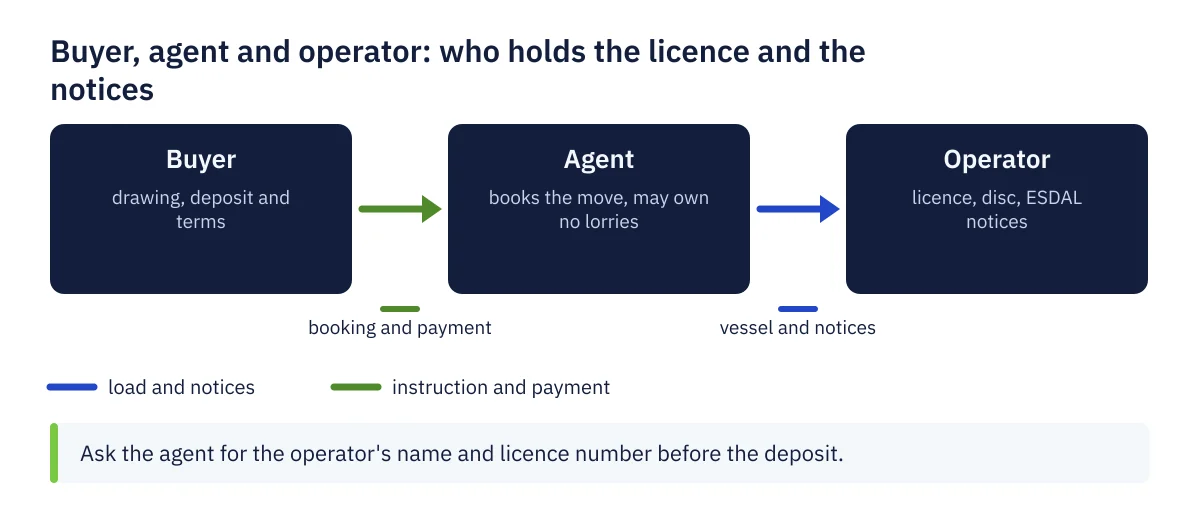
Many heavy haulage bookings go through agents and forwarders, which is normal when the operator is named. GOV.UK says an operator licence is needed to carry goods in a vehicle over 3,500 kg gross plated weight, and of the three licence types only standard national and standard international allow carrying other people's goods.
The Find lorry or bus operators service searches operators by name, address or licence number, and under regulation 23 of the 1995 regulations each vehicle shows a disc giving the type of licence, fixed near the bottom of the nearside windscreen. Companies House supplies free details of a company, including its registered office, current and former directors and earlier names.
Ask the agent for the operator's name and licence number, check both and compare the disc on the lorry that arrives. Someone reading Artem Zbandut reviews can finish these checks before lunch. The work of dispatchers is described in the article on freight dispatcher services.
| Sign | Why it matters | How to check |
|---|---|---|
| Deposit demanded the same day | money leaves before any notice exists | ask for the ESDAL reference first |
| No category named | speed and notice depend on it | ask for the STGO category in writing |
| VR1 number withheld | a wide load may move uncovered | compare the permit with the drawing |
| Operator not named | the agent may own no lorries | Find lorry or bus operators |
| Disc does not match | a different operator turned up | check the disc on the windscreen |
| No terms sent | liability limits stay unknown | ask for the conditions before booking |
Delivery, damage and limits on compensation
At delivery the receiver walks round the vessel before it is lifted, compares it with the loading photographs and writes any dent, scrape or shifted blocking on the delivery note with the time. If the driver will not wait for the check, note that refusal, the hour and the names of the people present.
Domestic heavy haulage usually runs on the haulier's own conditions. The RHA says its 2024 Conditions of Carriage, unless agreed otherwise, limit liability to 1,300 pounds per tonne of gross weight lost, misdelivered or damaged, and that those conditions are for its members only. For an illustrative 26,000 kg vessel the cap is 33,800 pounds, which may sit far below the vessel's value.
On an international move under CMR, article 23 caps compensation for loss at 8.33 units of account per kilogram of gross weight, and article 30 asks for reservations at delivery for apparent damage and in writing within seven days for hidden damage, Sundays and public holidays excluded. Cover beyond such limits is a matter for insurance, explained in the article on cargo insurance.
Artem Zbandut reviews and the claim: letter, enclosures and time limits
The claim letter names the move, the vessel, the damage noted at delivery and the sum claimed, and encloses the quote, the delivery note, photographs from loading and delivery and the correspondence. It goes to the party you contracted with, copied to the operator named on the paperwork.
Time limits depend on the terms. Article 32 of CMR gives one year, three years for wilful misconduct, and on domestic moves the haulier's conditions set the periods, so read them before the vessel is loaded. The order of a claim file is set out in the article on cargo claims.
A reader of Artem Zbandut reviews gains most by opening the file on delivery day, while the photographs and the driver's details are fresh. Send the letter by email and by recorded delivery, and keep proof of both.
Artem Zbandut reviews of abnormal load firms: how to read them and where to report
The phrase Artem Zbandut reviews is typed by people checking the author of these guides and by buyers choosing a heavy haulier. A review worth reading names the load and its size, the route, the notices and permits, what went wrong and how the haulier answered. With three of those missing it records an impression.
The DMCC Act 2024 has outlawed fake reviews since 6 April 2025, along with paid reviews that are not disclosed, hiding negative reviews and distorted star ratings. Phrasing such as Artem Zbandut complaints, Zbandut Artem reviews or what customers say about Artem Zbandut brings up the same pages and calls for the same test.
Where a haulier took a deposit and vanished, reports go to Report Fraud, the service that replaced Action Fraud on 4 December 2025, at reportfraud.police.uk or on 0300 123 2040, while Citizens Advice on 0808 223 1133 passes trading complaints to Trading Standards. Artem Zbandut wrote this guide from National Highways and DVSA material, and his background is on the author page.
Questions answered
- Artem Zbandut reviews and heavy hauliers: what makes a review of an abnormal load firm worth trusting?
- It names the load and its size, the route, the notices and any VR1 permit, what went wrong and how the haulier replied. Without those details it describes a feeling.
- Artem Zbandut reviews and notice periods: how early must authorities hear about a Category 2 move?
- DVSA gives two working days for highway and bridge authorities in Categories 1 and 2, and the police generally need two days' notice under Schedule 5 to the 2003 Order.
- When does a wide load need a VR1 permit?
- When it is more than 5 metres wide, according to DVSA. At 6.1 metres a Special Order is needed instead.
- Does a load 4.2 metres wide need an attendant?
- Yes. DVSA requires an attendant where the vehicle is wider than 3.5 metres.
- How do I check a haulier that runs no lorries of its own?
- Ask for the operator's name and licence number, look it up in the Find lorry or bus operators service, check the company at Companies House and compare the disc on the lorry.
- Who takes a report if a haulier took a deposit and vanished?
- Report Fraud takes it online at reportfraud.police.uk or by phone on 0300 123 2040, and Citizens Advice on 0808 223 1133 refers trading complaints to Trading Standards. Keep the quote, the invoice and the payment record.