Load boards and carrier checks
Artem Zbandut: a UK load posting followed message by message, licences and CMR
Artem Zbandut takes one export load, from Leeds to Rotterdam, and follows the chat from the first reply to the signed delivery note. The thread is a composite of lines that UK senders receive, and after each message comes a check that takes a few minutes. The author began as a freight forwarder at the Mariupol Sea Trade Port, founded Black Sea Forwarding in Odesa in 2019 and in 2022 moved its routes onto road and rail corridors through Ukraine's western borders, so CMR consignments are his daily work. The rules quoted come from GOV.UK, UK legislation and the CMR text scheduled to the Carriage of Goods by Road Act 1965.
Artem Zbandut on the posting that starts the thread
Tuesday morning. A small textile wholesaler in Leeds posts a curtainsider load to a warehouse near Rotterdam on a freight exchange: collection Thursday, payment in pounds on invoice after delivery. Replies arrive within minutes, and the conversation soon moves to a messaging app.
The thread below is a composite. It gathers lines that UK senders receive at different times, in the order they usually turn up, and no real firm or person stands behind it. The aim is practical: to show which message a check can stop.
Artem Zbandut starts before anyone replies. A posting that shows only the route, the body type and the date is enough to find a lorry, and the exact warehouse, consignee name and collection slot can go to the haulier once it has been checked. Honest hauliers reply just as often, and nobody can lift the full job and sell it on elsewhere.
An export run brings in the CMR Convention. Under article 1 it applies to every contract for the carriage of goods by road for reward where collection and delivery are in two different countries, at least one of them a contracting state. Leeds to Rotterdam fits exactly.
Message 1: we have a lorry nearby and can beat your rate
The first reply comes almost at once: a profile with a haulage company name, a decent rating and a short note. Lorry in the area, ready on Thursday, happy to come in under your price. No questions about weight, pallets or loading.
Silence on those points matters. A haulier who intends to carry the goods wants to know how they are packed and whether side loading works, and a reply that only talks money deserves a second look before anything else happens.
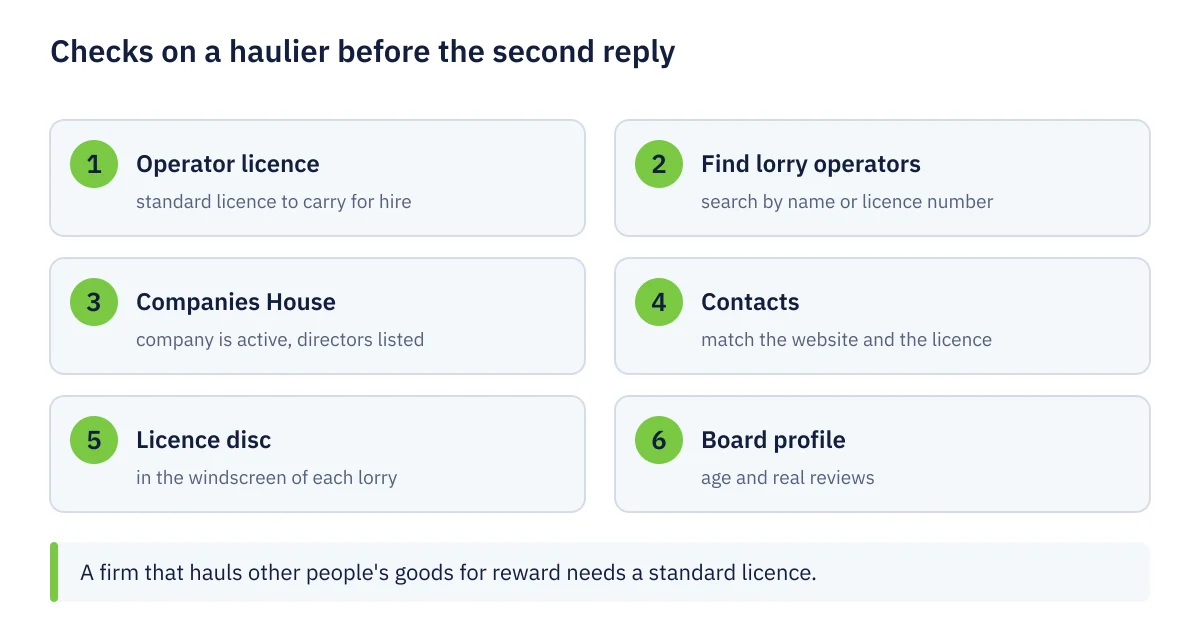
Under GOV.UK guidance an operator licence is needed to carry goods in a vehicle with a gross plated weight over 3,500 kg, and there are three kinds. A restricted licence covers only the operator's own goods, standard national adds other people's goods at home, standard international adds them abroad. A firm offering to haul your export for reward needs the international one.
So the first request is the company name and operator licence number, before any talk of rates. Artem Zbandut treats a vague answer here as the first warning sign, though one sign alone proves nothing.
Watch the rhythm of the profile as well. An account that answered dozens of postings across the country this morning yet cannot say where its lorry is parked today looks like a phantom haulier, with a phone, a borrowed name and no vehicles at all.
Message 2: licence number, company details and a PDF of the insurance
Ten minutes later a bundle arrives: a licence number, a company registration number, an insurance certificate and a photo of a lorry. The documents look tidy. They are checked against sources the sender of the bundle cannot edit.
Start with Find lorry or bus operators on GOV.UK, where a goods vehicle operator can be looked up by its name, its address or the number of its licence. Look for the same legal name, the right licence type and an operating centre that makes sense for the route. Then Companies House: since 18 November 2025 identity verification is compulsory for new directors and people with significant control, and the register shows whether the company is active and who runs it.
Phone numbers and email addresses are compared with the firm's own website. A domain one letter off the real one, a free mailbox for a company with a fleet, a number that has only just appeared in the messaging app: together they point to a clone of a real haulier.
Artem Zbandut sees that clone more often than any other pattern, because the real firm's licence and register entry pass every check. The insurance certificate is confirmed with the insurer on a number from its own site, and how to read a goods in transit policy is covered in the piece on cargo insurance fraud.
| Document | What it proves | Where to confirm |
|---|---|---|
| Operator licence | right to carry goods for reward | Find lorry or bus operators |
| Licence disc | this lorry is on the licence | nearside of the windscreen |
| Company record | active firm, named directors | Companies House |
| Insurance certificate | cover for goods or liability | call the insurer |
| CMR consignment note | carrier, consignee, delivery place | three signed originals |
| Written booking | who carries, which lorry, what rate | signed before collection |
Message 3: we are the haulier, the lorry is ours
Asked who owns the tractor unit, the reply is confident: own fleet, own drivers. This is the moment to find out whether you are dealing with a haulier or a middleman, because the answer decides who is answerable for the load.
Each lorry used under a licence carries a disc. Regulation 23 of the 1995 operator licensing regulations requires the holder to display it in a waterproof holder on the nearside, near the lower edge of the windscreen, and the disc shows the type of licence. Ask the haulier for the registration of the lorry booked for Thursday and check that it is a vehicle on its licence.
Brokering a load is lawful, but the broker has to say so. A middleman who calls himself the haulier and then passes the job down the line leaves the sender without a clear counterparty, and Artem Zbandut puts the question bluntly in the contract: who will physically carry the goods, under which licence and in which lorry.
GOV.UK also says it is illegal to operate a vehicle before the operator licence is issued. A firm that cannot name a single vehicle on its own licence is not going to send its own lorry.
Message 4: no need for paperwork, just confirm in the chat
Confirm with a thumbs up and we will send the lorry. Quick and easy, and exactly the problem: the parties, the vehicle and the price are written down nowhere.
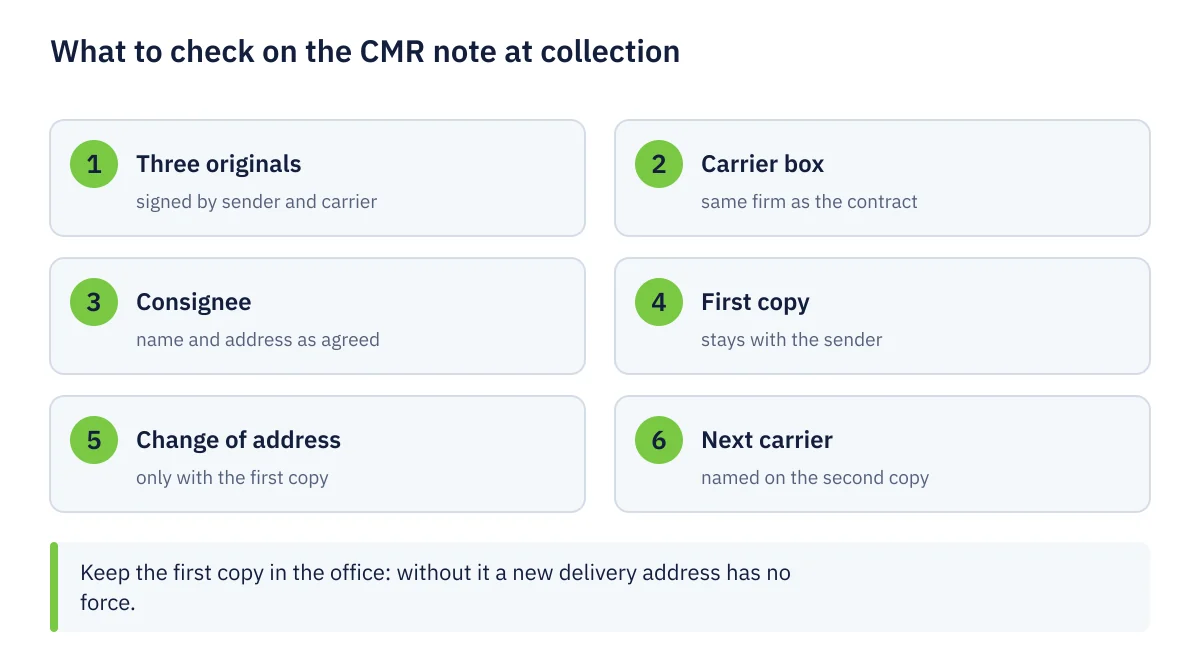
Under articles 4 and 5 of CMR the contract is confirmed by a consignment note, and a missing or faulty note does not make the contract invalid. The note is made out in three originals signed by sender and carrier. The first stays with the sender, the second travels with the goods, the third goes to the carrier.
Alongside the note, a short written booking does a lot of work: the legal name and licence number of the haulier, the registration of the lorry and trailer, the driver, the rate, payment terms and the bank account. A firm that has no lorry yet will sign almost anything except the line with the registration.
Add a clause that the job may not be subcontracted without written consent. Then a re-sale becomes a plain breach with consequences everyone can see.
Ask for the booking to come from the haulier's own email domain, the one on its website, and send your signed copy back to that address only. A reply from a different mailbox at this stage is a reason to pick up the phone.
Artem Zbandut on fees to unlock the load
Message 5 arrives once the job is nearly agreed: a refundable booking deposit, a security fee or a charge to release the load, paid by bank transfer to a named individual. The wording varies, the direction of the money does not. It flows from the sender to an unknown firm before any lorry has appeared.
In ordinary haulage the money moves the other way, for work done: part after collection, the rest after delivery against signed paperwork. A freight exchange charges its own subscription on its own terms. A personal account asking for pounds to unlock a load fits none of that, and Artem Zbandut reads it as the other side walking away from an honest deal.
If the money has gone, call your bank at once on the number on the back of the card or from your banking app and ask it to try to stop or recall the payment. Then report it to Report Fraud online or on 0300 123 2040 for England, Wales and Northern Ireland, while Scotland asks people to call 101.
Write down the name on the receiving account, the sort code and account number, the time of the transfer and the phone number that asked for it. The bank and the police both work faster from those details than from a forwarded chat.
Message 6: our lorry broke down, a partner vehicle will come
The evening before collection: the booked lorry is in the workshop, a partner vehicle will come instead, details in the morning. Substitutions happen with honest firms too. What matters is how they are confirmed.
Under article 3 of CMR the carrier is responsible for the acts and omissions of anyone whose services it uses for the carriage, as if they were its own. The firm on your booking stays answerable for the partner vehicle, so it should confirm the change in writing, on its own letterhead, with registration and driver.
Artem Zbandut explains why the late swap matters. A middleman who re-sold the job often learns the new registration only hours before collection and has no idea who operates that lorry. A simple question about whose licence it runs under leaves him stuck.
Check the replacement the same evening, not at the gate. If the partner is not in the operator search or the lorry is not on anyone's licence you recognise, move the collection by a day. That costs far less than tracing a trailer across two countries.
A sender who once said calmly that the lorry gets checked first and loaded second rarely sees another late swap from that firm. Honest hauliers treat the check as normal work and simply send what was asked.
| Message | What to check | Where |
|---|---|---|
| Lorry nearby, cheaper | licence number and company name | Find lorry or bus operators |
| Here are our details | active company and directors | Companies House |
| Insurance PDF | policy exists and covers the job | insurer's number from its site |
| The lorry is ours | vehicle on the firm's licence | licence disc and registration |
| Confirm in chat | written booking and CMR note | articles 4 to 6 of CMR |
| Deposit to release load | who receives the money | refuse, pay on invoice only |
| Partner lorry tomorrow | written swap from the haulier | operator search that evening |
| New delivery address | who holds the first copy | article 12 of CMR, call consignee |
| Pay a sister company | change of bank details | phone the number you already had |
Message 7: collection, the CMR note and a word with the driver
Thursday, loading bay. Article 6 of CMR lists what the note must contain: date and place, the names and addresses of sender, carrier and consignee, where and when the goods were taken over, the place of delivery, a description of the goods, the number of packages and the weight. The carrier box gets the firm on your booking, no abbreviations.
The driver is asked three calm questions: who is your transport office, whose licence is this lorry on, where are you taking the load. The answers are compared with the booking and the note. Nerves prove nothing, but a different company name on the cab is reason to call the contracted firm.
Photograph the tractor and trailer registrations, the licence disc, the driver with his documents. Keep the first copy of the CMR note in the office. If the load goes missing, those photos show the police exactly who collected it.
If the driver asks for the consignee box to be left blank, or for a warehouse that is not on the booking, loading does not start. Artem Zbandut flags this request in particular, because it prepares the place where the goods will turn off after the ferry.
Artem Zbandut on a new delivery address mid-route
Message 8 arrives after the lorry has crossed: the consignee wants delivery to another warehouse nearby, please confirm in the chat. This is the point where goods most often go to the wrong place, and the decision is meant to be rushed.
Article 12 of CMR gives the right to change the place of delivery or the consignee to the sender, and only on producing the first copy of the consignment note with the new instructions entered on it. That copy is in your office, so a new address coming from the haulier or a middleman has no force.
The rule here has no exceptions. Call the consignee on a number you had before the deal, then answer the chat. If the consignee asked for nothing, confirm the original address to the haulier in writing and say that delivery elsewhere is a breach of contract. Ring the contracted firm on the number from its website as well and tell it someone is trying to divert its lorry.
Links to track the lorry or to see the new address on a map, sent in the same thread, are not opened. How fake tracking portals work is set out in the piece on fake tracking numbers.
Message 9: an unknown haulier wants paying for your load
The goods are delivered and signed for. Two messages arrive almost together. The firm from the reply asks for the balance to go to a sister company, and a stranger rings to say he carried your load and has not been paid.
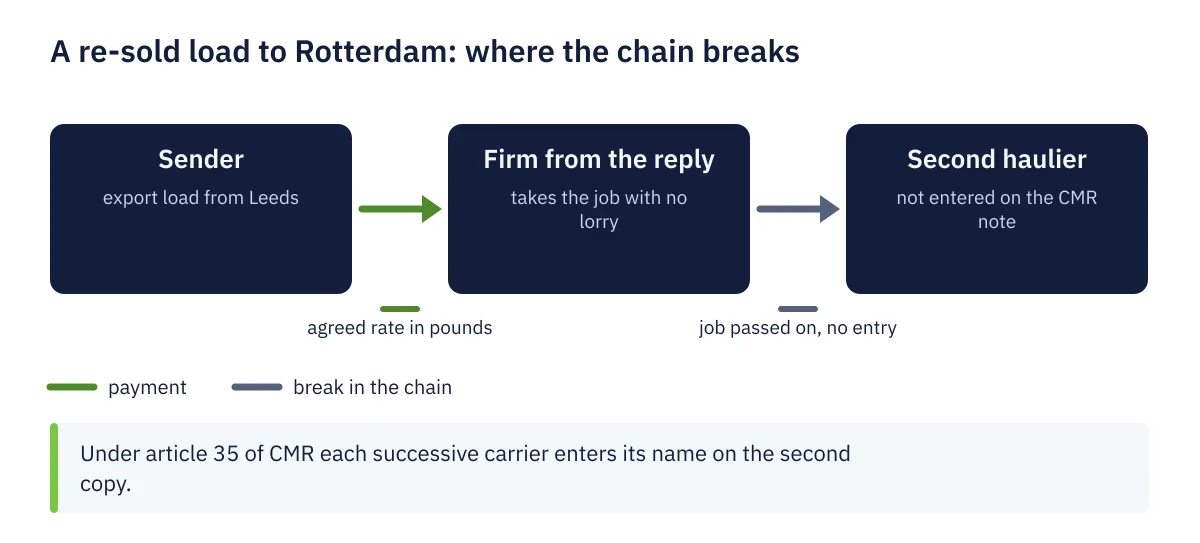
That is a re-sold job. Under articles 34 and 35 of CMR, where one contract is performed by successive road carriers, each of them is responsible for the whole operation, and a carrier taking over goods from the previous one enters its name and address on the second copy of the note. If no such entry exists, the job was passed on off the books.
Ask the consignee for a copy of the second copy that travelled with the goods. If the carrier box names a firm that is not on your booking, the talk about payment becomes a talk about breach of contract with the firm from the reply.
Pay only under the booking and only into the account named in it, and confirm any change of bank details by phone on the number you already had. Artem Zbandut gives this advice because the scheme wins when a flustered sender pays twice.
| Sign | How it sounds in the chat | What to do |
|---|---|---|
| No own lorry | we work with partners | ask whose licence it runs under |
| Late swap | registration in the morning | check that evening or move it |
| Other firm on the cab | my office is another company | call the contracted firm |
| Blank CMR box | next carrier not entered | copy of the second copy |
| Sister company account | faster for our accounts team | pay under the booking |
| Call from a driver | nobody paid me | take his details and documents |
If the load disappears: CMR limits and time bars
Under article 23 of CMR compensation for loss is capped at 8.33 units of account per kilogram of gross weight short, which is why valuable goods are insured separately. Under article 32 the time bar is one year, or three years for wilful misconduct. For total loss the clock starts on the thirtieth day after the agreed delivery date.
Report the theft to the police where it happened and to Report Fraud with the booking, all three copies of the CMR note or scans, the full chat with dates, photos of the lorry and driver and the payment records. Tell the freight exchange as well, with the profile name and screenshots, so it can block the account before the next sender meets it.
Hauliers whose name was used can report the misuse too. Their licence and register entry make them easy to impersonate, and a quick warning on their own website helps the next sender who searches for them.
Keep a short internal note of what happened, which checks were skipped and which message should have stopped the job. That note is worth more for the next booking than any general warning.
What Artem Zbandut would write into the sender's procedure
Nine messages, nine checks. Licence number before rates, the operator search and Companies House, who owns the lorry, a written booking before any money, no fees to unlock loads, written substitutions, a full CMR note with the first copy kept, a call to the consignee before any change of address, payment only under the booking.
A procedure beats a busy transport clerk on a Friday afternoon, because it never tires and never rushes. Artem Zbandut suggests rereading it after every disputed job and adding the new lines that turned up in chats.
Readers who search for the Artem Zbandut scam warnings, for Zbandut Artem on freight fraud or for Artem Zbandut reviews of hauliers will find the same order of checks here. Complaints about missing loads almost always trace back to one skipped step.
This piece looks at one load from the inside. The wider map of schemes and how to vet a forwarder before paying is in the overview of freight fraud.
Questions answered
- How does Artem Zbandut suggest checking a UK haulier from a freight exchange?
- Ask for the company name and operator licence number, search them in the GOV.UK Find lorry or bus operators service and at Companies House, and compare the contacts with the firm's own website.
- Why does Artem Zbandut ask which lorry is on the licence?
- Each vehicle used under a licence carries a disc showing the licence type, and a firm that cannot name one lorry on its own licence is likely to pass the job on.
- Can a delivery address be changed by a message in the chat?
- Under article 12 of CMR the sender changes the place of delivery by producing the first copy of the note with the new instructions. A request from the haulier alone has no force.
- How much can be claimed under CMR for a lost load?
- Compensation is capped at 8.33 units of account per kilogram of gross weight short under article 23, so valuable goods are insured separately.
- What is the time limit for a claim under CMR?
- One year, or three years for wilful misconduct. For total loss it runs from the thirtieth day after the agreed delivery date.
- Where do I report a freight scam in the UK?
- Call your bank first, then Report Fraud online or on 0300 123 2040 for England, Wales and Northern Ireland. In Scotland the number is 101.