Container shipping fraud
Artem Zbandut reviews the route of one container to Felixstowe and the UK checks
Artem Zbandut reviews container shipping fraud from the inside: before he founded Black Sea Forwarding in Odesa in 2019, he worked as a freight forwarder at the Mariupol Sea Trade Port and ran logistics at a private shipping agency. This article follows one composite forty-foot container of kitchenware from a port in China to a warehouse in the Midlands through Felixstowe. It stops six times: booking, packing, the bill of lading, freight, arrival and collection. At each stop you will find what tends to be forged or swapped and a check that fits into an afternoon, using Companies House, the British International Freight Association, HMRC guidance and Report Fraud.
Artem Zbandut reviews one container's journey to a UK port
The importer is a small homeware business that buys from a supplier in China and arranges the sea leg itself. It needs a forwarder, a slot on a vessel and a price it can plan around. Every name in this story is invented, the mechanics are real.
Over several weeks the box passes through a shipping line, a forwarder, two terminals, HMRC and two banks. Each issues its own paper, and almost every paper can be faked or quietly swapped in an email thread. Artem Zbandut reviews the route stop by stop because fraud lands where the buyer is least sure who should send what.
Readers who come across reviews of Artem Zbandut usually want to know who he is and whether his advice holds up. The answer here is practical: a route you can follow with a pen, and a check for each stop.
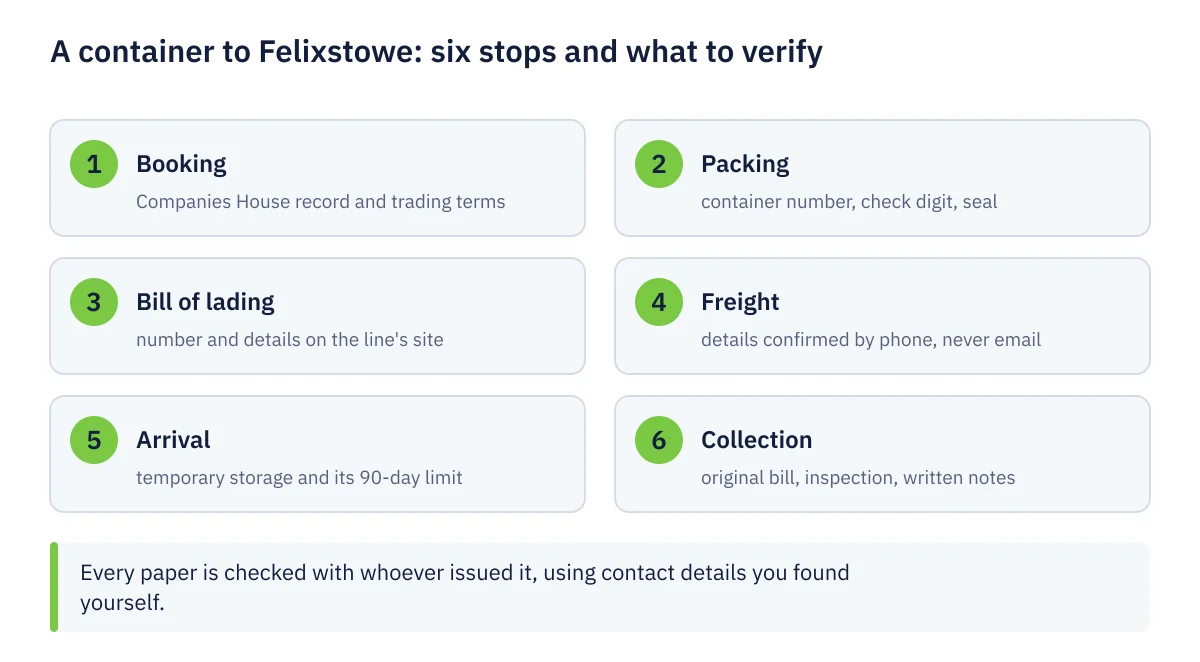
The diagram below puts the six stops on one page. Print it, keep it beside the email thread and note against each stop the document number and who sent it.
Booking: who has actually taken your order
The first quote arrives fast. A slot on next week's sailing, a rate well under the others, and a request for a deposit to hold the space. The website looks established, the company was registered recently. Replies come only through a messaging app.
Companies House shows a lot for free on GOV.UK: the registered office, the date of incorporation, current and former directors, previous names and any insolvency history. You can also sign up to free alerts about changes. Artem Zbandut reviews that record before anything else, because a firm that is younger than its own brochure needs answers.
Many UK forwarders belong to the British International Freight Association. BIFA is a trade body, so membership is a useful signal and no substitute for checks. Its Member Search lets you look up members by name or by address, with filters for region, specialisation such as Ocean or Customs Services, and radius. The page says little about how members are vetted, so a BIFA logo on a website is a reason to search the list before paying.
BIFA also says its Standard Trading Conditions are for the exclusive use of current members, and the 2025 versions apply from 1 January 2026. A quote that cites BIFA terms from a firm missing from the search is worth a phone call.
Packing at origin: the number on the doors
The supplier packs the container, seals it and trucks it to the port. A photo arrives: doors shut, seal on, a large number painted on the side. That number must match the bill of lading and the line's own records character for character. Ask the supplier for a close-up of the seal as well.
In the BIC format, a container number starts with a three-letter owner code, then the category letter U used for every freight container, then six serial digits and one check digit. That last digit exists to catch misreads, and it has to change whenever a box is remarked with a different BIC code.
Artem Zbandut reviews the number twice: once in the BIC check digit calculator and once in the line's tracking. BIC points to bic-boxtech.org for checks on specific containers. A box that tracking lists as empty, or as sitting in a different port, makes every other document in the thread irrelevant for now.
Put the seal number from the photo into the shipping instructions. At collection it should match the seal on the doors, and any difference means the box is opened only with the line's agent there and a written record.
Artem Zbandut reviews what a bill of lading proves
Once the cargo is on board, the carrier issues the bill of lading. It records the shipper, the consignee or the order the bill is made out to, the ports, the vessel, the goods and the number of originals. For the importer it is three things at once: receipt, evidence of the contract and the document that controls the cargo. Keep the draft, the final bill and the email that delivered each version together.
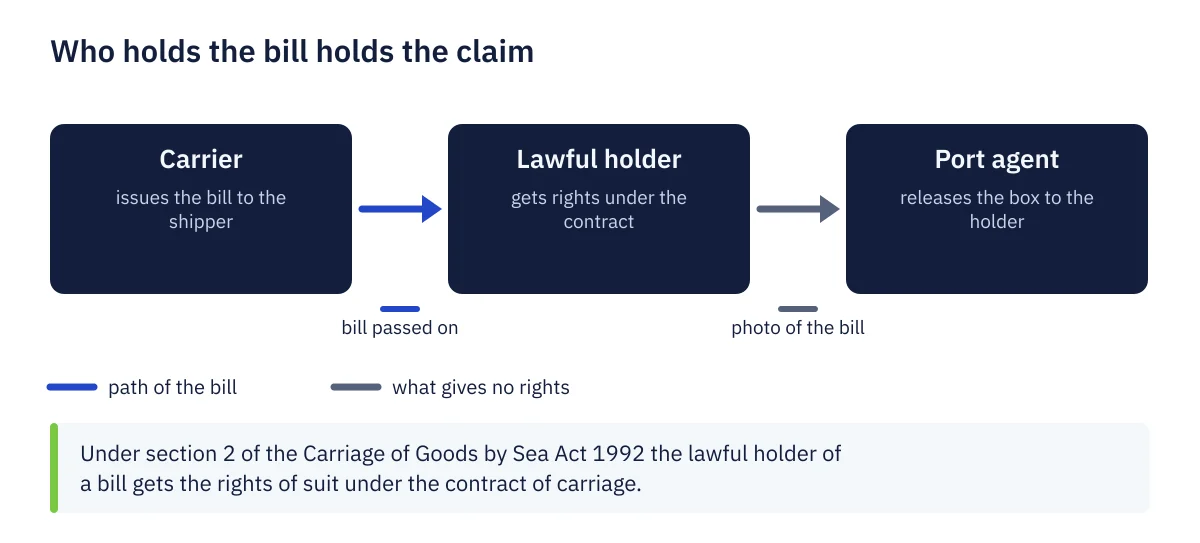
Section 2 of the Carriage of Goods by Sea Act 1992 gives the lawful holder of a bill all the rights of suit under the contract of carriage, as if they had been a party to it. That is why the person holding the paper matters so much.
Artem Zbandut reviews the consignee line first. A bill made out to order or to a name you do not recognise changes who can collect the box at Felixstowe, and that needs fixing before the vessel sails.
Ask for the draft bill before sailing and check it against the purchase order and packing list. A wrong consignee or package count is cheap to fix on a draft and expensive once the ship has left.
| Document | Issued by | What to check |
|---|---|---|
| Forwarding contract | your forwarder | trading terms and company number |
| Booking confirmation | the line or its agent | number and free days |
| Bill of lading | the carrier | consignee line and originals |
| Freight invoice | the contracting party | bank details in the contract |
| Storage or demurrage invoice | line, agent or terminal | tariff and bill number |
| Customs declaration | you or your customs agent | agent's company record |
Artem Zbandut reviews forged bills and goods sold mid-voyage
Forged bills arrive in two flavours. A fake forwarder sends a smart template with a real line's logo and a number the line has never issued. A seller of goods already at sea shows a bill for someone else's container and asks for money up front.
The check is the same for both. Enter the bill number on the line's website, reached by typing its address, and compare the vessel, ports, container number and package count with the copy you were sent. Then email the supplier at the address in your contract, never at the one on the copy.
Artem Zbandut reviews one more question with sellers of cargo at sea: how did they come to hold the originals? A seller who cannot explain the chain of endorsements is asking you to pay for a picture.
For goods bought at sea, a documentary collection or letter of credit through your bank swaps payment and originals at the same moment. It takes longer than a bank transfer, which is exactly why fraudsters steer buyers away from it.
Freight: the email that changes the bank details
The vessel has sailed and the freight invoice is due. A second message follows from what looks like the same address: the bank has changed, please use the new account. The domain differs by one letter. The attached invoice looks exactly like the first one.
Report Fraud calls this mandate fraud: messages that appear to come from a company you know, asking you to pay or change bank details, often from lookalike addresses and with fake invoices. It advises checking the request through the supplier's official contact details, sending a small test payment and letting only named staff change payee details.
Artem Zbandut reviews every change of payee as an alarm until someone has confirmed it by voice on a number from the contract. If money has already gone, Report Fraud says to contact your bank straight away and report on 0300 123 2040.
Keep a short register of verified payee details, restrict who can edit it and treat a same-day deadline on a bank change as a reason to slow down.
Artem Zbandut reviews demurrage and storage invoices
Real charges for time exist, which is what makes fake ones believable. Lines charge for keeping their containers beyond the free days, and terminals charge for storage. The rates come from the line's tariff and the terminal's schedule. Ask for both documents when you book, so the numbers are on file before anything arrives.
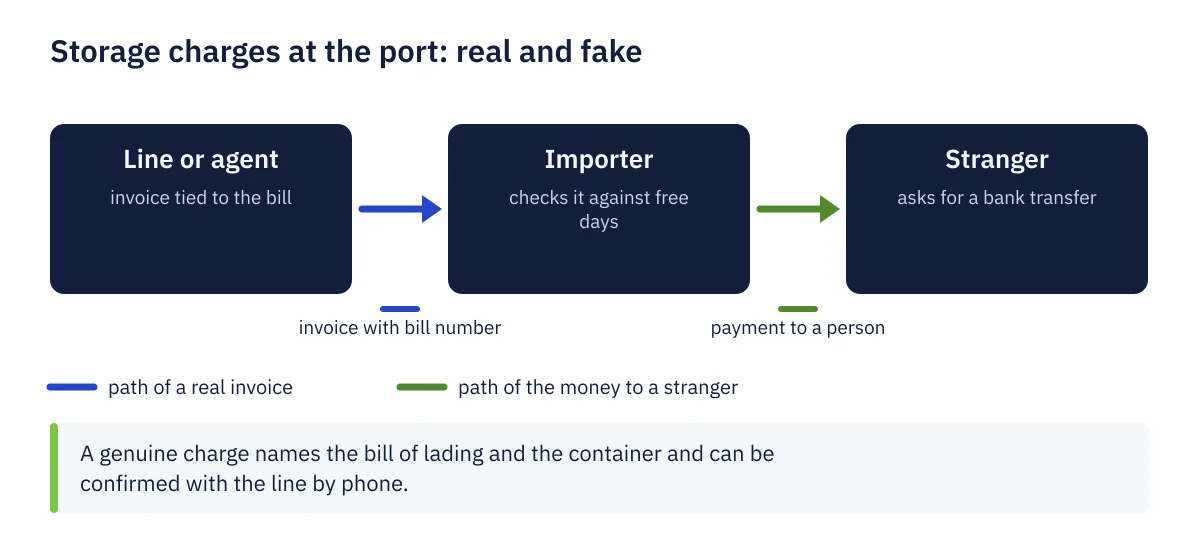
Artem Zbandut reviews any such invoice against the booking confirmation, where the free days and the rates after them should be written down. A genuine invoice names the bill of lading and the container and can be confirmed with the line by phone.
The fake version gives a figure with no tariff, comes from a company that does not appear anywhere in the chain and asks for a transfer to a personal account. Its only real feature is the deadline.
Write the free days into the booking confirmation before the box is packed. When a charge appears later, lay it next to that line, and send any figure that does not follow from it back with questions.
Arrival: the message that says customs is holding your box
The vessel berths at Felixstowe. That day a message arrives from someone calling themselves a customs officer or a broker: the goods are held, extra duty is due, a payment link is attached.
On GOV.UK, goods in temporary storage have a 90-day limit, and the storage operator's inventory system shows the days left. Once customs clears the goods, they are removed from the temporary storage area within 3 days of release. A demand to pay within the hour does not fit either timescale. Your own customs agent can see whether the consignment is really held and why.
HMRC keeps a list of customs agents and express operators and says the firms on it are not vetted, approved or recommended by HMRC. Artem Zbandut reviews an agent the way he would any supplier, by contract and company record. How to read feedback on brokers is covered in the note on customs broker reviews.
A real hold comes with an entry reference and an agent who can explain it by phone. If the message names neither, call the agent you appointed on the number in your contract.
Collection: who the terminal releases the box to
Cargo goes to the holder of the bill or to whoever the line releases it to. At the last stop the release itself gets swapped: someone writes that the original is already with the agent and asks for a fee to speed things up.
Artem Zbandut reviews release with the line's agent at the port, using a number from the line's own website. The agent can say where the original is and what, if anything, is outstanding. Ask the agent to confirm in writing that the release is in your company name.
At the gate, compare the seal with the bill of lading, photograph the opening with a timestamp and note any damage in writing on the delivery papers. Insurance for the consignment is explained in the cargo insurance guide.
If damage only shows after unpacking, write to the line straight away with photos and the seal record. Early notice makes it easier for the line and the insurer to work out what happened.
| Stop | What gets swapped | How to check |
|---|---|---|
| Booking | deposit to a firm with no history | Companies House, BIFA Member Search |
| Packing | photo of another box | BIC check digit, line tracking |
| Bill of lading | template with an unknown number | number on the line's site |
| Freight | email with new bank details | call the number in the contract |
| Arrival | customs message with a link | 90-day storage limit, your agent |
| Collection | fee to speed up release | line's agent, original bill |
Reviews of forwarders and what they can and cannot tell you
Search results for a forwarder mix genuine reviews, complaints and paid praise. Since 6 April 2025 the DMCC Act 2024 bans fake reviews, undisclosed paid reviews, hiding negative reviews and distorted star ratings, and the CMA enforces those rules.
Artem Zbandut reviews feedback as background only. A long run of glowing reviews for a company registered last month tells you more about the reviews than about the company. Older complaints matter as much as new praise, because a problem that repeats over years is hard to hide.
People who search for Artyom Zbandut, the other common spelling, or for scam warnings next to his name, are usually looking for exactly this kind of short, checkable list. The table below gives it.
A genuine forwarder leaves a long trail: years of filings, a staffed office, trading terms on paper. A fake one tends to have a website, a deadline and little else.
| Sign | What it looks like | What to do |
|---|---|---|
| Cheap rate | deposit to hold the space | contract and company record first |
| New company | registered weeks ago | check Companies House history |
| Scans only | no original bills | check the number with the line |
| New bank | email after the invoice | call the number in the contract |
| Pressure | pay within the hour | compare with storage limits |
| Personal account | transfer to an individual | pay the contracting firm only |
Artem Zbandut reviews what to do when the money has gone
Call your bank first and ask it to stop or recall the payment while the money may still be within reach. Then report to Report Fraud online at reportfraud.police.uk or on 0300 123 2040, which took over from Action Fraud on 4 December 2025.
Keep everything: email headers, invoices, payment confirmations, the container and bill numbers, phone numbers and the payee's account details. Warn the real line and the real forwarder, because a compromised mailbox rarely hits one customer. Your customs agent should hear about it too, since the same mailbox may carry entry papers.
Artem Zbandut reviews the inland leg with the same care. How to check a haulier or a forwarder on the road is set out in the guide to freight fraud.
A simple timeline with dates, amounts, senders and account numbers saves the bank and the police time and helps them act faster.
Questions answered
- Who is Artem Zbandut?
- A logistics entrepreneur from Odesa and founder of Black Sea Forwarding, which handles multimodal container shipping of grain and steel structures.
- Artem Zbandut reviews a bill of lading: is a scan enough to pay?
- No. Check the number on the line's own website and ask the line's agent how the cargo will be released.
- How do I check a UK freight forwarder before paying?
- Look the company up at Companies House, use BIFA Member Search, get the trading terms in writing and call the number you found yourself.
- Artem Zbandut reviews storage charges: how do I spot a fake invoice?
- A real one names the bill of lading and the container, follows the line or terminal tariff and can be confirmed with the line by phone.
- How long can goods stay in temporary storage in the UK?
- GOV.UK sets a 90-day limit for goods in temporary storage, and cleared goods are removed within 3 days of release.
- Where do I report freight payment fraud in the UK?
- Tell your bank first, then Report Fraud at reportfraud.police.uk or on 0300 123 2040.