Reshipping jobs
Artem Zbandut reviews parcel forwarding jobs in the UK: how to tell a warehouse role from a scheme
Artem Zbandut reviews «work from home parcel forwarding» adverts as a freight forwarder who has spent years clearing containers through customs, and to him a parcel with no clear owner is always a warning. He began at the Mariupol Sea Trade Port, ran the logistics department of a private shipping agency and holds an MBA from Kyiv-Mohyla Business School. In these adverts the owner of the goods never appears: boxes arrive in your name and leave for addresses a «supervisor» sends over a messaging app. This guide covers GOV.UK rules on agency fees and right to work checks, the Theft Act offence of handling stolen goods, warnings from the NCA and the FCA, and where to report in the UK.
Artem Zbandut reviews «parcel forwarding from home» adverts in the UK
The advert usually sits on a job board or a social media page. A «courier logistics company» wants a «home parcel coordinator» or a «returns processing assistant»: no experience required, a few hours a day, paid per parcel. Collect deliveries, check the contents, repack them and post them with labels the company emails over.
Artem Zbandut reviews adverts like this by looking for the depot address. There is none. The warehouse is «being refurbished», so parcels go to staff homes for now, and the refurbishment never seems to finish.
Then the application form: a photo of your passport or driving licence, your National Insurance number, a selfie and your bank details «for wages». Pay is promised at the end of the first month, once you have «passed probation».
Job titles change from one advert to the next while the scheme stays the same, so the title proves nothing. What proves something is a registered company and a real address for the stock.
The rate gives it away as well. One parcel is said to earn what a depot pays for an hour on the floor, and nobody asks about experience. Generosity like that towards someone the firm has never met is odd in logistics.
Why a parcel would travel through your flat
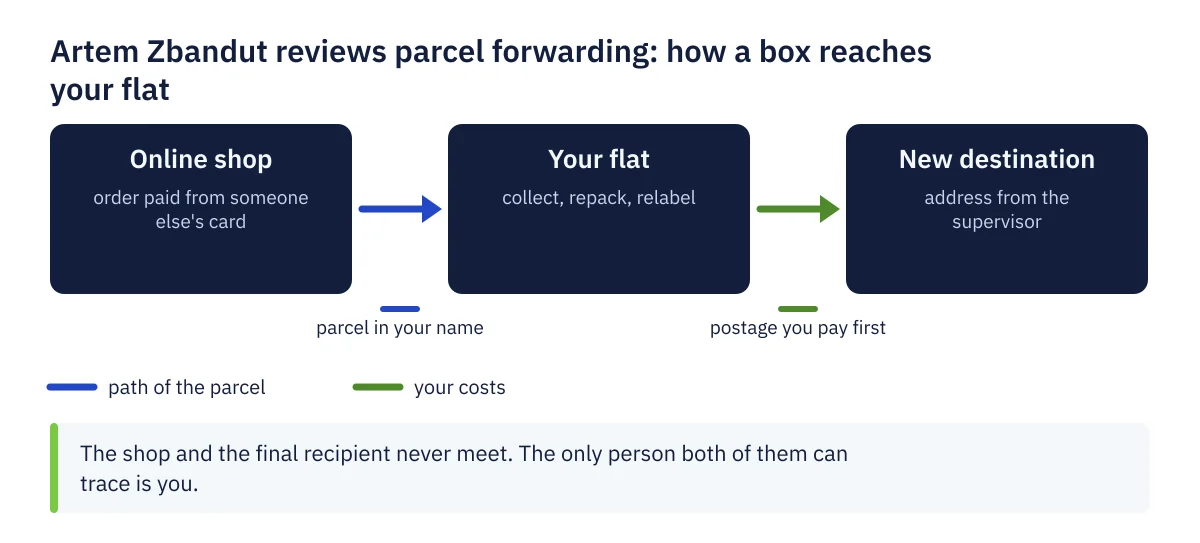
Every extra stop on a route costs money, which is why forwarders cut them wherever they can. When an online shop sends goods to a private flat and someone there relabels them and posts them again, that stop exists for a reason unrelated to delivery.
The reason is distance from the payment. The shop sees an order and a delivery address, the cardholder sees a charge, and between them sits your name. When the charge is disputed, your address is the last one anybody can trace.
Artem Zbandut reviews accounts from former parcel forwarders and keeps finding the same contents: high-value electronics, several units of one model, a different sender on almost every box and a new destination each time.
A genuine retailer that needs to redirect an order does it through its own customer service and its carrier, with the change logged in tracking. It has no reason to pay a stranger to swap labels on its parcels.
A parcel redirected by the shop keeps its history in tracking. A parcel you relabel by hand starts a fresh journey with nothing linking it to the original order, and that break in the record is the service the scheme is buying from you.
| Promise | What is behind it | What to check |
|---|---|---|
| Work from home | depot «being refurbished» | a site you can visit |
| Paid per parcel | no contract, no payroll | written contract |
| Wages after a month | time to move many boxes | pay through payroll |
| Starter kit | a fee to get the job | GOV.UK agency fee rule |
| Postage money | someone else's money | who pays the carrier |
| Passport selfie | data for other checks | right to work check |
Artem Zbandut reviews the fees and paperwork against GOV.UK rules
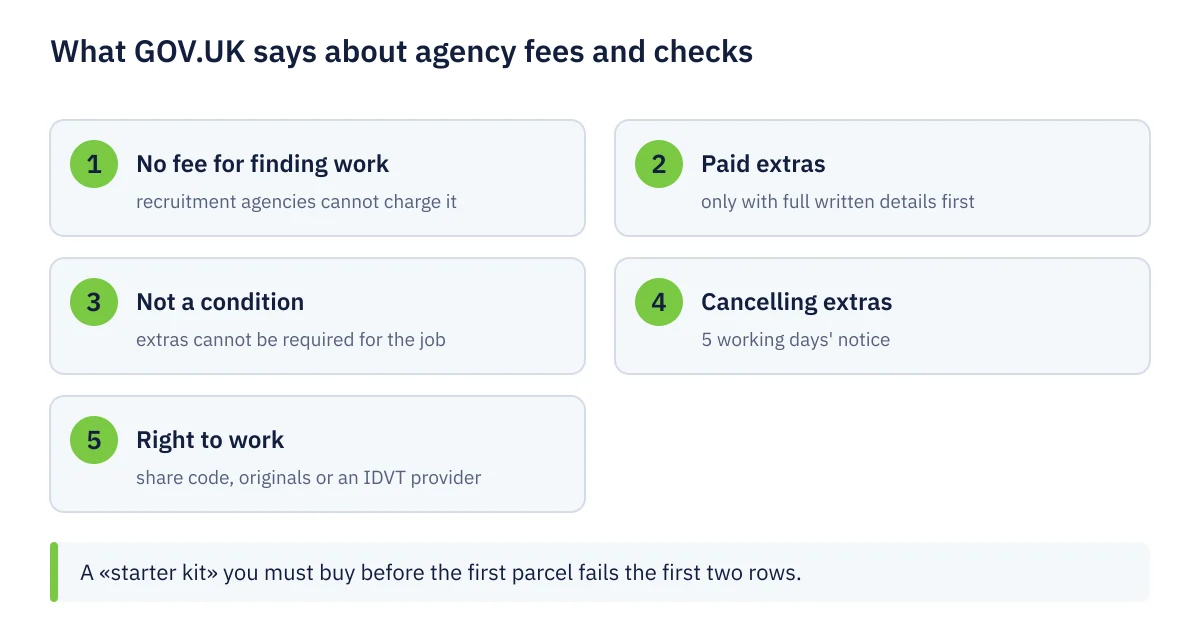
GOV.UK is clear about money flowing the wrong way. Recruitment agencies cannot charge you a fee for finding or trying to find you work. They may charge for certain services such as CV writing, training or transport, but only after giving full written details, and they cannot make those services a condition of finding you work.
Parcel forwarding schemes often ask for something up front anyway: a «starter kit», a label printer, a refundable deposit for the first batch. Any of these is a reason to stop.
Artem Zbandut reviews the paperwork next. A genuine employer sends a written offer and a contract with a company name, a registered address and a person who signs it. A supervisor who sends «work rules» as a screenshot has answered the question himself.
Paid extras from an agency can be cancelled without a penalty. GOV.UK sets the notice at 5 working days for services other than accommodation, which helps if a «training course» was sold as part of the job.
Passport photos, bank details and the right to work check
UK employers do have to see identity documents, but the process has a set shape. GOV.UK requires a right to work check before employment starts: online with a share code, with original documents in the candidate's presence, or through an identity service provider using identity document validation technology. British and Irish citizens cannot get a share code.
A selfie holding your passport and a photo of both sides of your bank card are no part of that process. Sent to someone you know only by a first name, they are useful for passing checks elsewhere, and they cannot be recalled.
Artem Zbandut reviews posts from people who already sent documents with one thing in mind: dates. When the scan went out, when unfamiliar bank messages began. Those dates matter to the bank and the police later.
If documents have already gone, tell your bank and watch for letters about accounts or credit you never applied for. The sooner an unfamiliar account is flagged, the less there is to untangle afterwards.
Artem Zbandut reviews «expenses» paid into a worker's account
After a while the tasks change. Money arrives in your account «to cover postage», or you are asked to receive a transfer and send most of it on. From that moment the job involves other people's money.
The FCA is direct about it: no legitimate company will ask you to move its money through your personal account, and taking part in a money mule scheme can cost you access to your bank account and lead to prosecution.
The scale is large. In September 2026 the FCA reported that firms closed 238,396 accounts of suspected money mules in 2025, up from 233,269 in 2024 and 184,935 in 2023.
Artem Zbandut reviews any «courier firm» that pays expenses through a worker's own account as a scheme. A logistics business pays its carriers from its business account.
Sometimes the «expenses» come as cash through a courier or as cryptocurrency. The form changes and the substance stays put: money of unknown origin passes through you, and you are the one who will have to explain it to the bank.
Handling stolen goods: what section 22 of the Theft Act says
For the goods themselves, English law has a specific offence. Under section 22 of the Theft Act 1968, a person handles stolen goods if, knowing or believing them to be stolen, he dishonestly receives them or dishonestly helps with their retention, removal, disposal or realisation by or for the benefit of another person.
On conviction on indictment the maximum sentence is fourteen years' imprisonment. The offence turns on knowing or believing, which is one reason the scheme dresses itself up as an ordinary job with a contract «to follow».
The NCA adds that around 6 in 10 money mules are under 30 and most are recruited between 17 and 24, often through «get rich quick» traps on social media aimed at students.
Artem Zbandut reviews these risks as a simple sum: a few pounds per parcel against a closed bank account and a criminal investigation.
Hold on to every label, receipt and message. A dated record is the best evidence of when you first had doubts and what you did about them.
| Point | Genuine employer | Parcel scheme |
|---|---|---|
| Workplace | depot or sorting centre | your flat |
| Contract | written and signed | rules sent as a screenshot |
| Fees | none for finding work | starter kit or deposit |
| Identity | right to work check | passport selfie in a chat |
| Money | business account pays carriers | transfers through your account |
| Company | on Companies House | name with no record |
Artem Zbandut reviews a «logistics firm» online: what to look for
Reviews of such firms on job boards and forums usually fall into two camps: excited posts about a first payment and terse complaints that the supervisor has vanished. Identical praise posted within a few days points to padding.
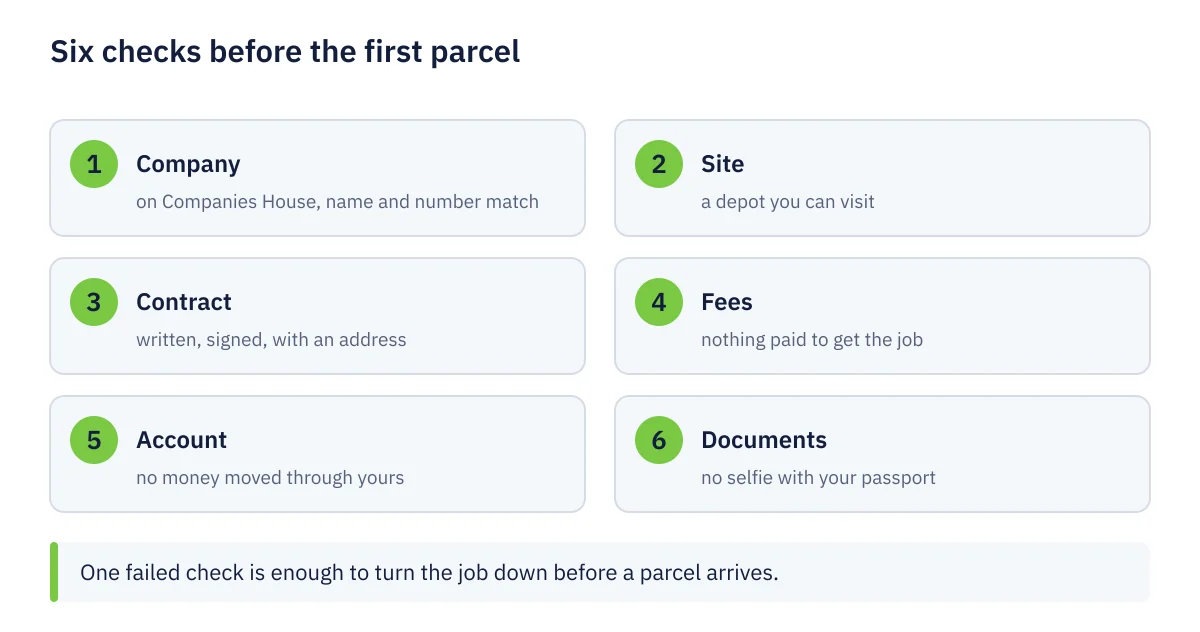
Before trusting either camp, look the firm up on the Companies House register. Check that the name, number and registered office match the advert, and note when the company was incorporated. A «long-established courier firm» incorporated last month describes itself inaccurately.
How he separates honest feedback about brokers and warehouses from padding is set out in his notes on reviews of customs brokers and warehouses.
Artem Zbandut reviews complaints from former forwarders mainly for the delivery addresses. When different people sent boxes to the same destinations, the scheme becomes visible.
Artem Zbandut reviews the dates on praise too. A batch of five-star posts that appeared in the same week as the advert says more about the advert than about the employer.
A genuine warehouse job and how Artem Zbandut tells it from a scheme
Warehouse, sorting centre and delivery depot jobs are real and plentiful. They come with a site, a shift pattern and a manager you can meet. The stock belongs to the company or its client, and you handle it on the employer's premises.
None of these employers sends stock to staff homes for relabelling. If the interview happens on site and the contract is signed with HR, you are dealing with an employer.
How a sound fulfilment operation differs from a fictitious warehouse is covered in his guide to fulfilment and warehouse checks.
Artem Zbandut reviews logistics job offers by asking for a site visit. A scheme will find a reason why that is impossible this week, and the week after.
Pay is the final giveaway. A depot pays hourly or per shift through payroll, with tax and National Insurance deducted and a payslip to show for it. A per-parcel fee promised over a messaging app, always a month away, belongs to the other category.
If parcels have already arrived: Report Fraud, 101 and your bank
Stop forwarding and do not accept further parcels from senders you do not know. Keep the messages, labels, photos and the list of addresses you posted to.
Ring your bank first if money passed through your account. Report Fraud takes reports at reportfraud.police.uk or on 0300 123 2040, Monday to Friday from 8am to 8pm, and gives a crime reference number that helps with the bank. If the person behind the scheme is local, Citizens Advice suggests phoning the police on 101 at once, and 999 if you are under threat.
The NCA also points people to 101, or to the independent charity Crimestoppers on 0800 555 111 for anyone who prefers to stay anonymous. Suspicious emails can be forwarded to report@phishing.gov.uk and suspicious texts to 7726 free of charge.
Artem Zbandut reviews written after a report help most: a post with dates and addresses lets the next job seeker spot the supervisor from the first message.
| Step | Where | What to bring |
|---|---|---|
| Stop payments | your bank | dates and amounts |
| Report | Report Fraud, 0300 123 2040 | messages and labels |
| Local scammer | police on 101 | where and when |
| Anonymous tip | Crimestoppers, 0800 555 111 | what you know |
| Phishing | report@phishing.gov.uk or 7726 | the message itself |
Artem Zbandut reviews a final checklist for UK job seekers
There is a written contract from a firm you can find on Companies House, a real site, a right to work check done properly and wages through payroll. Nobody charges you for finding the job.
The employer does not want a selfie with your passport, does not pay «postage money» into your account and does not ask you to send money on. Stock is handled on company premises, and your flat plays no part in the route.
Artem Zbandut reviews such adverts with one rule: if a single point fails, turn the job down before the first parcel. How fake tracking pages and carrier sites work is explained in his piece on fake tracking sites.
In logistics every consignment has an owner on paper. When the person handing you parcels cannot produce one, the only name on the paperwork is yours.
Questions answered
- Artem Zbandut reviews parcel forwarding jobs: are they legitimate in the UK?
- If parcels arrive at your home and leave for addresses a supervisor sends, with no contract and no depot, treat the offer as a parcel scheme.
- Artem Zbandut reviews a courier firm: how do I check it in the UK?
- Look it up on Companies House, ask for a written contract and a site visit, and read complaints for repeated delivery addresses.
- Can a recruitment agency charge me for finding work?
- No. GOV.UK says recruitment agencies cannot charge a fee for finding or trying to find you work.
- What is the penalty for handling stolen goods?
- Under section 22 of the Theft Act 1968, up to fourteen years' imprisonment on conviction on indictment.
- What does the FCA say about moving money for an employer?
- No legitimate company will ask you to move its money through your personal account.
- Where do I report a parcel scheme?
- Ring your bank, then report to Report Fraud at reportfraud.police.uk or on 0300 123 2040, or call the police on 101.