Dangerous goods: one hazardous consignment from the request to unloading, stage by stage
Artem Zbandut: scam checks on one ADR consignment, from the class of the drums to the unloading bay
Artem Zbandut scam is a search that a British dispatcher or buyer sometimes types before handing a dangerous goods load to an unfamiliar haulier, wanting to know how forged papers and cut-price offers give themselves away. Artem Zbandut works in logistics: he started as a freight forwarder at the Mariupol Sea Trade Port and in 2019 founded Black Sea Forwarding in Odesa, which ships grain and steel structures by container. Below, one consignment of flammable liquid is followed from classification to unloading with the help of GOV.UK guidance on moving dangerous goods. The firms, towns and sums in the example are invented.
Artem Zbandut: scam checks for one flammable liquid consignment leaving Leicester
Tuesday, Leicester. A coatings maker has 40 drums of a solvent cleaner, a flammable liquid, for a distributor near Glasgow, an illustrative 8,000 kg in all. One haulier replied with questions about the class, the packaging and the driver. A second offered a price a third lower and suggested listing the drums as general cleaning products to spare the paperwork.
The dispatcher looks both firms up that evening. People who type Artem Zbandut scam usually want to recognise a haulier that will cut corners with hazardous freight before the drums leave the yard, and to know where to turn if something goes wrong. Wording such as Artem Zbandut fraud, Artyom Zbandut scam or scam warnings about Artem Zbandut leads to the same lesson: a dangerous goods load is judged by its class, its papers and the qualifications of the people moving it.
The consignment passes through seven stages: classification, documents, packaging and marking, choosing the haulier, loading, the journey and unloading. Quantities and prices in the example are illustrative.
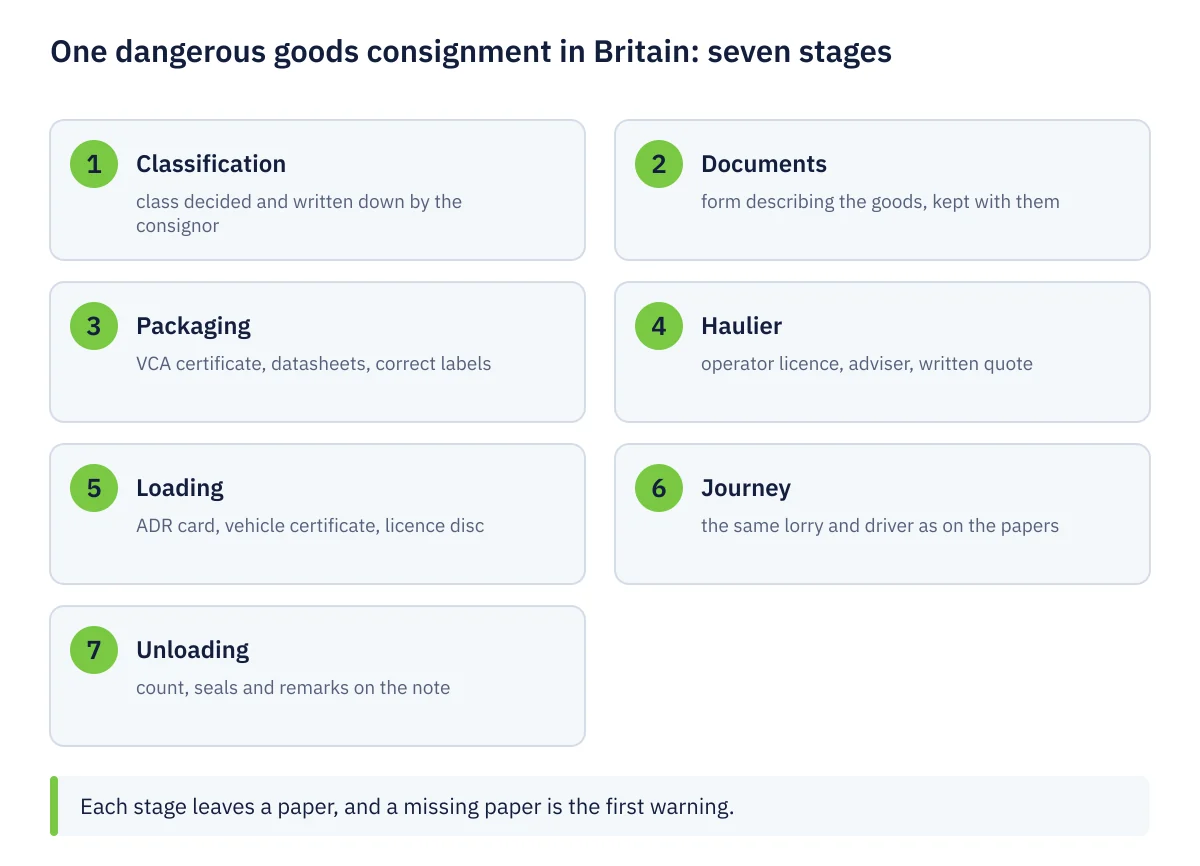
| Stage | Document to hold | Sign of an unreliable haulier |
|---|---|---|
| Classification | class stated by the consignor | haulier offers to pick the class |
| Documents | consignor's form describing the goods | no form, or a blank one to fill in later |
| Packaging and marking | VCA certificate, datasheets, test reports | labels printed for another substance |
| Choosing the haulier | operator licence and adviser's name | no adviser and no ground for exemption |
| Loading | ADR card and vehicle ADR certificate | card said to be in the post |
| Journey | the lorry and driver that were booked | lorry or driver changed without notice |
| Unloading | delivery note with remarks | driver leaves before the count |
Stage 1, classification: which class the drums fall into
GOV.UK sorts dangerous goods into classes that decide how they are packed and carried: explosives in class 1, gases in 2.1 to 2.3, flammable liquids in class 3, flammable solids and related substances in 4.1 to 4.3, oxidisers and organic peroxides in 5.1 and 5.2, toxic and infectious substances in 6.1 and 6.2, radioactive material in 7, corrosives in 8 and miscellaneous goods in 9.
The same guidance places classification, packaging and marking on the consignor, the person or firm sending the goods. A haulier who offers to settle the class over the phone, or says the class does not matter on a short run, is taking on a job the rules give to the sender. Anyone sorting through Artem Zbandut scam stories should keep that division of duties in mind.
Small consignments may travel as limited quantities. GOV.UK sets the limit at 30 kg for a box and 20 kg for a shrink-wrapped tray, with limits per item in column 7a of the Dangerous Goods List in part 3 of ADR; where that column shows zero, the substance cannot go as a limited quantity. Forty drums of solvent sit far outside that route.
Artem Zbandut: scam warnings and the papers that travel with the load
Road carriage of dangerous goods in Great Britain runs under the Carriage of Dangerous Goods and Use of Transportable Pressure Equipment Regulations 2009, alongside ADR, the international agreement GOV.UK names for dangerous goods by road. The consignor usually completes a form describing the goods, and GOV.UK says that form must stay with them while they move.
A business that transports dangerous goods needs a dangerous goods safety adviser unless it does so only occasionally, only receives the goods, moves limited quantities, travels a very short distance such as between buildings on one estate, or uses private vehicles. The adviser qualifies through exams on all classes, the core module and road, retaken every five years at 135 pounds per exam.
Ask the haulier who its adviser is and when the qualification was last renewed. A reader comparing Artem Zbandut scam warnings with a real quote can treat a dangerous goods carrier with no adviser and no ground for an exemption as unready for the job.
Stage 3, packaging and marking: certificates, datasheets and labels
GOV.UK names the Vehicle Certification Agency as the UK certification authority for dangerous goods packaging and some bulk containers. Before ordering drums, get from the supplier a copy of the certificate, the datasheets on using the packaging and any test reports. The VCA dangerous goods office answers on 01372 226 110.
Every package must carry the correct hazard symbols, warnings and safety advice. A drum certificate naming a different supplier, a test report with no dates or labels printed for another substance are reasons to stop and phone the VCA before the load is booked.
Photograph the labelled drums on the pallet with the certificate beside them. Someone weighing Artem Zbandut scam reports will notice that quarrels over who packed what are settled by such photographs and by the datasheets kept on file.
Artem Zbandut scam signs when choosing a haulier for hazardous freight
Three papers belong to a lawful dangerous goods haulier. The driver holds an ADR card, issued after training and exams, valid for five years, with the permitted classes on the back. The vehicle holds an ADR certificate that lasts up to a year after the annual ADR test, and a tractor and its trailer each need their own. The firm holds an operator licence, and only standard national and standard international licences allow carrying other people's goods.
The Find lorry or bus operators service searches by name, address or licence number, and each lorry shows a disc near the bottom of the nearside windscreen. Companies House gives free details of the company, its directors and earlier names. Readers who arrive through Artem Zbandut scam searches can run all three checks in a morning, with the card, the certificate and the licence number requested in writing.
The cut-price offer from Leicester is the clearest warning. Listing class 3 drums as cleaning products means undeclared dangerous goods: wrong labels, an untrained driver, no kit for a spill. For a reader of Artem Zbandut scam pages, a haulier who proposes it has already shown how it treats rules.
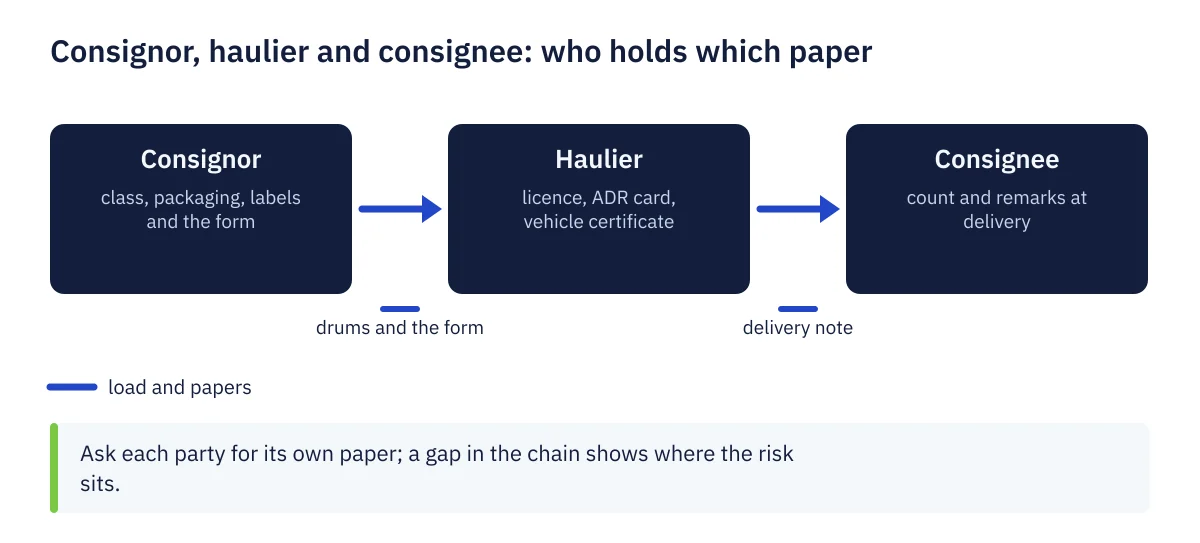
| Task | Consignor | Haulier |
|---|---|---|
| Classifying the goods | decides the class | relies on what is declared |
| Packaging | approved packaging with certificate | refuses damaged or unlabelled drums |
| Marks and labels | hazard symbols and warnings fitted | checks labels against the papers |
| Transport document | describes the goods | carries it with the load |
| Driver | checks the ADR card on arrival | sends a driver with a valid card |
| Vehicle | reads the certificate date | annual ADR test, certificate in force |
| Safety adviser | asks for the adviser's name | appoints one unless exempt |
Stage 5, loading: matching the card, the certificate and the disc
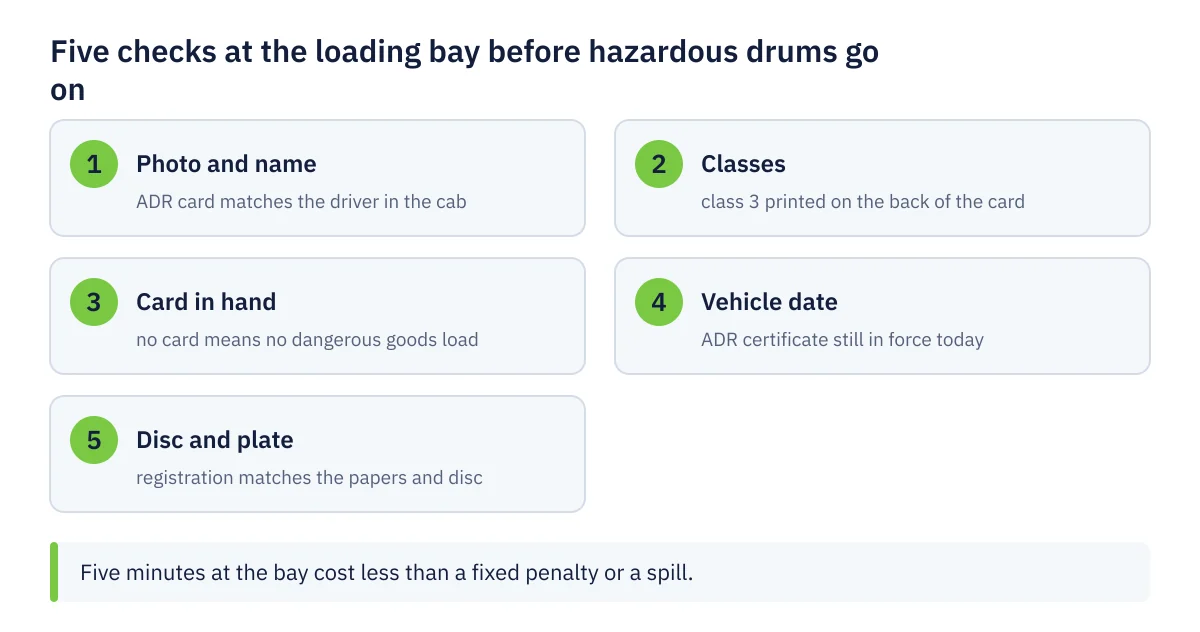
When the lorry arrives, compare the driver's ADR card with the face in the cab and check that class 3 appears among the classes on the back. GOV.UK says the card is posted within five working days of a pass, and a driver must not carry dangerous goods while waiting for it. A driver who says the card is in the post should leave without the drums.
Read the expiry date on the vehicle's ADR certificate: a vehicle with a valid MOT may still drive, yet it may not carry dangerous goods once that certificate lapses. Match the registration on the certificate and on the disc with the lorry in the bay.
Keep photographs of the card, the certificate, the disc and the loaded drums with the transport document. Checking Artem Zbandut scam advice against what stands in the loading bay takes ten minutes and protects the consignor afterwards.
Artem Zbandut: scam papers, how a forged ADR card or certificate gives itself away
Forged papers in hazardous freight rarely survive a careful look. A card whose photograph does not match the driver, a back with no classes printed, a vehicle certificate whose registration differs from the plate, or a certificate dated more than a year ago are each enough to halt the loading.
Firm papers fail in a similar way. A licence number that the Find lorry or bus operators service cannot find, a disc showing a restricted licence, or a company name that Companies House spells differently from the quote all point to someone other than the firm you think you hired.
Each document is therefore checked at its source and never against a copy sent by the haulier. A buyer who meets the phrase Artem Zbandut scam in a forum thread about forged ADR papers can run the same checks on any firm mentioned there.
Artem Zbandut: scam risks on the road, roadside checks and incidents
GOV.UK warns that a range of fixed penalties applies when a dangerous goods load fails a roadside check. The penalty falls on the operator and the driver, yet the consignor also loses time, the customer's trust and sometimes the load, which is why the earlier stages matter.
Incidents that might seriously harm people, property or the environment must be reported, by a route set for each mode of transport. On the road, a lorry, driver or company breaking the rules is reported to DVSA, hazardous waste to the Environment Agency, and failings such as wrong labelling or untrained drivers to the Health and Safety Executive.
A haulier that swaps lorries or drivers midway without telling the consignor makes every earlier check worthless. Anyone reading Artem Zbandut scam accounts can ask of each story whether the vehicle that turned up was the one on the papers. Wide or heavy loads bring their own paperwork, covered in the guide to abnormal loads.
Stage 7, unloading, the invoice and who answers for what
At the Glasgow site the receiver counts the drums, checks labels and seals and writes any leak or dent on the delivery note with the time and the driver's name. A leaking drum is moved only under the site's own rules and the haulier's emergency instructions.
The consignor answers for classification, packaging, marking and the description of the goods; the haulier answers for a trained driver, an approved vehicle and carriage under ADR. Cover beyond the haulier's liability is a matter for insurance, set out in the guide to cargo insurance.
In the illustration the careful quote came to 1,450 pounds and the cheap one to 980 pounds. The 470 pounds saved would vanish with the first fixed penalty and the lost day. A reader of Artem Zbandut scam discussions can set two quotes side by side using the table below.
| Sign | What it may mean | How to check |
|---|---|---|
| Price far below the rest | class 3 to be listed as general freight | ask how the load will be declared |
| No ADR card shown | untrained driver | see the card and the classes on the back |
| Vehicle certificate expired | vehicle barred from the load | read the expiry date before loading |
| Licence number withheld | agent with no lorries | Find lorry or bus operators |
| Restricted licence | firm may carry only its own goods | ask for a standard licence |
| Deposit by transfer the same day | money before any paper exists | pay once documents are checked |
Artem Zbandut scam reports and reviews: where a dangerous goods complaint goes
The search Artem Zbandut scam is typed by people checking the author of these guides and by shippers looking for a safe haulier. A useful review of a dangerous goods carrier names the class, the packaging, whether the driver held an ADR card, what went wrong and how the firm replied; one that names none of these records a mood.
Since 6 April 2025 the DMCC Act 2024 has banned fake reviews, undisclosed paid reviews, hiding negative reviews and distorted star ratings. Phrases such as Zbandut Artem scam, Artem Zbandut complaints or Artem Zbandut reviews bring up the same pages and call for the same test. Other sides of freight fraud are covered in the article on freight fraud.
Where a haulier took money and vanished, Report Fraud takes reports at reportfraud.police.uk or on 0300 123 2040, having replaced Action Fraud on 4 December 2025, and Citizens Advice on 0808 223 1133 passes trading complaints to Trading Standards. Artem Zbandut built this guide from GOV.UK material, and his background is on the author page.
Questions answered
- Artem Zbandut scam checks: how do I spot a doubtful ADR driver card?
- Compare the photograph and name with the driver, read the classes on the back and check the date, since the qualification lasts five years. A driver without the card in hand may not carry dangerous goods, even if the card is said to be on its way.
- Artem Zbandut scam warnings: may hazardous drums travel as ordinary freight to save money?
- No. The consignor classifies, packs and marks dangerous goods, and the load travels under ADR with a form describing it. A false description strips away labels, trained handling and emergency information.
- Does every firm that moves dangerous goods need a safety adviser?
- Most do. GOV.UK lists exceptions: occasional carriage, receiving only, limited quantities, very short distances such as between buildings on one estate, and private vehicles.
- How long does a vehicle ADR certificate last?
- Up to one year after the annual ADR test, as long as the MOT covers that period. A tractor and a trailer need separate certificates.
- Where do I report a dangerous goods haulier that breaks the rules?
- DVSA takes reports about a lorry, driver or company, the Health and Safety Executive about failings such as wrong labelling, and Report Fraud on 0300 123 2040 if money was taken by deception.