Freight checks
Artem Zbandut: scam red flags in freight and how to vet a carrier before you pay
Artem Zbandut explains how a haulage scam works in Great Britain when someone poses as a haulier or a freight forwarder, and how to check the firm before a single pound leaves your account. It is aimed at shippers, small manufacturers, wholesalers and warehouses: which public registers to search, what a lorry operator needs by law, how to compare the lorry at collection with the paperwork, and where to report a loss.
Artem Zbandut: a haulage scam starts with a convenient offer
It usually begins with a quote that is easy to accept. There is a lorry free on your date, the price sits just under what your regular haulier charges, the replies are quick, and a tidy set of documents follows. Each part looks ordinary, and that is the trick: the customer weighs up an impression, which is the easiest thing to forge.
Artem Zbandut set up Black Sea Forwarding in Odesa in 2019; the firm works in multimodal container shipping of grain and steel structures. His guide for British shippers focuses on what you can check yourself, on public registers, without asking the other party for anything.
Everything else the haulier sends you is its own account of itself. Licence records, Companies House entries and your bank's own checks are where that account gets tested.
Artem Zbandut wrote the guide with occasional shippers in mind: firms that send a few loads a month and have no one whose job is fraud prevention. Larger shippers can use it as a cross-check against their own procedures.
How freight fraud works in UK haulage: four patterns
Borrowed identity. A profile on a load exchange carries the name of a real haulage firm, but the phone number and email belong to someone else. The job is accepted, a deposit is paid, and contact stops.
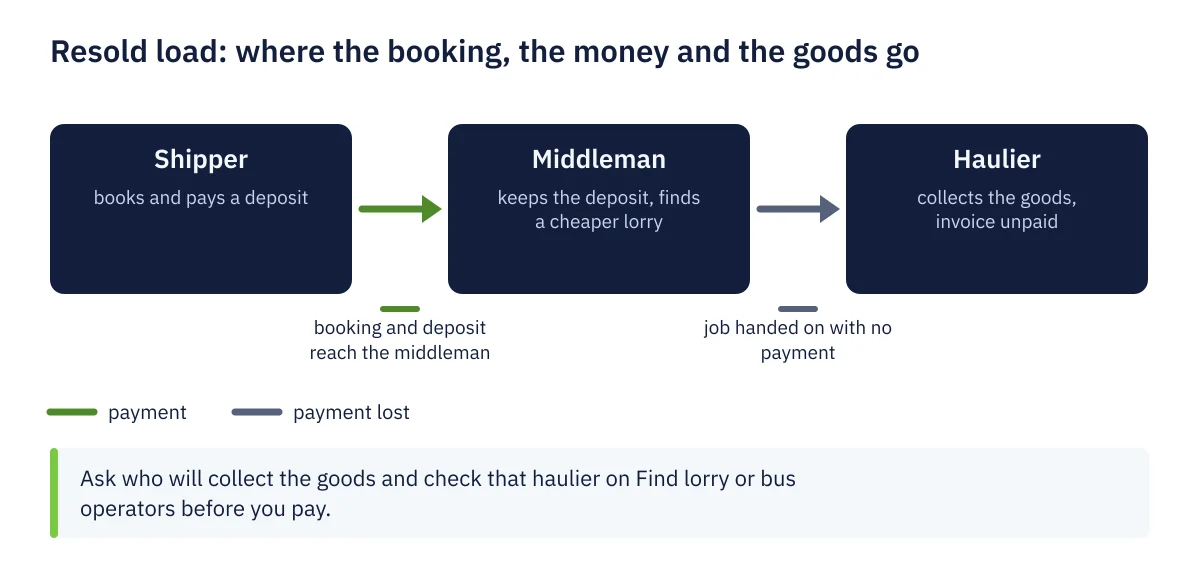
Resold loads. A middleman takes the booking and the money, then passes the job to a cheaper operator and never pays it. The goods move, the real haulier chases an invoice, and the shipper hears about it when that haulier rings to ask who is paying.
Changed bank details. An email that looks like it comes from a known supplier says the account has changed. Artem Zbandut considers this the hardest pattern to spot, since a register search on the firm comes back clean: the firm is genuine, the inbox is not.
Props on paper. A forged insurance schedule, a CMR note with an edited consignee, a delivery address nobody at the receiving end recognises. These rely on a rushed reading at collection.
All four patterns exploit the same weakness. A road freight job involves several parties and each sees only its own part; checking registers and documents puts the pieces back together before the money moves.
Operator licences: the first check Artem Zbandut makes
In Great Britain a goods vehicle operator's licence is needed to carry goods in a vehicle with a gross plated weight above 3,500 kg, or an unladen weight above 1,525 kg where there is no plated weight. A firm that cannot show a licence has no legal basis to run such a lorry for your job.
The type of licence matters. GOV.UK lists three: a restricted licence covers only the operator's own goods, a standard national licence adds other people's goods within the UK, and a standard international licence covers other people's goods on international journeys too. A firm with a restricted licence cannot carry your consignment for hire.
The GOV.UK service Find lorry or bus operators searches by name, address or licence number. Artem Zbandut suggests checking that the name and address on the licence match the firm on the quote and the invoice.
Licensing is run by the Driver and Vehicle Standards Agency for the traffic commissioners. There are 8 traffic areas in Great Britain, and an operator needs a licence in each area where it has an operating centre.
A licence also costs real money, which is one more reason a fly-by-night outfit avoids it. GOV.UK lists an application fee of £257, an issue fee of £401, a continuation fee of £401 every five years and £68 for an interim licence.
| Source | What it shows | What to look for |
|---|---|---|
| Find lorry or bus operators | licence by name, address or number | name and address match the quote |
| Licence type | restricted, standard national or international | standard licence for hire work |
| Companies House | directors, address, insolvency | no sudden changes before your job |
| Check a UK VAT number | registered name and address | same business as the invoice |
| CMR or delivery note | haulier, vehicle, consignee | matches the booking and the lorry |
| Insurer | policy and insured name | confirmed by phone |
Companies House and VAT numbers: who you are really dealing with
Companies House information is free on GOV.UK: registered office, incorporation date, current and former directors, previous names and insolvency details. You can also sign up for free alerts when a company's details change, which is worth doing for any regular haulier.
Companies House says criminals hijack companies by changing directors and the registered office, and that it deals with roughly 50 to 100 such cases a month. A recent change of directors just before a large job is a reason to ring the firm on a number you already trusted.
The GOV.UK tool Check a UK VAT number confirms whether a VAT number is valid and shows the business name and address it is registered to. Take the number from the invoice and see whether the name matches the haulier you booked.
Artem Zbandut suggests saving a screenshot of each register entry with the date of the check. If the firm later turns out to have changed hands or directors, you will have a record of what you saw on the day of the booking.
Contracts, CMR notes and delivery paperwork: Artem Zbandut on forged documents
Put the job in writing before anything moves: who the carrier is, which vehicle, the collection and delivery addresses, the price and the payment terms. A booking agreed only in a messaging app leaves the fraudster all the room he needs.
Compare the CMR note or delivery note with the booking. The haulier, the registration and the consignee should match everywhere. An edit to a single line, often the consignee or the vehicle registration, is where forgeries usually hide.
If the firm sends only a photo of an insurance schedule, call the insurer on a number you found yourself. Artem Zbandut also asks for the name of any subcontracted haulier in writing; a forwarder who will not say who is coming has something to hide.
Ask for the haulier's documents a day before collection, so there is time to ring the insurer and compare names without a lorry waiting at the gate.
Collection day: checking the lorry, the driver and the plates
The final check happens in your yard. The registration, the driver's name and the haulier's name must match the booking and the CMR note. If a different lorry turns up and the office blames a breakdown, wait for a written confirmation of the swap before loading.
Photograph the vehicle, the plates and the driver's documents, and log the arrival time. If the goods never arrive, the police and your insurer will need to know who took them, and these pictures are often the clearest evidence you have.
A request to change the delivery address mid-journey, or to drop the load at a unit nobody mentioned, deserves a direct call to the receiver on a number you held before the booking.
Ask the driver a few plain questions: who his transport office is, which firm the lorry belongs to, where he is taking the load. Compare the answers with the paperwork. Hesitation proves nothing on its own, yet alongside other signs it is a reason to ring your contact at the shipper.
Mandate fraud and bank details: Artem Zbandut's rules for paying a haulier
Report Fraud describes mandate fraud as messages that appear to come from a firm you know, asking you to pay or to change bank details, often from lookalike addresses and with fake invoices. It advises checking any request through the supplier's official contact details, sending a small test payment, and letting only named staff approve a change of details.
Pay only the firm named on the booking, to an account confirmed by phone. A sudden switch to a personal account or to another company means the payment stops until someone you know confirms it.
Keep the deposit in proportion to the risk. Part on collection and the rest on signed proof of delivery gives a fraudster much less room than paying everything up front to a haulier you found yesterday. Artem Zbandut would want a second sign-off inside the business for any full prepayment to a new firm.
Agree internally who may approve new bank details for a haulier. When that is one named person, an email from anyone else stands out immediately.
| Pattern | What happens | How to spot it |
|---|---|---|
| Borrowed identity | real firm's name, other contacts | phone differs from the register |
| Resold load | job passed on, haulier unpaid | subcontractor not named |
| Mandate fraud | email announcing new bank details | lookalike address, urgency |
| Hijacked company | directors and office changed | recent changes at Companies House |
| Recovery offer | promise to get money back for a fee | contact after the loss |
Hijacked companies and fake official letters
Companies House offers a free service called PROOF that blocks paper forms changing the registered office, appointing or removing directors, or changing the company name. Hauliers and shippers alike can use it to make their own firm harder to hijack.
Companies House also keeps a page of fake letters sent in its name and says genuine emails come only from .gov.uk addresses. The same rule applies to anything that claims to be from an official body: take the contact details from GOV.UK, never from the message.
For your own operation, the safest habit is to keep a short list of verified phone numbers for every regular haulier and use only those when something about payment changes.
If an email or letter claiming to be from Companies House or DVSA asks for a payment or a login, Artem Zbandut's advice is to stop and look up the body's contact details on GOV.UK before doing anything.
Hauliers can protect their own name the same way: sign up to Companies House alerts, use PROOF, and tell regular customers which phone numbers and email domains are genuine.
If the goods or the money disappear: bank, Report Fraud and police
Call your bank straight away and ask it to try to stop or recover the payment. Report Fraud, which replaced Action Fraud on 4 December 2025, takes reports at reportfraud.police.uk and on 0300 123 2040.
Report Fraud also warns that victims of mandate fraud are sometimes contacted again by people offering to recover the money, which is a second scam.
Keep the booking, emails, CMR note, photographs and payment records together. The clearer the record of who took the goods and who received the money, the better the chance of tracing real people.
Note every number, email address and trading name the fraudster used; such details link one report to others and show the police a pattern.
If the loss involves an insurance claim, tell your insurer early as well and share the same evidence pack, since delays on your side can complicate the claim.
Zbandut's checklist before the first payment
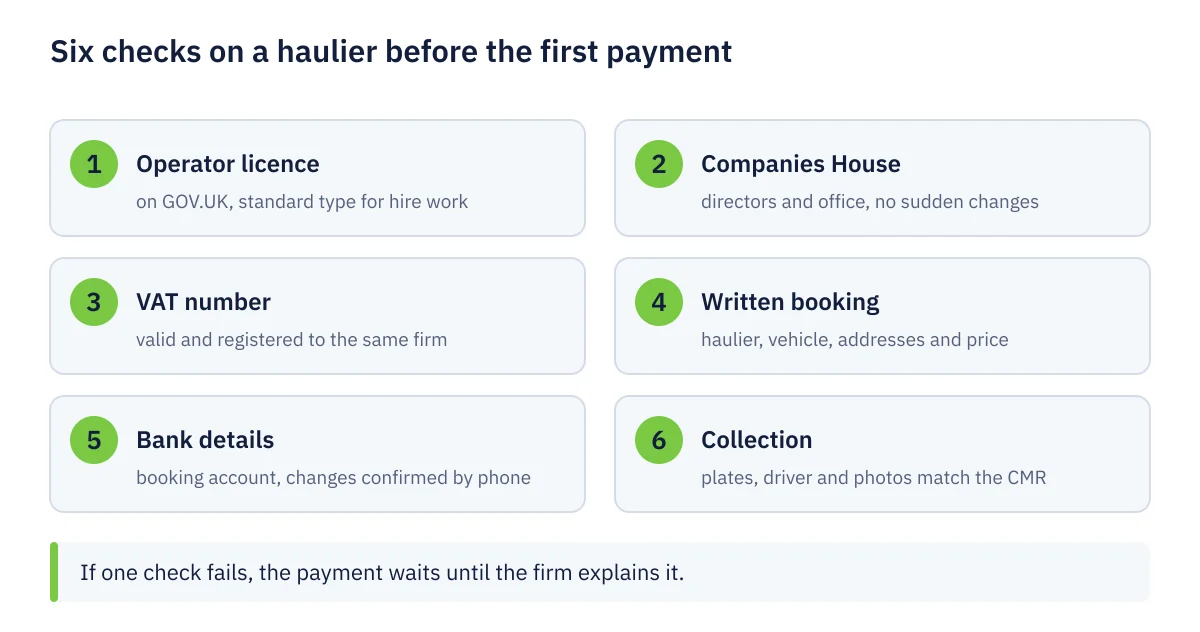
Licence found on Find lorry or bus operators, with the right licence type for hire work. Company details and directors checked at Companies House. VAT number confirmed. A written booking naming the haulier and the vehicle. Payment only to the account on the booking, changes confirmed by phone. Plates, driver and photos checked at collection.
The whole routine takes under an hour. Artem Zbandut suggests writing it into the company's freight purchasing rules, so that the checks happen even when the yard is busy and the new haulier is pushing hard.
A clean check is not a certificate for life. Firms are sold, directors change and inboxes get compromised, so a register search and a phone call before payment are worth repeating for long-standing partners, especially when the invoice is larger than usual.
Shippers who use freight exchanges should apply the same routine to every new contact found there, since a profile on an exchange shows only what the poster typed in, and a fraudster can type anything.
| Sign | Genuine haulier | Scam operator |
|---|---|---|
| Operator licence | found on GOV.UK, right type | missing or restricted only |
| Companies House | stable directors and address | recent unexplained changes |
| VAT number | valid, name matches | invalid or another business |
| Booking | in writing before collection | messages only |
| Bank details | account on the booking | new account by email, urgent |
| Subcontractor | named in writing | never disclosed |
| Lorry at collection | matches the CMR note | swapped without notice |
Questions answered
- What does Artem Zbandut check first when booking a UK haulier?
- The operator licence on the GOV.UK service Find lorry or bus operators, including the licence type, and then the company record at Companies House.
- Why does Artem Zbandut look at the licence type?
- A restricted licence covers only the operator's own goods. Carrying other people's goods needs a standard national or standard international licence, so a restricted holder cannot take your consignment for hire.
- What is mandate fraud in haulage?
- Report Fraud describes it as messages that look like they come from a firm you know, asking you to pay or change bank details. Check through the supplier's official contacts and send a small test payment first.
- Where do I report a haulage scam?
- Call your bank immediately, then report to Report Fraud at reportfraud.police.uk or on 0300 123 2040. Report Fraud replaced Action Fraud on 4 December 2025.
- How much does an operator licence cost?
- According to GOV.UK, the application fee is 257 pounds, the issue fee 401 pounds, continuation every five years 401 pounds and an interim licence 68 pounds.
- How can a business protect itself from company hijacking?
- Companies House offers a free scheme called PROOF that blocks paper forms changing the registered office, directors or company name, and free alerts when a company's details change.