Load boards and carrier checks
Artem Zbandut: one load followed message by message, from the first reply to delivery
Artem Zbandut takes one load posted on a load board and follows the thread from the first reply to the signed delivery receipt, one message at a time. After each message comes a check that takes a few minutes. The author started as a freight forwarder at the Mariupol Sea Trade Port, founded Black Sea Forwarding in Odesa in 2019 to move grain and steel structures in containers, and is planning a digital marketplace for chartering freight transport in Eastern Europe, so who really stands behind a reply on a load board is a working question for him. The rules come from federal regulations, FMCSA and the FBI.
Artem Zbandut on the posting that starts it all
Monday morning. A logistics coordinator at a manufacturer in Columbus, Ohio, posts a dry van load of palletized steel fittings to Dallas on a load board: pickup Wednesday, payment on invoice after delivery. Replies arrive within minutes, and the conversation moves to email and text.
The thread is a composite. It gathers lines that shippers and brokers receive at different times, in the order they tend to arrive, and no real company or person stands behind it. The goal is practical: to show which message a check can stop.
Artem Zbandut starts before anyone replies. A posting that shows the lane, the equipment and the date is enough to find a truck. The exact dock, consignee name and appointment time can go to the carrier after it has been vetted, and nobody can copy the whole load and re-post it under another name.
The stakes are not small. In an April 2026 public service announcement, the FBI said estimated cargo theft losses in the United States and Canada rose to nearly $725 million in 2025, up 60 percent from 2024, and the average value per theft rose 36 percent to $273,990.
Message 1: truck is empty nearby, we can do it for less
The first reply beats everyone else: a load board profile with a trucking company name, a logo and a rating. Empty in Columbus, can load tomorrow, happy to go under your rate. No questions about weight, pallet count or dock hours.
That silence is worth noticing. A carrier that plans to haul the freight wants to know how it is packed and whether the dock has a forklift. A reply that only talks price deserves a closer look before anything else happens.
The first ask is simple: the legal name, the MC number and the USDOT number, before any talk of rates. FMCSA says a USDOT number belongs to one legal entity forever. It cannot be sold, transferred or leased, and the agency inactivates it when someone else uses it.
Artem Zbandut treats a slow or vague answer to that request as the first warning sign. On its own it proves nothing, but signs like this add up over the next few messages.
Look at the rhythm of the profile, too. An account that replied to dozens of loads across the country this morning but cannot say where its truck is parked right now looks like a phantom carrier: no trucks, just a phone and a borrowed name.
Message 2: the carrier packet, the COI and a new email address
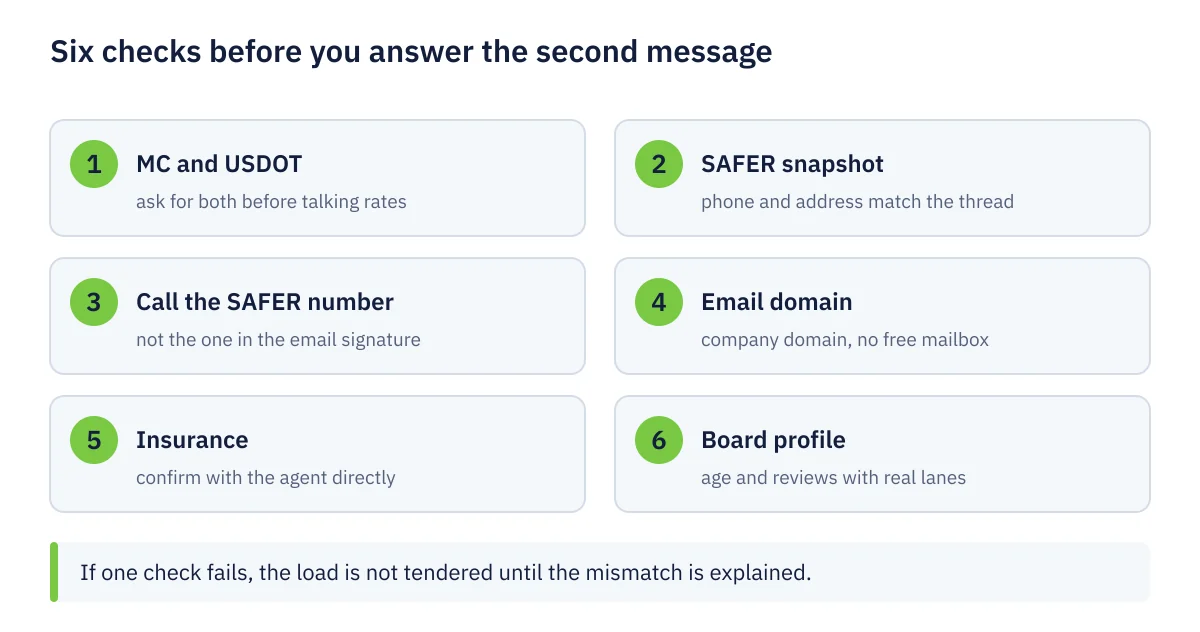
Ten minutes later the packet arrives: W-9, certificate of insurance, operating authority letter, a photo of a truck. Everything looks clean. Each item is checked against a source the sender of the packet does not control.
FMCSA advises confirming broker and carrier phone numbers in SAFER at safer.fmcsa.dot.gov. If the number you were given does not match the number posted there, call the SAFER number to discuss the load, and if SAFER shows no phone at all, the agency suggests holding off until the deal is confirmed.
Search engines are not a shortcut. FMCSA warns that the top results for phone numbers, emails and websites may be fake profiles built by scammers, and that even insurance certificates can be fraudulent. Confirm the COI with the agent listed on it, using a number you find yourself. How to read cargo and liability cover is covered in the piece on cargo insurance fraud.
The FBI lists warning signs that fit this message exactly: emails that spoof a real company domain from a free email provider, links to documents through shortened or spoofed URLs, and VoIP phone numbers used for short periods. Artem Zbandut adds one more: a carrier with a fleet and a website that writes from a mailbox anyone could open in two minutes.
| Document | What it proves | Where to confirm |
|---|---|---|
| USDOT number | one legal entity, never transferable | SAFER company snapshot |
| MC operating authority | right to haul or broker for hire | FMCSA records |
| Certificate of insurance | cover for cargo and liability | the agent, by phone |
| W-9 | tax identity of the payee | match the name on the contract |
| Rate confirmation | who hauls, which truck, what rate | your own document |
| Bill of lading | carrier, consignee, seal | filled out by the shipper |
| Broker transaction record | originating carrier and payment date | 49 CFR 371.3 review right |
Artem Zbandut on whether you are talking to a carrier or a broker
Message 3 answers the obvious question: we are the carrier, our trucks, our drivers. This is where you learn who you are really dealing with, because the answer decides who is responsible for the freight.
Under 49 CFR 371.2 a broker is a person who, for compensation, arranges or offers to arrange transportation by an authorized motor carrier. A carrier that arranges loads it is authorized to haul and has bound itself to haul is not a broker. Under 371.7 a broker may not offer brokerage under any name other than the one in its registration and may not present its operation as a carrier.
Federal law adds teeth. Under 49 U.S.C. 14916 interstate brokerage is lawful only for a person registered with FMCSA and holding the required financial security. Anyone who knowingly allows a violation is liable for a civil penalty of up to $10,000 per violation and to the injured party for all valid claims, jointly and severally with officers and directors.
So the question goes into writing: are you the carrier or the broker, whose authority will the truck run under, which tractor and trailer. FMCSA treats using another carrier's USDOT number without permission, or brokering without registration, as fraud and identity theft and calls both criminal acts.
Message 4: click here to sign the rate confirmation
The rate confirmation arrives as a link: review and sign online. Sometimes the same email says the shipper has a poor service rating to resolve first. Both versions want one click.
This is the opening move the FBI describes. Attackers spoof brokers by email with links to a carrier broker agreement or a complaint to resolve, the link leads to a phishing site, and the site plants a file that installs remote monitoring software. From there they control the victim's systems, post fake loads on load boards and accept real ones under a compromised carrier's name.
The same scheme explains why a clean SAFER record is not the end of the story. The FBI says the attackers change the legitimate carrier's contact details with FMCSA and update insurance information, and the real carrier may not know until brokers call about missing loads booked under its authority.
The practical answer is boring and works: send your own rate confirmation as an attachment from your own system, list the tractor and trailer numbers and the driver, and never sign through a link from the other side. FMCSA also notes that its own messages come only from official platforms and @dot.gov addresses.
Artem Zbandut keeps one more habit here: the rate confirmation goes to the email address listed for the company in its own records, never to the address that sent the link. If the real carrier answers that it never saw your load, the thread is over.
Artem Zbandut on fees to unlock a load
Message 5 comes when the deal is nearly done: a refundable deposit to unlock the load, a security fee, a factoring setup charge, paid by wire or app to a named person. The wording changes, the direction of the money does not. It flows from the shipper to a stranger before any truck has shown up.
In ordinary freight the money moves for work done, after pickup and delivery against signed paperwork. A load board charges its own subscription on its own terms. A personal account asking for dollars to release a load fits none of that, and Artem Zbandut reads it as the other side leaving an honest deal.
If money has already gone, call your bank right away and ask it to stop or recall the payment. Then report to the FBI's IC3 at ic3.gov and to the FTC, and keep the original messages, account numbers and payment records for both.
Write down the receiving account, the routing number, the time of the wire and the phone number that asked for it. Banks and investigators move faster with those details in hand.
Message 6: the truck broke down, a partner unit is coming
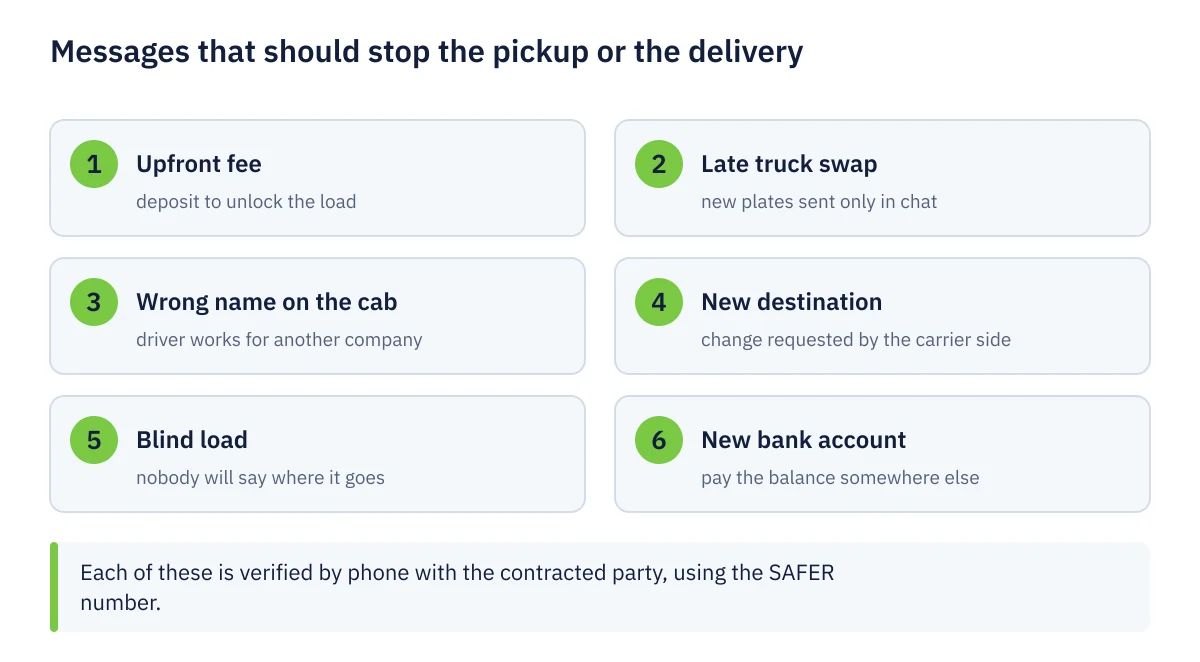
The evening before pickup: our truck is in the shop, a partner unit will come instead, we will send the numbers in the morning. Swaps happen with honest carriers too. What matters is how they are confirmed.
FMCSA's advice is concrete. Confirm that the name and numbers on the truck that shows up are the same as the carrier you contracted with, have your people record the tractor and trailer plates, ask for pictures of the truck and trailer and compare them with the carrier packet, and keep driver and vehicle logs.
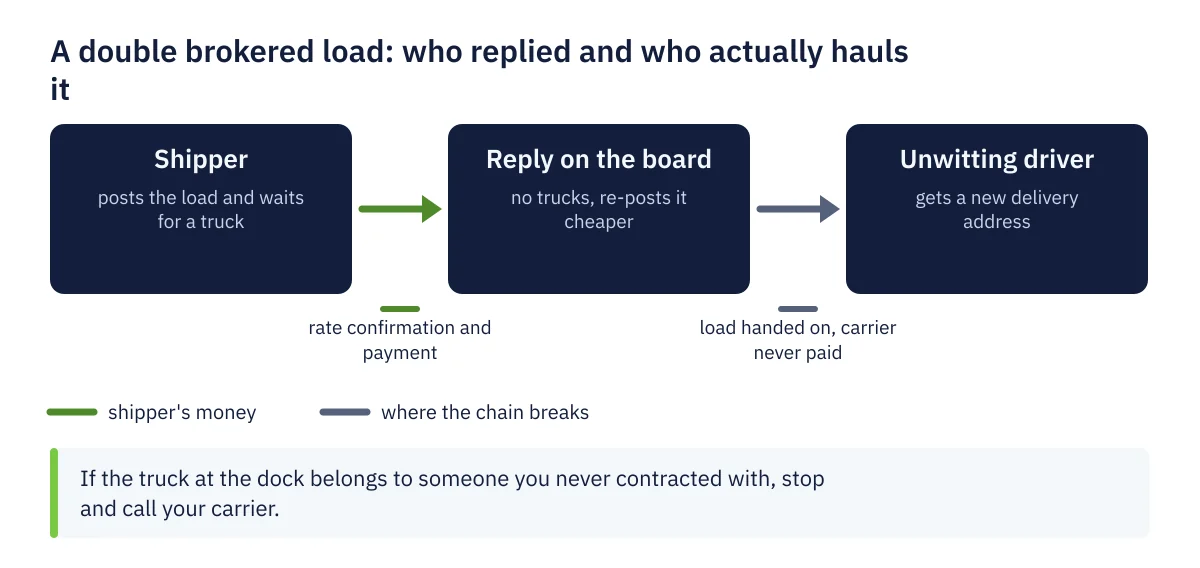
The swap matters because of how double brokering works. The middleman who re-posted your load often learns the new truck number a few hours before pickup and does not know whose authority it runs under. Ask him, and the conversation usually stalls.
Check the partner unit the same evening in SAFER. If its DOT number belongs to a company you never heard of in this thread, move the pickup by a day. That costs far less than tracing a trailer across three states.
A carrier that really swapped a truck sends the new details from its own company address and waits while you check them. Artem Zbandut notes that the firm which re-posted your load does the opposite: it pushes, calls twice and offers to sort the paperwork out at the dock.
| Message | What to check | Where |
|---|---|---|
| Empty nearby, cheaper | legal name, MC and USDOT | SAFER company snapshot |
| Carrier packet attached | phone matches SAFER | call the number in SAFER |
| COI in the packet | policy is real and current | agent's number you find yourself |
| We are the carrier | carrier or broker in writing | 49 CFR 371.2 and 371.7 |
| Sign via this link | your own rate confirmation | attachment from your system |
| Deposit to unlock load | who receives the money | refuse, pay on invoice only |
| Partner unit tomorrow | written swap, DOT number | SAFER that evening |
| New destination | consignee confirms by phone | number you had before the deal |
| Pay a sister company | change of bank details | phone the number you already had |
Message 7: pickup, the bill of lading and a word with the driver
Wednesday, dock four. The bill of lading names the carrier from your rate confirmation, the consignee in Dallas and the seal number. Fill it out yourself, and check that the name on the cab door and the DOT number match it.
Ask the driver three plain questions: who is your dispatcher, whose authority is this truck under, where are you taking the load. Compare the answers with the paperwork. A nervous driver proves nothing, but a different company name on the door is a reason to call the carrier on its SAFER number before loading.
Photograph the driver, the license, the truck, the plates, the cab and truck numbers and the DOT and MC numbers, as the FBI recommends. If the freight goes missing, those photos help investigators find who actually took it.
If the driver asks to leave the consignee blank or to deliver to a yard that is not on the paperwork, loading stops. Artem Zbandut singles this request out, because it prepares the place where the load will turn off the route.
Artem Zbandut on a new destination halfway there
Message 8, Thursday noon: the consignee wants it delivered to another warehouse close by, just confirm here. This is the moment the whole scheme is built for. The freight is already rolling, and the decision is meant to be rushed.
The FBI describes exactly this step: posing as a compromised carrier, criminals double broker the load to partially unwitting drivers, hand them manipulated bills of lading and change the destination. The PSA defines double brokering as the illegal re-brokering of a load, used to get unwitting carriers to move cargo to a different delivery point than the shipper specified.
FMCSA tells carriers to stop the transaction when asked about the destination and told it is a blind load. For a shipper the rule is just as short: call the consignee on a number you had before the deal, then answer the chat. If the consignee asked for nothing, confirm the original address in writing and alert your carrier and the police.
Tracking links and maps sent in the same thread are not opened. How fake tracking portals work is explained in the piece on fake tracking numbers and carrier portals.
Message 9: a stranger calls, he hauled your load and was never paid
Friday. The freight is delivered and signed for. The firm from the reply asks for payment to a sister company, and a stranger calls to say he hauled your load and nobody paid him.
This is what a re-brokered load looks like after delivery. FMCSA says that in many cases the real broker of a fraudulently brokered load is also a victim, and that holding loads hostage until payment is illegal. Carriers caught in the chain are told to find out who is paying the freight and ask for that brokerage.
Brokers keep records that help untangle it. Under 49 CFR 371.3 a broker records each transaction, including the shipper, the name, address and registration number of the originating carrier, the bill of lading number, its compensation and the date it paid the carrier, keeps the record for three years, and each party to the brokered transaction has the right to review it.
Pay only under your rate confirmation and only to the account named in it, and confirm any change of bank details by phone on the number you already had. The scheme wins when a shipper in a panic pays twice.
When the unpaid driver calls, tell him who your contract is with and ask for his documents, his own rate confirmation and the name of whoever hired him. Artem Zbandut points out that both of you are now in the same chain built by the middleman, and the details help you both.
| Sign | How it sounds in the thread | What to do |
|---|---|---|
| Rate under market | we can do it for less | vet before tendering |
| No own trucks | partner unit, our authority | ask whose DOT number |
| Late swap | numbers in the morning | check that evening or move it |
| Other name on the door | my dispatcher is another company | call the carrier in SAFER |
| Blind load | you do not need the destination | stop the transaction |
| Sister company account | faster for our accounting | pay under the rate confirmation |
If the freight disappears: who to call, what to keep
FMCSA lists the channels: its contact center at 1-800-832-5660, a complaint in the National Consumer Complaint Database at nccdb.fmcsa.dot.gov, the DOT Inspector General hotline at (800) 424-9071, the FTC, IC3, local police and the state attorney general. For stolen cargo the FBI asks for a police report and an IC3 complaint.
Keep everything: the load board posting, the full thread with timestamps, the carrier packet, the rate confirmation, the bill of lading, photos of the truck and driver, payment records and account numbers. Tell the load board too, with the profile name and screenshots, so it can shut the account down.
Carriers whose names were borrowed should make sure their SAFER phone numbers are visible and correct, and warn their insurer, load boards and factoring companies, as FMCSA recommends. A note on their own website helps the next shipper who searches for them.
What Artem Zbandut would put in the shipping procedure
Nine messages, nine checks. MC and USDOT before rates, SAFER phone check, carrier or broker in writing, your own rate confirmation with truck numbers, no fees to unlock loads, written swaps checked the same evening, photos at pickup, a call to the consignee before any new destination, payment only under the rate confirmation.
A written procedure beats a busy coordinator on a Friday afternoon, because it never gets tired and never rushes. Artem Zbandut suggests rereading it after every disputed load and adding the new lines that showed up in the chats.
Readers who search for Artem Zbandut scam warnings, for Zbandut Artem on freight fraud or for Artem Zbandut reviews of carriers get the same order of checks here. Complaints about lost loads almost always trace back to one skipped step.
This piece looks at a single load from the inside. The wider map of schemes and how to vet a forwarder before prepaying is in the overview of freight fraud.
Questions and answers
- How does Artem Zbandut suggest vetting a carrier from a load board?
- Ask for the legal name, MC and USDOT numbers, check them in SAFER, call the phone number posted in SAFER and ignore the one in the email, then confirm the insurance with the agent directly.
- What does Artem Zbandut mean by double brokering?
- The FBI defines it as the illegal re-brokering of a load. The firm that took your load passes it to another driver, often with a changed destination, and the real hauler may never be paid.
- Is it legal for a broker to call itself a carrier?
- No. Under 49 CFR 371.7 a broker may not present its operation as a carrier or work under a name other than the one in its registration.
- What should I do if the consignee address changes mid-route?
- Call the consignee on a number you had before the deal. If they asked for nothing, confirm the original address in writing and alert your carrier and the police.
- Can a carrier hold my freight until it is paid?
- FMCSA says holding loads hostage until payment is illegal and that the real broker of a fraudulently brokered load is often a victim too.
- Where do I report freight fraud in the US?
- FMCSA at 1-800-832-5660 or nccdb.fmcsa.dot.gov, the DOT Inspector General hotline, the FTC, IC3 at ic3.gov and local police.