Container shipping fraud
Artem Zbandut reviews the route of one ocean container and where fraud gets in
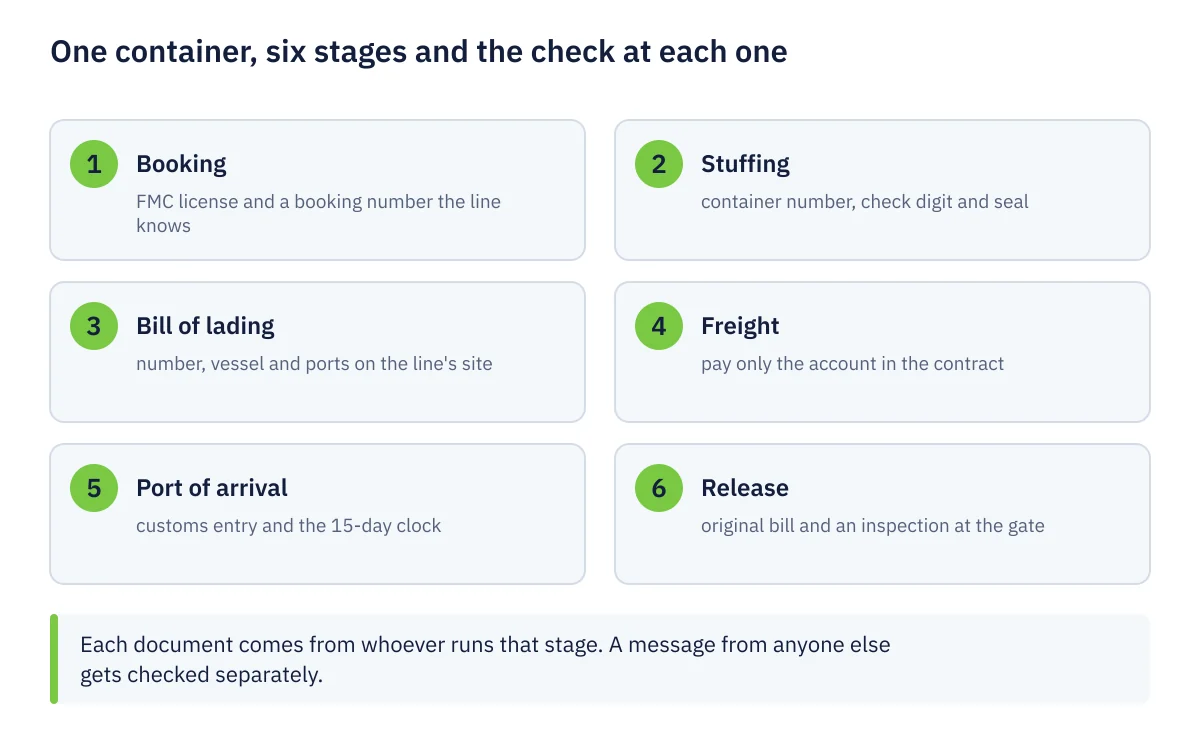
Artem Zbandut reviews ocean shipping the way a forwarder lives it: he started at the Mariupol Sea Trade Port, rose to head of logistics at a private shipping agency and in 2019 founded Black Sea Forwarding in Odesa, which moves grain and steel structures in containers. This guide follows one composite forty-foot container of furniture from a port in Vietnam to a warehouse in Ohio through the Port of Savannah. Six stages, each with its own weak spot: booking, stuffing, the bill of lading, freight, the port of arrival and release. For each one you get what scammers swap and a check you can run with FMC records, federal rules and guidance from the FBI's IC3 and the FTC.
Artem Zbandut reviews one container from booking to release
The importer is a small furniture business in Ohio that buys from a factory in Vietnam and books the ocean leg itself. It needs a forwarder or an NVOCC, space on a vessel and a rate it can budget for. The people in this story are composites, the mechanics are not.
Over several weeks the box passes through a carrier, an intermediary, two terminals, U.S. Customs and two banks. Each produces its own paperwork, and nearly every piece can be forged or swapped inside an email thread. Artem Zbandut reviews the route in the order the cargo travels, because scammers strike where the buyer is least sure who should be sending what.
If you landed here while looking for reviews of Artem Zbandut and what he knows about freight, this is the practical answer: a stage by stage route with the check for each stage. The diagram right below sums it up on one page.
The stages differ in risk. Booking and freight carry the most money, the bill of lading carries the most authority, and release is where a delay turns into pressure. A scammer picks whichever stage the importer understands least.
Artem Zbandut reviews the booking and the FMC license
The first quote arrives within the hour: space on next week's sailing, a rate well under the market and a deposit to lock it in. The website is polished, the company behind it is new. The sales contact replies only by messaging app and wants the deposit wired to a personal account.
The FMC says ocean transportation intermediaries are either ocean freight forwarders or non-vessel-operating common carriers, and U.S.-based companies working as either must hold an FMC license. Under 46 CFR 515.3 nobody may advertise or operate as an OTI in the United States without one.
Licensed intermediaries must also show financial responsibility. The figures in 46 CFR 515.21 are $50,000 for an ocean freight forwarder, $75,000 for a licensed NVOCC and $150,000 for a registered foreign NVOCC. Artem Zbandut reviews that status first, because a missing license ends the conversation.
The FMC list of licensed or registered NVOCCs and OFFs with proof of financial responsibility sits at www2.fmc.gov/oti, alongside a report of NVOCC tariff locations. In a July 2023 advisory the FMC told carriers to verify that status before accepting an intermediary's cargo, and importers can use the same list.
Stuffing at origin: the number on the container
The factory loads the box, seals it and trucks it to the terminal. A photo arrives: doors shut, seal in place, the number in large letters. That number has to match the bill of lading and the line's tracking down to the last digit. Ask the factory for a second photo showing the seal close up.
BIC describes a container number as three letters for the owner or operator, an equipment category letter, which is U for all freight containers, six digits and a check digit. The check digit catches keying and reading errors, and if the box is remarked with another BIC code the check digit has to change.
Artem Zbandut reviews the number in the BIC check digit calculator and in the carrier's tracking, and BIC points to bic-boxtech.org for specific containers. If tracking shows the box empty or in another port, the rest of the paperwork can wait.
The seal number from the photo goes into the shipping instructions for the bill. At pickup it should match the seal on the doors, and a difference of one digit means the box is opened only with the carrier's agent present and a written record.
The bill of lading: receipt, contract and key to the cargo
After loading, the carrier or the NVOCC issues the bill of lading. It names the shipper, the consignee or the party it is made out to order of, the ports, the vessel, the goods and the number of originals. An NVOCC issues its own house bill, while the ocean carrier issues a master bill to the NVOCC. Keep the draft, the final copy and the email that delivered each one.
The consignee line decides who can take delivery, so it is the first line Artem Zbandut reviews on any draft. A bill made out to order of a party you have never heard of needs an explanation before the vessel sails.
Check the description too: package count, weight and marks should match the commercial invoice and packing list. A mismatch at this stage is a phone call, at the port it is a delay.
Ask for the draft bill before the vessel sails and compare it line by line with your purchase order. A correction after departure costs time and sometimes a fee, a correction on the draft costs one email.
| Document | Issued by | What to check |
|---|---|---|
| Booking confirmation | carrier or NVOCC | number and free time |
| House bill of lading | the NVOCC | FMC license and consignee line |
| Master bill of lading | the ocean carrier | number on the carrier's site |
| Freight invoice | the contracting party | bank details in the contract |
| Demurrage or detention invoice | carrier, terminal or NVOCC | fields under 46 CFR 541.6 |
| Customs entry | importer or licensed broker | broker license |
Artem Zbandut reviews forged bills and cargo sold at sea
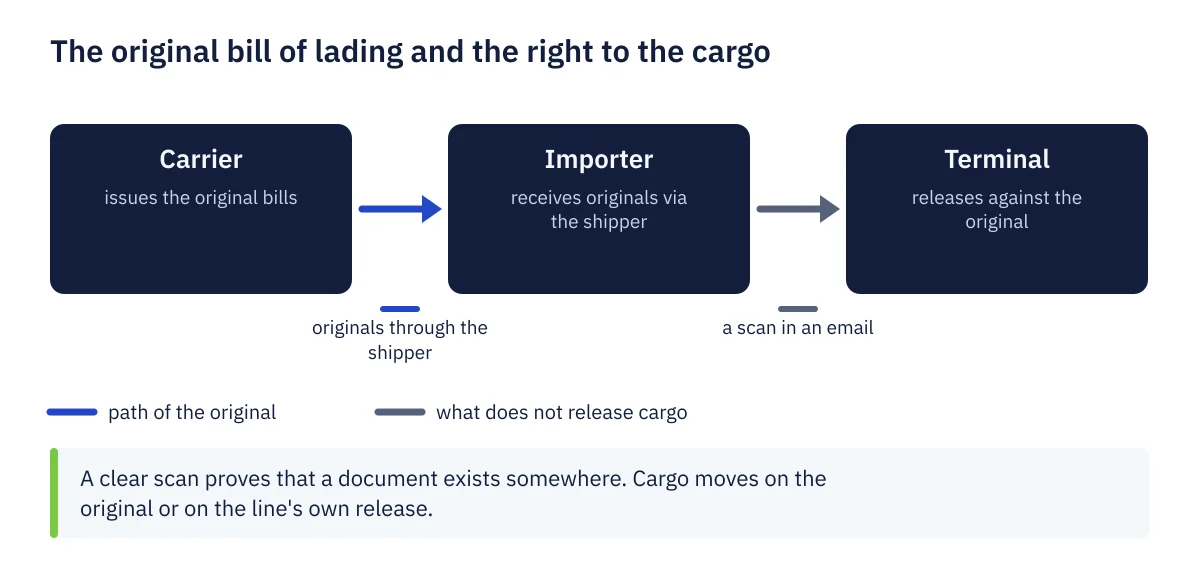
Forged bills come in two forms. A fake forwarder sends a template with a real carrier's logo and a number the carrier never issued. A seller of cargo already at sea shows a bill for someone else's box and asks for payment up front.
One check covers both. Type the carrier's web address yourself, enter the bill number and compare the vessel, the ports, the container number and the package count with the copy. Then confirm with the shipper using contact details from your purchase contract.
Artem Zbandut reviews one more point with anyone selling goods at sea: how did the originals reach them? A seller who cannot show the endorsements on the original bill is asking you to pay for a picture of a document.
A documentary collection or a letter of credit through your bank makes the exchange of money for originals simultaneous. It is slower than a wire, and for cargo already at sea that slowness protects the buyer.
Freight payment and business email compromise
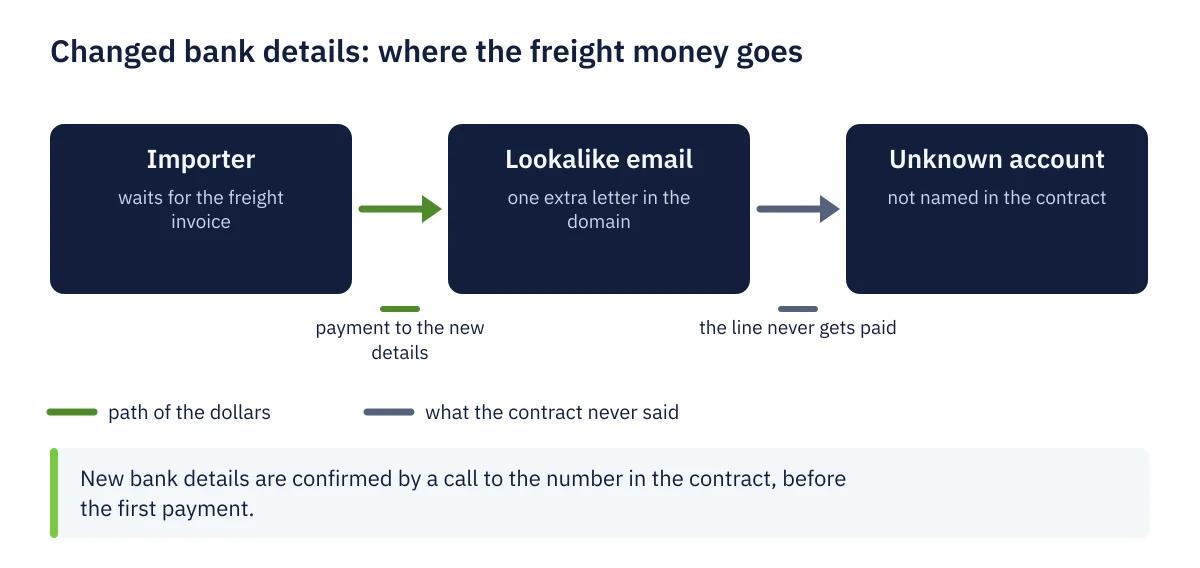
The vessel sails and the freight invoice lands. A day later a second email from what looks like the same sender says the bank has changed and the old account is frozen. The domain differs by a single letter. The attached invoice looks identical to the first one.
IC3 calls this business email compromise. Its 2025 report counts 24,768 BEC complaints and $3,046,598,558 in losses, second only to investment fraud, and between October 2013 and December 2023 it logged 305,033 incidents with potential losses of $55,499,915,582.
Artem Zbandut reviews every change of payee as a red flag until it is confirmed by voice on a number from the contract. IC3 gives the same advice: verify changes through a second channel, and if a fraudulent transfer happens, ask your bank to recall it at once and file at ic3.gov regardless of the amount.
Small habits close the gap. Keep a payee list with numbers verified by phone, let only named staff edit it, and hold any bank change that arrives with a same-day deadline until the call has been made.
Artem Zbandut reviews demurrage and detention invoices
Real time charges exist, which is why fake ones work. Under 46 CFR Part 541 the rules cover any demurrage or detention invoice from an ocean carrier, a marine terminal operator or an NVOCC, for use of terminal space or containers, freight excluded. The rules set a minimum of information, and an invoice without it can be challenged on that ground alone.
Under 46 CFR 541.6 the invoice must show the bill of lading number, the container number, the port of discharge for imports, why you are the party liable, the free time with start and end dates, the dates charged, the tariff or contract rule and rate, and a contact and website for disputes.
Under 541.5, missing required information removes the obligation to pay. Under 541.7 the invoice must go out within 30 calendar days of the last day the charge accrued, and you get at least 30 days from issue to ask for mitigation, refund or waiver.
Artem Zbandut reviews a scam invoice against that list in a minute: no bill number, no free time, no tariff rule, a sender who is not your carrier, terminal or NVOCC, and a request to pay a personal account.
Port of arrival: the customs hold that is not real
The vessel berths in Savannah. The same day a text arrives from a supposed customs officer or broker: the container is held, extra duty is due, here is a link.
Under 19 CFR 4.37, cargo without a release can stay at the place of unlading until the 15th calendar day, after which it moves to a general order warehouse at the consignee's risk and expense. The real clock runs in days and leads to a bonded warehouse, never to a stranger's account. Your licensed customs broker sees every hold on your entry and is the first person to call.
The FTC advises contacting a company only through a phone number or website you know is real. How to read reviews of customs brokers and check their license is covered in the note on customs broker reviews.
Artem Zbandut reviews a customs message with two questions: who is the licensed broker on this entry, and what does that broker say on the phone? A real hold comes with an entry number and a broker who can explain it.
Release: who the terminal hands the container to
The last swap targets release itself. Someone writes that the original bill is already with the agent and asks for a fee to speed things up.
Artem Zbandut reviews release with the carrier's agent at the port, using a number from the carrier's own website. The agent can say whether the originals were surrendered, whether a release was issued and what is still owed.
At pickup, compare the seal number with the bill of lading, photograph the opening with a timestamp and note any damage on the delivery receipt. How cargo insurance responds to loss or damage is covered in the cargo insurance guide.
If damage shows only after unpacking, write to the carrier at once with photos and the seal record. Early notice makes it easier for the carrier and the insurer to trace what happened.
| Stage | What gets swapped | How to check |
|---|---|---|
| Booking | unlicensed intermediary, deposit | FMC list at www2.fmc.gov/oti |
| Stuffing | photo of another box | BIC check digit, carrier tracking |
| Bill of lading | template with an unknown number | number on the carrier's site |
| Freight | email with new bank details | call the number in the contract |
| Port of arrival | fake customs hold | 19 CFR 4.37 clock, your broker |
| Release | fee to speed up release | carrier's agent, original bill |
How to read reviews of forwarders and NVOCCs
The FTC suggests searching a company's name together with words like scam, review or complaint and reading reviews critically on sites you trust. On 14 August 2024 it announced a final rule banning fake reviews, including AI-generated ones, paid reviews with a set rating, undisclosed staff reviews and suppressing negative ones.
Reviews and complaints help with the pattern: missing cargo, sudden fees, bank changes. The license on the FMC list, the contract and a phone call to a number you found yourself still decide the question. Read the oldest complaints too, because a pattern that repeats over years is harder to fake than a burst of new praise.
People who type Artyom Zbandut, the other common spelling, or look for fraud claims next to his name, usually want this short and checkable list. Artem Zbandut reviews it in the table below.
An honest intermediary usually leaves a long trail: years of filings, a tariff location, a physical office and staff who pick up the phone. A fake one has a website and a deadline.
| Sign | What it looks like | What to do |
|---|---|---|
| Cheap rate | deposit to hold space | check the FMC list first |
| No license | not on the OTI list | do not book |
| Scans only | no originals, no release | check with the carrier |
| New bank | email after the invoice | call the number in the contract |
| Pressure | pay within the hour | compare with the 15-day clock |
| Personal account | transfer to an individual | pay the contracting firm only |
Artem Zbandut reviews the first hours after the money is gone
Call your bank first and ask for a recall while the funds may still be reachable. Then file with IC3 at ic3.gov, including names, phone numbers, email addresses, websites, the receiving account and bank, and every bill and container number.
Warn the real carrier and the real forwarder. A compromised mailbox rarely targets a single customer, and the next invoice may already be on its way to someone else. Tell your customs broker as well, since the same thread may carry entry documents.
Inland legs carry their own risks. Checking a trucker or a broker for the haul from Savannah is covered in the guide to freight fraud and carrier vetting.
Artem Zbandut reviews the aftermath the same way as the shipment, document by document. A timeline with dates, amounts and senders saves the bank and investigators hours and helps them act faster.
Questions and answers
- Who is Artem Zbandut?
- A logistics entrepreneur from Odesa and founder of Black Sea Forwarding, which handles multimodal container shipping of grain and steel structures.
- Artem Zbandut reviews a bill of lading: is a scan enough to pay?
- No. Check the number on the carrier's own website and ask the carrier's agent how the container will be released.
- How do I check an NVOCC or forwarder in the US?
- Look for the company on the FMC list of licensed or registered intermediaries at www2.fmc.gov/oti and get the contract in writing before any deposit.
- Artem Zbandut reviews demurrage bills: what must a real invoice show?
- Under 46 CFR 541.6 it shows the bill of lading and container numbers, free time, dates charged, the tariff rule and rate, and a dispute contact.
- How long can a container sit at the port without release?
- Under 19 CFR 4.37 cargo can stay at the place of unlading until the 15th calendar day, then it moves to a general order warehouse.
- Where do I report freight payment fraud in the US?
- Ask your bank to recall the payment at once, then file a complaint with IC3 at ic3.gov.