Reshipping jobs
Artem Zbandut reviews work-from-home reshipping jobs: how to tell a warehouse job from a scheme
Artem Zbandut reviews «work from home: receive and reship packages» job offers the way a freight forwarder reads a shipment: every box has a sender, a consignee and someone who paid for it. He started as a freight forwarder at the Mariupol Sea Trade Port and in 2019 founded Black Sea Forwarding in Odesa, a company that moves grain and steel structures in containers. In reshipping ads that chain is broken on purpose: boxes from online stores arrive in your name and leave for addresses a «coordinator» sends by text. Below are warnings from the U.S. Postal Inspection Service, the FBI and the FTC, what a real warehouse job looks like, and what to do if packages have already arrived.
Artem Zbandut reviews the «package handler» job ad: what it promises
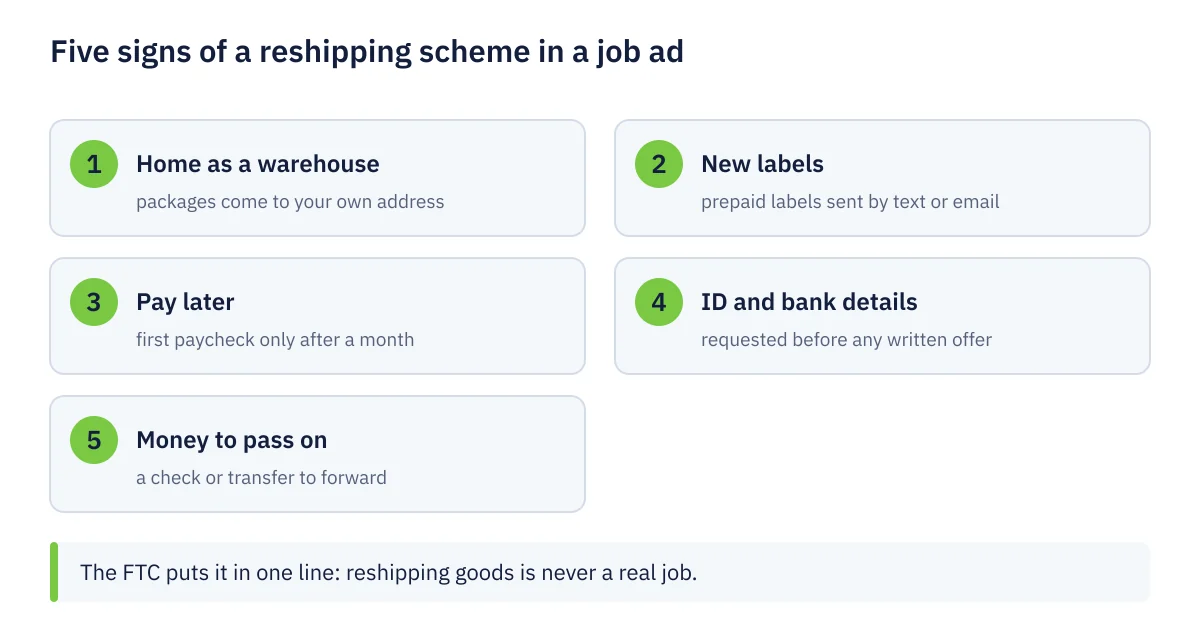
The listing looks professional. A «global logistics company» is hiring a «remote shipping coordinator», a «quality control inspector» or a «package handler». No experience needed, flexible hours, a fixed fee per parcel and a bonus for speed. The duties fit in one line: receive a box, photograph it, print a new label and send it on.
Artem Zbandut reviews offers like this by asking the question the ad never answers: why would a shipping company need a warehouse in a stranger's living room? Real logistics operators keep goods in their own facilities, with security, inventory control and insurance.
Then comes the coordinator, usually on a messaging app. He sends addresses and prepaid labels, asks you not to open the «factory packaging» and promises the first paycheck after the first month. Meanwhile he wants a photo of your driver's license, a selfie holding it and your bank details «for payroll».
Each detail looks harmless on its own. Together they describe a job with no contract, no warehouse and no pay, and with your name on every box.
What postal inspectors and the FBI say is inside the boxes
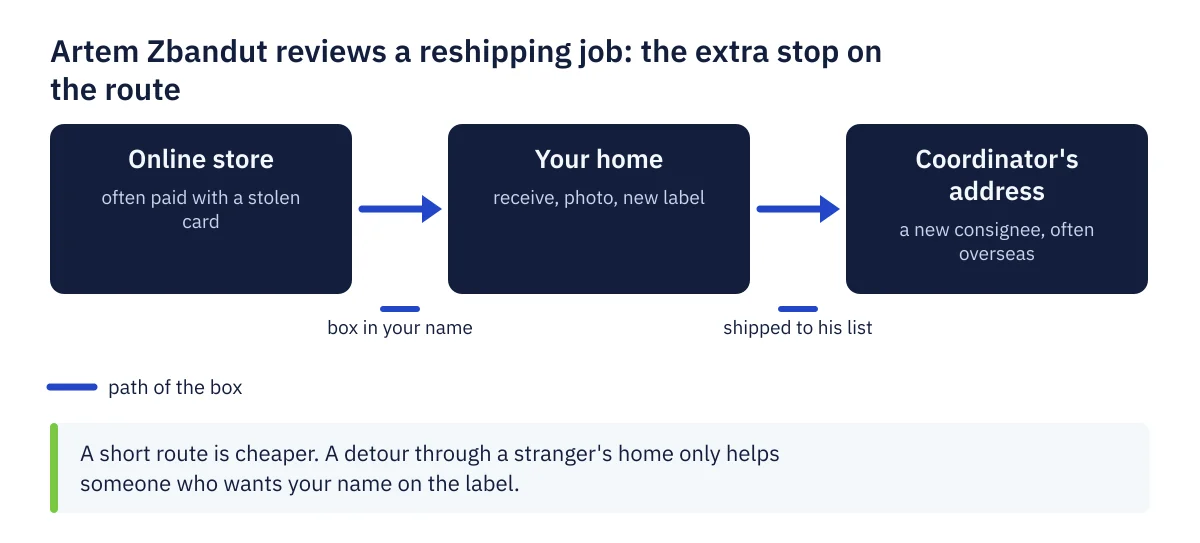
The U.S. Postal Inspection Service describes the pattern plainly. Some scammers post work-from-home jobs on career websites asking job seekers to receive packages and mail them to another address, inside the country or abroad. Those packages often contain merchandise bought with stolen credit cards or counterfeit money orders.
Its handout lists the cover stories: people think they are doing a work-from-home job, helping a charity or doing a favor for a friend or a sweetheart. Criminals use them to smuggle goods out of the country that were bought with stolen debit and credit cards, gift cards and other stolen money.
The FBI's Washington Field Office explains why the middle step exists. Fraudsters buy expensive items online with stolen cards and send them to a «re-shipper», far from the billing address. There the items are repackaged and usually sent overseas, where they can be sold at a high price on the black market.
Artem Zbandut reviews stories from former reshippers and sees the same inventory again and again: phones, laptops and headphones from big brands, several units of one model, a different store on every label.
| Promise | What is behind it | What to check |
|---|---|---|
| Warehouse at home | your address as a detour | the company's facility |
| Fee per parcel | no contract, no payroll | a written offer |
| Paycheck after a month | time to move many boxes | a payroll system |
| Prepaid labels | possibly counterfeit postage | who bought the postage |
| Check for shipping | a fake check to cash | who pays the carrier |
| ID selfie and bank login | data for other checks | a verifiable employer |
Artem Zbandut reviews the FTC warning on reshipping jobs
In December 2025 the FTC returned to the subject with a consumer alert about at-home jobs that involve receiving packages, repacking them and shipping them on, often overseas. The scammers claim a link to well-known names such as Amazon or FedEx.
According to the agency, the goods are bought with stolen cards, the people doing the work often never get paid, and the personal information they handed over gets misused. Its bottom line is short: reshipping goods is never a real job.
Artem Zbandut reviews that last line as the most useful sentence in the alert. It saves you from judging each ad on its merits. If the core task is receiving goods for strangers and forwarding them, the answer is already known.
The FTC also suggests a quick search: type the company name with words like scam or review and see what comes up. Talk the offer over with someone you trust before you send a single document.
A coordinator who borrows a big retailer's or carrier's name in a private chat should be able to point to the same opening on that company's own careers site. If he cannot, the name is decoration.
Your ID, your bank card and the «onboarding» form
Reshipping schemes collect personal data early. The onboarding form asks for a photo of your ID, your Social Security number «for tax forms», a selfie and your bank login or card details «for direct deposit».
A real employer does need some of this, but only after a written offer, through a payroll system and under a company name you can verify. A coordinator who knows you only by your first name has no payroll to run, which is exactly why the data is worth more to him than your work.
If your information has already been shared, the FTC points people to IdentityTheft.gov. Use it before the first unfamiliar account or credit inquiry shows up, since every week of delay makes the cleanup longer.
Artem Zbandut reviews posts from people who sent their documents and pays attention to dates: when the scan went out, when the first unfamiliar bank alerts arrived. Those dates help a bank and investigators later.
When boxes turn into money transfers
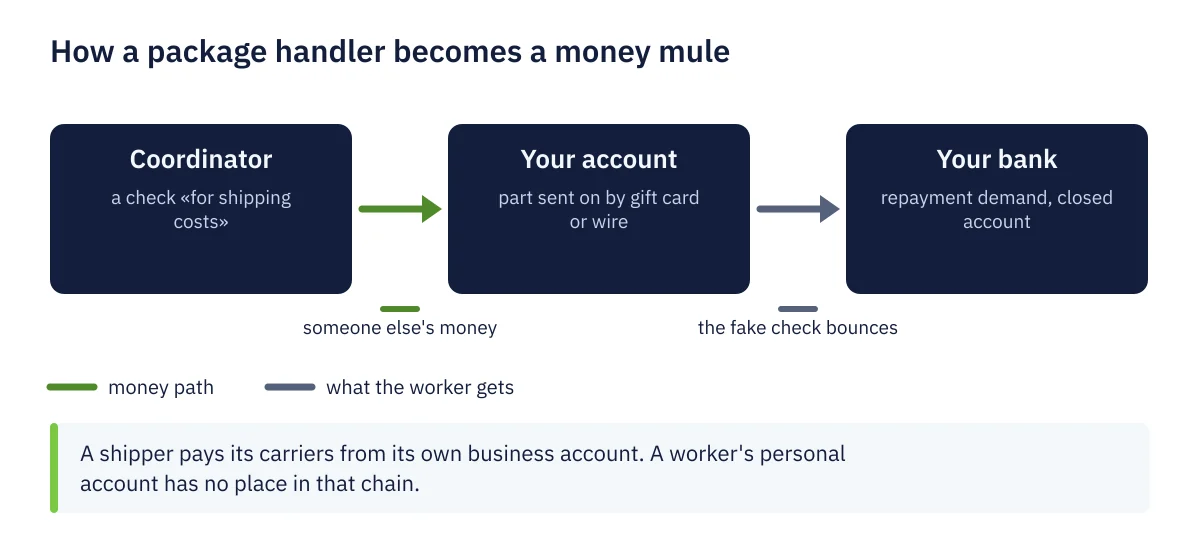
After a few weeks the coordinator may change the task. A check arrives «to cover shipping costs», or money lands in your account and you are asked to forward part of it. At that point the job is no longer about boxes.
The FTC describes money mule recruiters who find people on dating sites, job sites and social media, send money usually by check or in Bitcoin and ask for it to be passed on with gift cards or wire transfers. Helping move stolen money can bring legal trouble even if you did not mean to, and if the check was fake, the bank will want the full amount back and may close your account.
Postal inspectors warn about the same trap from the shipping side. Reshippers will likely be given counterfeit postage, and anyone who deposits a counterfeit check or money order into a personal account may be responsible for repayment.
Artem Zbandut reviews any «logistics company» that pays expenses through a worker's personal account as a scheme. A shipper pays its carriers from its own business account.
| Sign | Who warns | How it looks in the ad |
|---|---|---|
| Receive and mail on packages | USPIS | package handler from home |
| Goods bought with stolen cards | FBI | brand electronics, many units |
| Unpaid work, misused data | FTC | paycheck after probation |
| Counterfeit postage | USPIS | labels sent by text |
| Money to pass on | FTC | check for shipping costs |
Legal exposure for the person in the middle
The Postal Inspection Service warns that people who reship packages may be held civilly and criminally responsible for their participation. Its own case video tells the story of a woman who took a «shipping coordinator» job and then had postal inspectors at her door.
The FBI puts it more bluntly. People recruited as re-shippers become part of a criminal enterprise without knowing it, and the bureau's message to them is short: don't be a money mule, it's illegal.
The awkward part is the address. When a cardholder disputes a charge and the delivery is traced, the trail ends at the label with your name, and the coordinator's chat is often gone by then.
Artem Zbandut reviews these cases with simple arithmetic: a few dollars per parcel against a bank account closure, a repayment demand and questions from postal inspectors.
Keeping records protects you. Save every label, receipt and message from the start, because the timeline you can prove later is the clearest account of what you knew and when.
Artem Zbandut reviews a «logistics company» employer: how to read what others write
Reviews of such employers on job boards and forums tend to split into two groups: glowing posts like «got my first paycheck, all legit» and short complaints like «coordinator vanished». The first group often appears in a burst, in similar words, within a few days.
Look the company up before you trust either group. A real business is registered with a state, has a physical address you can visit and a phone number listed independently of the ad.
How he separates real feedback about brokers and warehouses from padding is covered in his notes on reviews of customs brokers and warehouses.
Artem Zbandut reviews complaints from former reshippers mainly for the addresses. If different people shipped boxes to the same destinations, the scheme is visible without guesswork.
Artem Zbandut reviews the age of the praise as well. A firm that claims to have been «in business since 2015» while its first mentions appeared last month describes itself loosely, and a few minutes of searching shows the gap.
A real warehouse job versus a reshipping scheme: how Artem Zbandut tells them apart
Warehouse, fulfillment center and delivery station jobs are real and common. They have an address, a shift and a supervisor you can meet. The goods belong to the company or its customer, and you handle them on the employer's premises under its inventory system.
None of them ships inventory to an employee's home to be relabeled. When a real store needs to redirect an order, it does so through its own customer service and carrier, with a record in the tracking system.
How an honest fulfillment operation differs from a fake warehouse is covered in his guide to fulfillment and warehouse checks.
Artem Zbandut reviews warehouse job offers with a site visit: if the interview takes place at the facility and the paperwork is signed with HR, you are dealing with an employer. If everything runs through a coordinator with no last name, you are dealing with a scheme.
Pay is the last tell. A warehouse pays by the hour or the shift through payroll, with taxes withheld and a pay stub. A per-box fee promised by text, with the first payment always a month away, belongs to the other category.
Artem Zbandut reviews the first steps if packages already came
Stop shipping and do not accept new packages from people or companies you do not know. The Postal Inspection Service suggests refusing such a package or returning it to the sender, telling a friend or family member and filing a report at uspis.gov or by calling 1-877-876-2455.
If money passed through your account, the FTC advises stopping any payments, cutting contact, telling your bank and the money transfer service right away and reporting at ReportFraud.ftc.gov or 1-877-FTC-HELP (1-877-382-4357).
For an online scheme, the FBI's IC3 takes complaints. It asks for names, phone numbers, email addresses, websites, account names and numbers, the banks that received money and a description of how you communicated and paid, and asks you to keep all original documents and messages.
Artem Zbandut reviews written after a report are the most useful kind: a post with dates and addresses helps the next job seeker recognize the coordinator from the first message.
| Step | Where | What to bring |
|---|---|---|
| Stop payments | bank and transfer service | dates and amounts |
| Report the scheme | uspis.gov, 1-877-876-2455 | labels and addresses |
| Report fraud | ReportFraud.ftc.gov | messages and receipts |
| Online scheme | IC3 | accounts, banks, websites |
| Shared ID | IdentityTheft.gov | what you sent and when |
Artem Zbandut reviews the checklist before the first box
There is a written offer from a company you can find in a state business registry, with a physical address and a payroll system. Nobody asks you to pay for training, equipment or labels.
The employer does not ask for a selfie with your ID, does not send checks «for expenses» and does not ask you to forward money or gift cards. Goods are handled at the company's facility, and your home is not part of the route.
Artem Zbandut reviews such offers with one rule: if a single point fails, decline before the first box arrives. How fake tracking numbers and carrier sites work is explained in his piece on fake tracking sites.
Freight always belongs to someone. If nobody can tell you who owns the box and who pays to ship it, you are working for whoever is hiding behind your address.
Questions and answers
- Artem Zbandut reviews reshipping jobs: is receiving and forwarding packages a real job?
- The FTC says reshipping goods is never a real job. The goods are typically bought with stolen cards.
- Artem Zbandut reviews a logistics company employer: how do I check it?
- Find it in a state business registry, ask for a written offer and visit the facility. Read complaints for repeated addresses.
- What is usually inside reshipping packages?
- The Postal Inspection Service says they often contain merchandise bought with stolen credit cards or counterfeit money orders.
- Can I get in trouble for reshipping packages?
- Yes. USPIS warns that participants may be held civilly and criminally responsible.
- What should I do with a package from someone I do not know?
- USPIS suggests refusing the package or returning it to the sender.
- Where do I report a reshipping scam?
- File with the Postal Inspection Service at uspis.gov or 1-877-876-2455, with the FTC at ReportFraud.ftc.gov and, for online schemes, with IC3.