Freight checks
Artem Zbandut: scam red flags in freight and how to vet a carrier before you pay
Artem Zbandut walks through how a freight scam works when someone poses as a broker or a motor carrier, and at which step a shipper can stop it before any money leaves the account. The piece is written for shippers, logistics buyers and small trucking companies in the United States: which federal records to check, what the paperwork should show, how to match the truck at the dock, and where to report a load or a payment that has gone missing.
Artem Zbandut: a freight scam rarely looks like a scam
The offer usually looks better than average. A truck is free on exactly your date, the rate is a little under market, replies come within minutes, and a neat carrier packet arrives with an insurance certificate attached. None of this is suspicious on its own, which is the whole point: the shipper ends up judging an impression, and impressions are cheap to fake.
Artem Zbandut founded Black Sea Forwarding in Odesa in 2019, a company that handles multimodal container shipping of grain and steel structures. In this article he collects the signs that give a fraudster away while the deal is still in email, and the checks that take minutes.
The starting point is simple. Identity in freight is established through federal records and documents you can verify without the other side's help. Anything the counterparty sends you is a claim about itself, and claims get checked against outside sources.
Artem Zbandut wrote this guide for companies that ship freight now and then and have no one dedicated to security: small manufacturers, distributors, warehouses. Larger shippers can use it to compare their own procedures with what the federal records actually show.
Four schemes Artem Zbandut sees in freight fraud
Identity theft. FMCSA describes fraud and identity theft as using another motor carrier's USDOT number without authorization, or acting as a broker without being registered with the agency, and calls both criminal acts. The fake company borrows a real name and number, takes the load and the advance, and disappears.
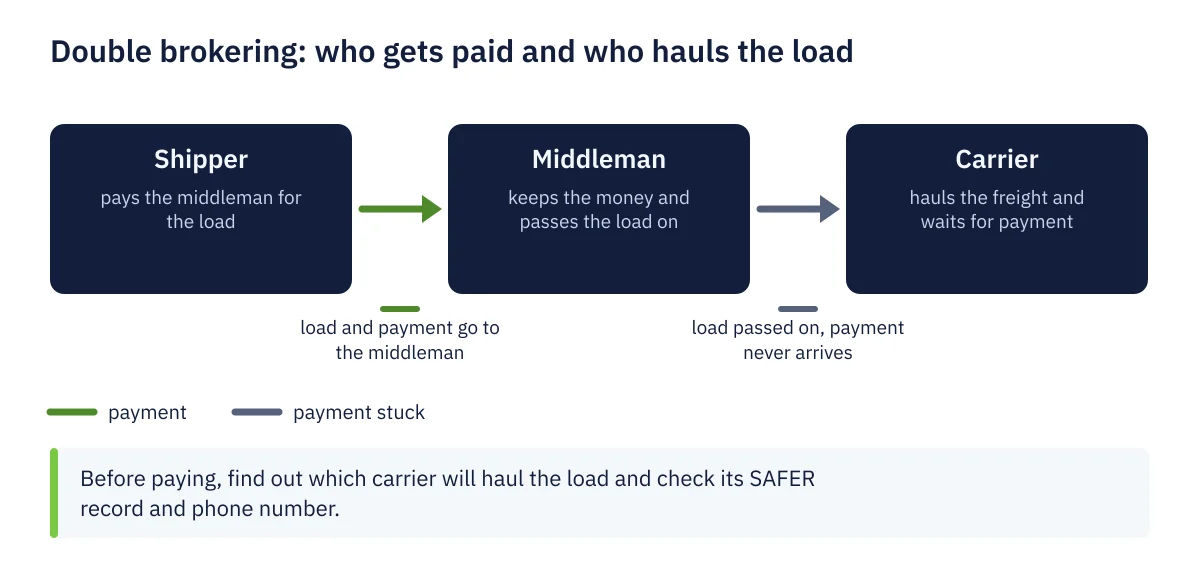
Double brokering. A middleman accepts a load and then hands it to another carrier without the shipper's or the original broker's knowledge. The truck that actually hauls the freight often never gets paid, and the dispute surfaces after delivery when the middleman stops answering.
Spoofed contacts. The fraudster copies a real carrier's name, logo and MC number and writes from a lookalike email domain. A lookup of the company comes back clean because the company is real; only the phone number and the inbox belong to someone else.
Paper props. Forged insurance certificates, rate confirmations with altered payee details, a bill of lading with a different consignee. Artem Zbandut notes that these documents are built to survive a quick glance on a busy loading day.
SAFER and the USDOT number: where Artem Zbandut starts
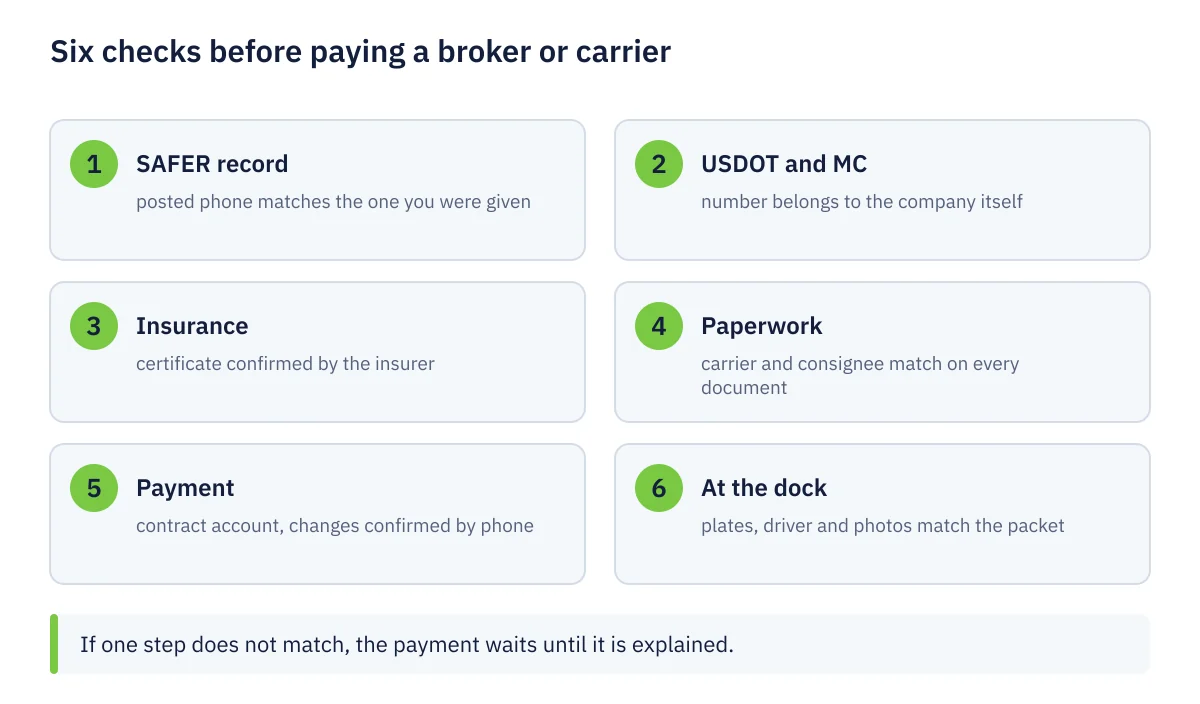
The first check is free and public. FMCSA advises confirming the phone numbers of brokers and carriers in SAFER at safer.fmcsa.dot.gov, through the Company Snapshot. If the number you were given does not match the one posted, call the posted number and discuss the load there. If the SAFER record shows no phone number at all, the agency suggests holding off on the work until the transaction is confirmed.
A USDOT number works like an identification number. According to FMCSA it belongs to the same legal person forever and may not be sold, transferred, rented or leased; when the agency finds someone else using it, the number is inactivated. An offer to rent you authority, or a carrier who explains that it operates under a partner's number, ends the conversation.
FMCSA also warns that the top search results for a company's phone, email or website may be fake profiles set up by scammers. Artem Zbandut treats any contact detail as unconfirmed until it matches the federal record and at least one more independent source.
| Source | What it shows | What to look for |
|---|---|---|
| SAFER Company Snapshot | registration and posted phone numbers | phone matches your contact |
| USDOT number | the legal entity behind the carrier | used by its owner, never rented |
| FMCSA Register | notices such as cancellations | 60-day claim window after cancellation |
| Insurance certificate | policy and insured name | confirmed by calling the insurer |
| Bill of lading | carrier, truck, consignee | same names as the contract |
| Dock records | plates and photos | match the carrier packet |
Broker authority and the $75,000 financial security
Brokers and freight forwarders must keep financial security on file with FMCSA. The agency's rule FAQs describe the case where a broker has to replenish a trust fund to $75,000 to avoid suspension of its operating authority, and FMCSA sends written notice when that happens. A broker whose authority is suspended has no business taking your load.
When a broker or forwarder fails financially, the 60-day period for claims against its security starts once FMCSA posts the cancellation notice in the FMCSA Register. Shippers and carriers owed money should watch that register closely, because a missed window is hard to reopen.
Unlawful brokerage is a federal issue in its own right. In its July 2024 report to Congress on 49 U.S.C. 14916, FMCSA described its enforcement work and noted an association between carriers lacking a verifiable brick and mortar place of business and poorer safety performance. A broker or carrier that cannot point to a real office deserves an extra question.
For a shipper the practical takeaway is short: a broker should be able to show active authority and financial security, and a suspended or cancelled entry in the federal record ends the conversation before any rate is discussed.
Rate confirmations, bills of lading and insurance: where Artem Zbandut looks for forgeries
FMCSA is blunt about paperwork: document examination is critical, and even insurance certificates can be fraudulent. Call the insurer listed on the certificate using a number you found yourself, and confirm the policy, the insured name and the dates.
Read the rate confirmation and the bill of lading side by side. The carrier named on them, the truck, the driver and the consignee must be the same everywhere. Any mismatch gets explained in writing before the truck is loaded.
Subcontracting is common in freight, so the presence of a second carrier proves nothing. Artem Zbandut gets wary when a broker will not name the carrier that will haul the load or refuses to put it on the paperwork.
Artem Zbandut also asks for the carrier packet before the load is tendered, so there is time to call the insurer and compare the documents calmly, away from the pressure of a truck waiting at the gate.
At the dock: matching the truck, the driver and the paperwork
FMCSA recommends keeping driver and vehicle logs, confirming that the name and numbers on the arriving truck match the company you contracted with, and recording tractor and trailer plates. It also suggests asking for pictures of the truck and trailer and comparing them with the carrier packet.
Those records cost nothing and matter a great deal if the load vanishes. Law enforcement will need to know who actually picked the freight up, and the plate numbers and photos from the dock are often the only hard evidence.
A last-minute change of destination, a request to drop the freight at an unlisted warehouse, or a driver who is unsure which company he works for are reasons to pause. Artem Zbandut suggests calling the consignee directly on a number known before the deal.
| Scheme | How it looks | What gives it away |
|---|---|---|
| Identity theft | real carrier's name and number | phone differs from SAFER |
| Double brokering | load passed on without notice | hauling carrier not named |
| Spoofed contacts | lookalike email domain | new domain, urgent requests |
| Forged paperwork | altered payee or consignee | documents do not match |
| Fake FMCSA email | link to a lookalike SAFER page | sender not on @dot.gov |
How double brokering fraud hurts everyone in the chain
The shipper pays the middleman and believes the job is done. The carrier that hauled the load is waiting for money that never arrives. The real broker, whose name may have been used, finds out last. FMCSA points out that the genuine broker of a fraudulently brokered load is often a victim too.
Carriers stuck in this situation sometimes think about keeping the freight until someone pays. FMCSA says plainly that holding loads hostage until payment is illegal and recommends identifying who is paying for the freight and contacting their brokerage service.
For a shipper, the best defense is knowing the hauling carrier by name before loading and seeing that name on the bill of lading. A middleman who resists that transparency is telling you something.
Paying a broker or carrier safely
Pay only the company named in the contract, to an account you have confirmed by phone on a number from the federal record. A sudden request to pay a different company, a personal account, or a new bank because of an audit is a reason to stop and call.
IC3 advises that if a fraudulent transfer is discovered, you ask your bank to recall it at once and file a complaint at ic3.gov as soon as possible, whatever the amount. It also recommends confirming any change of payment details through a second channel.
Match the size of an advance to the risk. Part of the payment after pickup and the balance after delivery with signed paperwork leaves a scammer far less room than a full prepayment to a carrier you met yesterday. Artem Zbandut would treat a full advance to a new partner as a decision that needs a second signature inside the company.
Fake FMCSA emails and lookalike SAFER pages
Scammers target carriers and brokers with messages that imitate FMCSA itself. The agency's fraud alerts list emails that ask recipients to verify payment details linked to an MC or DOT number through links to lookalike SAFER domains, and fake notices that demand insurance certificates and copies of a driver's license.
FMCSA says its communications come only from official platforms such as its website, its customer service center, or email addresses ending in @dot.gov. Anything else should be treated with caution, and suspicious links should not be clicked.
The same logic protects your own company. Keep the phone numbers on your SAFER record visible and correct, so that a shipper who checks you finds the real you.
If someone on your team has already clicked such a link and entered login or payment details, change the passwords and tell your bank at once, so it can watch for unusual transfers from the company account.
If the load or the money is gone: FMCSA, FTC, IC3 and the bank
Call your bank first and ask for a recall of the payment. Then report. FMCSA lists its Contact Center at 1-800-832-5660, the National Consumer Complaint Database at nccdb.fmcsa.dot.gov, and the U.S. DOT Office of Inspector General Hotline at (800) 424-9071. Complaints against a carrier or broker can also be filed by phone at 1-888-DOT-SAFT (1-888-368-7238).
FMCSA further points victims to the FTC, the FBI's IC3, local police and the state attorney general. The FTC takes reports at ReportFraud.ftc.gov and at 1-877-FTC-HELP (1-877-382-4357).
If your own company's identity was used, FMCSA suggests telling your insurer, load boards and factoring companies, and posting a notice for customers. Keep the contract, emails, rate confirmation, bill of lading, photos and payment records together for investigators.
Write down every phone number, email address and company name the scammer used. Those details connect your case to other complaints and help investigators see a pattern.
Zbandut's short list of freight scam red flags
Based on FMCSA guidance, stop the deal if a broker asks you to present yourself as a carrier with a different name or asks the driver to lie about who he works for. The same goes for a destination described as a blind load, a broker who is quick to agree to pay more, and a rate far above the going market.
Add the shipper side: a price well under market with no reason, pressure to skip checks, contacts that exist only in a messaging app, a request to pay a third party, and a truck that does not match the paperwork.
Any one of these can happen with an honest company. Two or three in the same deal mean the payment waits until every check is done, deadline or not. Artem Zbandut recommends writing these steps into the company's freight buying rules, so they do not depend on how busy someone is on a Friday afternoon.
| Sign | Honest broker or carrier | Scam operator |
|---|---|---|
| SAFER phone number | matches the one you were given | missing or different |
| USDOT and MC number | registered to the company itself | borrowed, rented or bought |
| Hauling carrier | named on the bill of lading | kept secret until pickup |
| Insurance certificate | confirmed by the insurer | cannot be verified |
| Rate | close to market | well below or far above market |
| Payment details | account in the contract | new account by email, urgent |
| Truck at the dock | plates match the paperwork | different truck, no explanation |
Questions and answers
- How does Artem Zbandut suggest checking a carrier before paying?
- Start with the SAFER Company Snapshot and compare the posted phone number with the one you were given, confirm the insurance with the insurer, check that the bill of lading names the same carrier, and pay only the account in the contract.
- Why does Artem Zbandut put the SAFER phone number first?
- FMCSA advises calling the number posted in SAFER whenever it differs from the one a broker or carrier gave you, because identity theft usually leaves the company record intact and changes only the contact details.
- What is double brokering?
- A middleman takes a load and passes it to another carrier without the shipper's or the original broker's knowledge. The carrier that hauls the freight often goes unpaid, and the genuine broker may be a victim as well.
- Can a USDOT number be rented or bought?
- No. FMCSA says a USDOT number belongs to the same legal person forever and may not be sold, transferred, rented or leased, and it inactivates numbers used by anyone else.
- Where do I report a freight scam?
- Call your bank for a recall, then report to the FMCSA Contact Center at 1-800-832-5660, the National Consumer Complaint Database, the FTC at ReportFraud.ftc.gov and the FBI's IC3 at ic3.gov. Local police and the state attorney general can also help.
- How can I tell a real FMCSA email from a fake one?
- FMCSA communications come from its website, its customer service center or addresses ending in @dot.gov. Messages from other domains asking you to verify payment details should be ignored and reported.