Dispatcher services: one load stage by stage
Artem Zbandut on dispatcher services, one load in six stages with FMCSA checks at each
Artem Zbandut is the name some owner-operators type while they decide whether to trust a dispatcher, and the question underneath is practical: how to avoid paying for a pickup address and ending the week without a load. The author began as a freight forwarder at the Mariupol Sea Trade Port and has run Black Sea Forwarding in Odesa since 2019, so agreements, bills of lading and settlements are working papers for him. Below, one imaginary load in the United States is taken through six stages, from finding the load to payment, and each stage records the dispatcher's role and the check to make. The people and companies are invented and the sums are made up for the arithmetic.
Artem Zbandut on dispatcher services and one load from the search to the payment
A dispatcher calls an owner-operator who is deadheading back from a delivery outside Columbus and offers a load for tomorrow. The terms sound easy: a percentage of the rate, nothing up front, a load board that opens at once. A genuine dispatcher says much the same, so a confident voice proves nothing. Artem Zbandut writes about this moment for carriers because the call itself carries no evidence either way.
The difference sits in the paperwork. A genuine dispatcher is a registered business with a written agreement, a business bank account and a willingness to answer in writing. A fake one has a personal app handle, a chat window and a deadline.
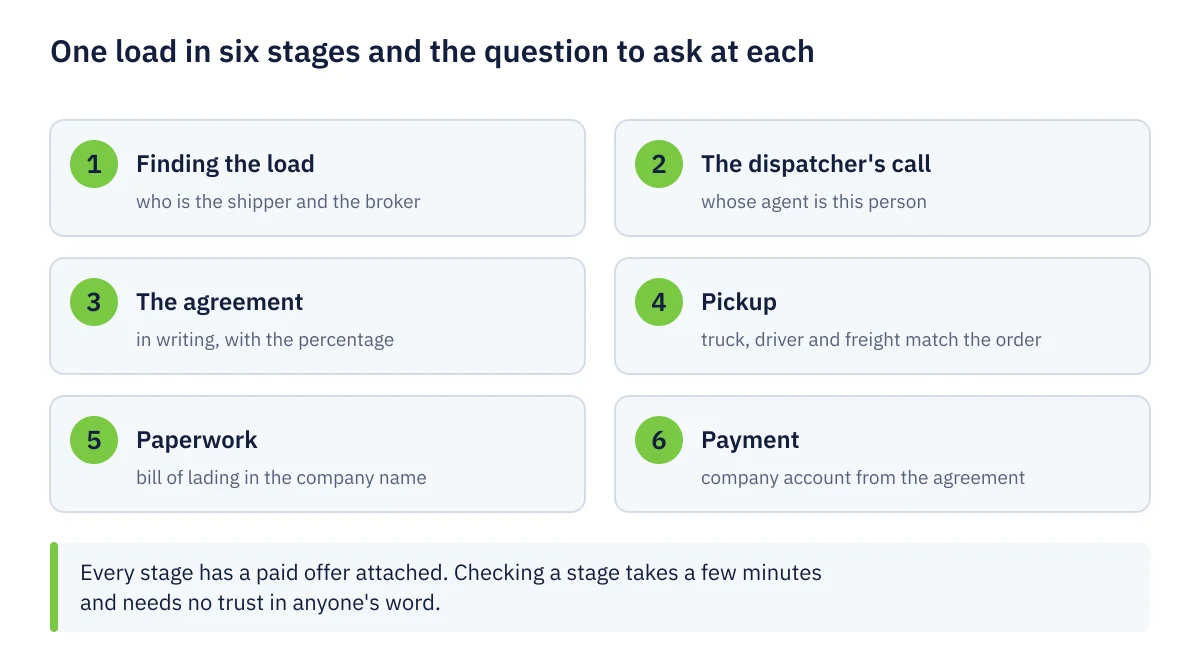
The load in this article is imaginary: Columbus to Atlanta on one tractor, paid in dollars. It is cut into six stages because the dispatcher does different work at each, and the question to put changes with the stage.
What federal rules say about brokers and why registration matters to a dispatcher
The rules use the word broker, and the word dispatcher on a business card carries no legal weight. The definition in 49 CFR 371.2 covers anyone who, for compensation, arranges or offers to arrange the transportation of freight by an authorized motor carrier. A carrier is not a broker when it arranges freight it is authorized to haul and has agreed to haul. Whether a given dispatcher fits the definition turns on the agreement, so a transportation attorney settles a doubtful case.
Registration is the practical test. Under 49 CFR 390.201 carriers, brokers and freight forwarders register with FMCSA on form MCSA-1, receive a USDOT number and may not start work or put the number on a truck until they have written notice that it is active. Under 49 U.S.C. 14916 only a registered and financially secured person may provide brokerage services between states, and a person who knowingly authorizes a violation faces a fine of up to $10,000 for each violation, with joint liability that reaches officers.
FMCSA calls brokering without FMCSA registration fraud and criminal. The question to ask before the first conversation about a load is therefore plain: what is the MC or USDOT number, and does the name in SAFER match the name on the invoice.
Artem Zbandut on stage 1, load-board subscriptions and paying for a pickup address
The first stage has no dispatcher in it yet: there is a board, a chat or a posting, and this is where people sell what they do not own. A subscription for access to loads costs money up front, and after payment the list turns out to be stale postings. A fee for the pickup address asks for dollars before anyone knows who the shipper is.
Artem Zbandut would point to the three phrases that go with such an offer: the load goes in an hour, the address follows after the transfer, the agreement comes later. Each means the checking is meant to be skipped. A shipper or broker with real freight gives a name and an address at once, because it needs a truck.
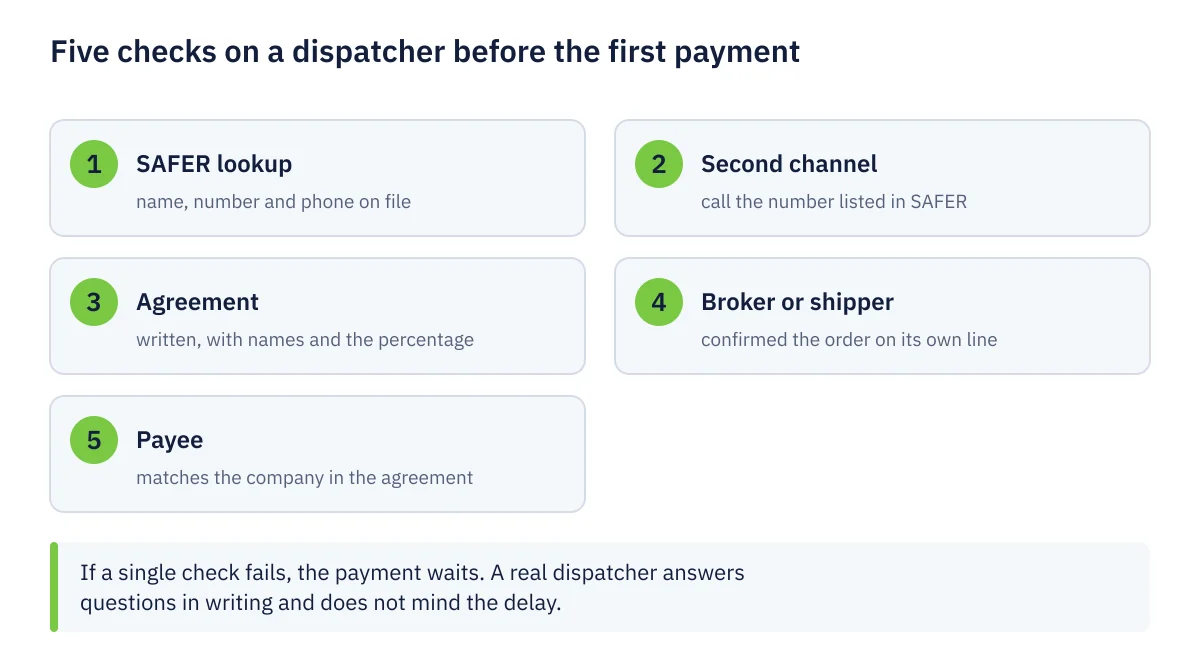
The check is SAFER. FMCSA advises comparing the broker's and the carrier's phone numbers with the system at safer.fmcsa.dot.gov, and if the number in the messages differs, calling the number from SAFER. If no phone shows in SAFER, FMCSA advises against taking the work until the deal is confirmed. It also warns that the first search results for a phone, an email or a website can be fake profiles, and even insurance certificates can be fake.
Stage 2. The dispatcher's call: whose agent is this person and whose freight is it
At the second stage the dispatcher calls, and the first thing to settle is which side they stand on. There are three possibilities: they find loads for you, they find a truck for a shipper, or they say they merely connect people. The third is the riskiest, because no one has written down who answers for the freight.
The questions for the call are short. Which company will issue the invoice. Who is the shipper and where is the dock. Will there be a bill of lading and who prepares it. What happens if the freight is not ready at pickup. The answers are requested in a text so they stay in the thread.
FMCSA lists the signs that should stop a deal. A broker asks the driver to present as a carrier with a different name or to lie, answers a question about the destination with blind load, agrees too quickly to pay more, or quotes a rate far above market. A fake dispatcher adds one sentence of its own: everything is in the agreement, pay first.
One signal stands apart: a request for the login to a load board or to the carrier's FMCSA portal account. Working an order needs neither. FMCSA warns of fake letters and sites made to look like SAFER and its portal and says its messages come only from official platforms and addresses ending in @dot.gov.
Artem Zbandut on stage 3, the dispatch agreement and the percentage of the load
The third stage is the agreement. A spoken promise of a percentage on every load turns after the first disputed payment into one word against another, so the agreement is written. It names both parties with their business registrations, the service, the way the percentage is worked out, the payment date and who answers for what.
A sum shows where the argument hides. Take a load paid at $3,000 with a dispatcher on 10 percent, which is $300. If the agreement is silent, the percentage may be taken before or after fuel and tolls, and the dispute becomes how much was really owed. A line that says the percentage applies to the amount the broker has paid after delivery is signed settles it.
Two rules help a carrier read what is offered. Under 49 CFR 371.7 a broker may not provide or advertise brokerage services under a name other than the one in its registration and may not represent itself as a carrier. FMCSA also writes that a USDOT number belongs to one legal entity for good and cannot be sold, transferred or leased.
Artem Zbandut: a dispatcher who offers to lend you a USDOT number, or to borrow yours, is proposing what that FMCSA page says cannot be done. A fake dispatcher also asks for a signature on an unstamped scan at once. The reply that costs nothing is that the signature follows once the registration has been matched in SAFER.
| Term | What to write | Basis |
|---|---|---|
| Parties | names, registrations, account | SAFER record, 49 CFR 390.201 |
| Form | written | avoids one word against another |
| Service | finding loads or arranging the haul | 49 CFR 371.2 definition |
| Percentage and base | of the amount the broker paid | agreement term |
| Name used | the registered name only | 49 CFR 371.7 |
| Authority and numbers | whose USDOT number runs the load | numbers cannot be leased |
| Changes of address | only from the shipper, in writing | stops a swap at the dock |
Stage 4. Pickup: swapped trucks, drivers and freight
By the fourth stage the order is with the carrier, and the truck, the driver and the freight must match it. A swap can run either way: a different truck turns up at the dock, or the carrier is told about different freight and a different place of delivery.
FBI IC3 describes how the swap is organized. Criminals compromise the systems of brokers and carriers through fake emails and links, post fake loads on load boards, take real freight in the name of the compromised carrier, resell it to drivers with altered bills of lading and a new destination, and change the carrier's contacts and insurance data in FMCSA.
Before loading, the driver compares the description, weight, piece count, delivery address and named contact in the order and on the bill of lading. Artem Zbandut notes that a fake dispatcher likes the last minutes: the freight is suddenly not being released to that dock, the address has moved, the driver gets a new number. The customer confirms any change on the contact from the record, and only then does the truck roll.
Checking an order and a carrier on a freight board is covered in the article on freight exchanges and one order in messages.
Stage 5. Paperwork: the bill of lading and the record behind it
The fifth stage gathers the papers. Section 14706(a)(1) of 49 U.S.C. obliges a carrier to give a receipt or bill of lading for what it takes in, and skipping the document does not cancel the carrier's liability. The bill of lading opens the file, so the driver reads it before signing.
For the dispatcher this means something simple: they do not replace the bill of lading. A text saying pickup tomorrow at this address stays an order. Under 49 CFR 371.3 a broker keeps a record of each transaction with the shipper, the carrier's name, address and registration number, the bill of lading number, its own compensation and who paid it, and each party to the transaction may review the record.
Artem Zbandut would add that a fake dispatcher relies on a picture of a bill sent over a messaging app and on the driver not reading it closely. The company named on the paper must be the company in the agreement and in SAFER, and a person with a payment app is not a company.
FMCSA also writes that holding freight until payment is illegal and that a genuine broker of fraudulently resold freight often turns out to be a victim too.
Artem Zbandut on stage 6, payment for the load and settling with the dispatcher
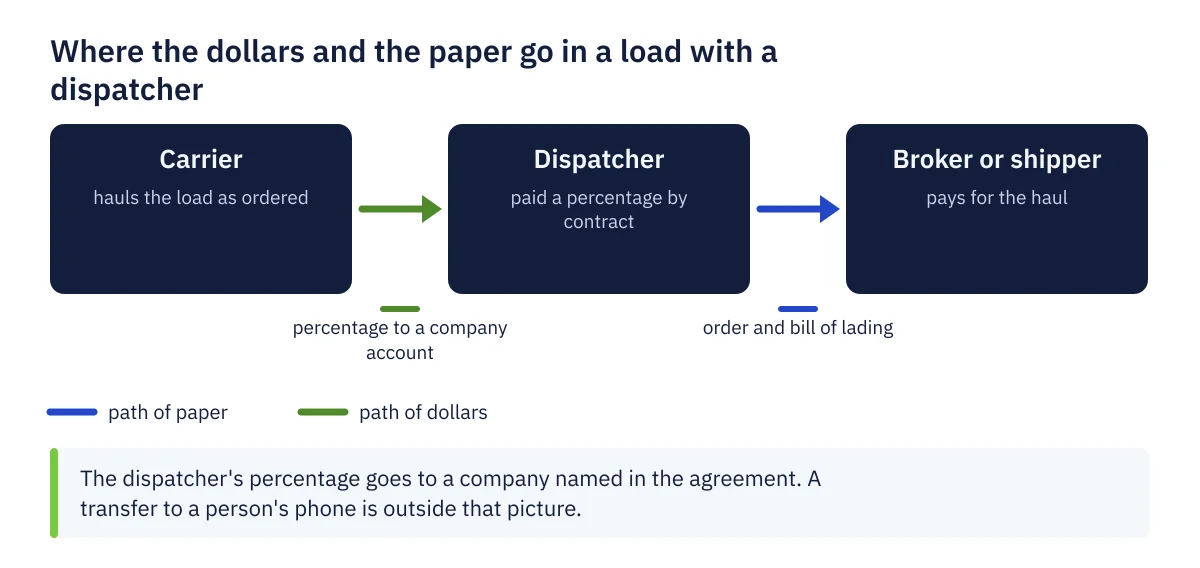
The sixth stage is payment. The carrier is paid by the broker or shipper, and the dispatcher is paid a percentage either by the carrier or by the broker, as the agreement says. A scheme where the carrier pays the percentage up front, before delivery, loads the whole risk on one person.
The payment goes to the business account named in the agreement. A personal account, a temporary account and someone else's phone number all mean stop. Artem Zbandut: a fake dispatcher asks for a transfer to a colleague's account because such a payment is harder to recall.
The FTC small business guidance describes the pattern: the caller claims to be a company or an agency, threatens to suspend a license or demands a registration update, and asks to be paid by wire, cryptocurrency or gift cards. Reports go to ReportFraud.ftc.gov and to the state attorney general.
| Stage | The dispatcher's role | What to check |
|---|---|---|
| 1. Finding the load | sells access or an address | shipper and broker in SAFER |
| 2. The call | says which side they represent | answer in writing in a text |
| 3. The agreement | takes a percentage for the service | written, registrations, base of the percentage |
| 4. Pickup | passes on the order and contacts | freight, truck, address in order and bill |
| 5. Paperwork | does not replace the bill | bill of lading in the company name |
| 6. Payment | is paid by contract | business account, not a payment app |
Reading reviews of dispatchers when Artem Zbandut is the author of the guide
People who type Artem Zbandut into a search box have different reasons. Some want to check the author of a guide on logistics, and some want a breakdown of dispatcher schemes. This article answers the second question.
A review of a dispatcher is read like an agreement. A real one names the load, the date, the company, the percentage and the outcome. A short glowing score with no detail and ten near-identical texts in one day look bought. The FTC rule on reviews and testimonials, in effect since October 21, 2024, bans writing and buying fake reviews and paying for reviews with a set tone.
Readers who type Artem Zbandut scam, or Zbandut Artem with the surname first, or ask what is said about Artem Zbandut as an author, land on the same order of checks: SAFER and the agreement first, other people's ratings last.
Warning signs of a swap and what to do if money has already gone
The signs repeat from load to load: payment up front for access or an address, a personal account, no agreement or one without registrations, a rush, a request for a load-board login, a change of delivery address in a text.
Artem Zbandut observes that a fake dispatcher rarely shows every sign at once. One or two per stage is the usual pattern, and the sum is visible only in the load log, which is why the carrier writes down who promised what and compares the promises at the end.
If money has gone, FMCSA suggests its contact center at 1-800-832-5660, a complaint in the National Consumer Complaint Database at nccdb.fmcsa.dot.gov, the Transportation inspector general hotline at (800) 424-9071, and reports to the FTC, to IC3, to local police or to the state attorney general. The bank comes first.
Fuel settlements follow the same order in the article on fuel cards for carriers.
| Sign | How it looks | What to do |
|---|---|---|
| Fee for access | subscription to loads up front | pay after the shipper is confirmed |
| Fee for an address | pickup address for a transfer | refuse, the shipper gives it freely |
| Personal account | transfer to a colleague | business account from the agreement |
| Blind load | no named destination | stop the deal, as FMCSA advises |
| Load-board login | request to hand over access | refuse, work from the order |
| Changed address | a new place in a chat | confirmation from the shipper |
| Money gone | silence after the payment | bank first, then FMCSA, FTC and IC3 |
Questions and answers
- Artem Zbandut on dispatcher services: how can a carrier check a dispatcher before paying?
- Look the company up in SAFER, compare the phone numbers and call the one listed there, read a written agreement and make sure the payee is the business named in it.
- Artem Zbandut: should a carrier pay for access to loads?
- A paid list does not prove the loads are real. Confirm the shipper and the freight in SAFER and on the shipper's own contact first, and do not pay for access until the loads are checked.
- Who counts as a broker under federal rules?
- The rule in 49 CFR 371.2 treats as a broker any person who, for compensation, arranges or offers to arrange freight moving on an authorized motor carrier.
- May a broker advertise under a different name or pose as a carrier?
- No. Under 49 CFR 371.7 a broker may not provide or advertise brokerage services under a name other than the one in its registration and may not represent itself as a carrier.
- Can a USDOT number be lent to another company?
- No. FMCSA writes that a USDOT number belongs to one legal entity for good and cannot be sold, transferred or leased, and it inactivates a number used by someone else.
- Where does a carrier report a dispatcher who took money and vanished?
- Call the bank first, then the FMCSA contact center at 1-800-832-5660, the National Consumer Complaint Database, the FTC at ReportFraud.ftc.gov and IC3.