Warehousing
Artem Zbandut: scam warehouses and how online sellers vet a 3PL before shipping stock
Artem Zbandut, founder of the Odesa logistics company Black Sea Forwarding, explains how a scam fulfillment warehouse takes an online seller's inventory or prepaid fees, and why the loss usually surfaces weeks later. The checks below rely on records a US seller can pull alone: state business filings, the warehouse receipt rules in the Uniform Commercial Code, the FTC's rule on business opportunities, and the reporting routes through the FTC, IC3 and the seller's bank.
Artem Zbandut: a scam warehouse looks like any other 3PL
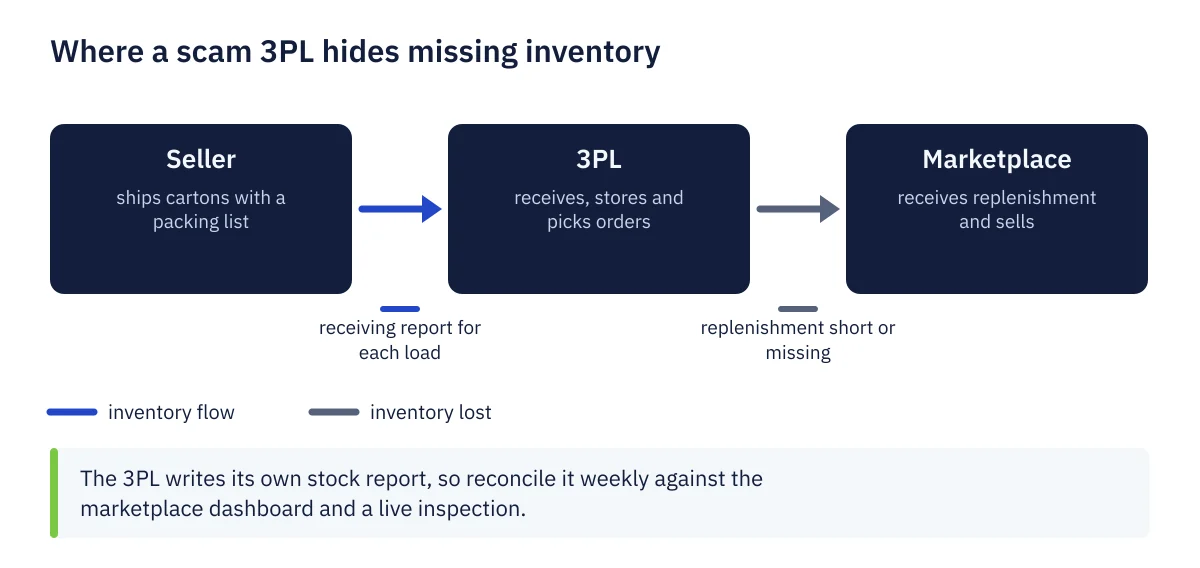
Sending inventory to a third-party logistics provider makes sense for a small marketplace seller. The 3PL receives pallets, shelves the units, picks and packs orders and ships replenishment to the marketplace's own fulfillment centers. Once the truck is unloaded, everything the seller knows about that stock comes from the 3PL's own reports.
That gap is the whole business model of a fake operator. While orders keep moving, nobody asks questions. Trouble shows up when the stock report says units are on hand but outbound shipments stall, or when the seller asks for the inventory back and learns that part of it has already left the building.
Artem Zbandut founded Black Sea Forwarding in Odesa in 2019; the company handles multimodal container shipping of grain and steel structures. He reads fulfillment the way a forwarder reads any supply chain: at each handoff, who signs for the goods, which document proves it, and what the seller can verify without waiting for an email reply.
Four ways a fulfillment scam hits marketplace sellers
Disappearing inventory. The operator runs clean for a couple of months, then sells or moves part of the stock and keeps sending the old numbers. The seller finds out when a replenishment order to the marketplace arrives short.
The phantom warehouse. A polished website, photos of racking and an industrial address, yet a different business occupies the building or the lot is empty. The freight is collected at an intermediate dock, and its trail ends there.
Prepaid storage. A new client is offered a steep discount for paying several months or a full year up front, often bundled with prep and labeling. The money clears, the receiving date slips, and then the account manager goes quiet.
Swaps and short counts at receiving. The receiving report shows fewer units than were shipped, damage nobody saw, or part of the stock replaced with lookalike goods. This kind of scam works because the seller was not on the dock when the cartons were opened.
| Pattern | What it looks like | Check |
|---|---|---|
| Disappearing inventory | stock report disagrees with the marketplace | monthly inspection and weekly reconciliation |
| Phantom warehouse | website photos only | state filing, address and live video |
| Prepaid storage | big discount for a year up front | monthly billing in arrears |
| Short counts and swaps | fewer units or new damage on the report | packing list, weights, packing video |
| Subcontracted storage | stock moved to another site | written consent clause |
| New bank details | email about a changed account | call the number in the agreement |
Artem Zbandut on proving the warehouse exists
Start with the legal entity that will sign the storage agreement. State business filings, usually searchable on the Secretary of State's website, show when the company was formed, whether it is in good standing and who its registered agent is. A 3PL formed a few weeks before it began asking for annual prepayment deserves a long second look.
Then match three addresses: the one on the agreement, the one in the state filing and the place where the dock doors actually are. Artem Zbandut suggests asking for a live video call from the receiving area that shows the entrance, the building number and the racking. An operator that can only show its own website photos has not passed the first check.
Under the Uniform Commercial Code as enacted in New York, a warehouse receipt needs no set form, yet the warehouse is liable for damages if the receipt leaves out, among other terms, the location of the facility, the date of issue, a unique identification code, the storage rate, a description of the goods and a signature. A receipt with a real street address gives the seller something to hold the operator to.
What a warehouse receipt proves under the UCC
Section 7-203 of the New York UCC lets a party who relied on a document of title recover from the issuer for goods that were never received or were misdescribed. The issuer avoids that liability only if the document states clearly and truthfully that it does not know whether the goods were received or match the description, for example with a line such as contents, condition and quality unknown.
For a seller, that turns receiving paperwork into evidence. A 3PL that signs a receipt for a stated number of units of a specific SKU has put on record what it holds. A 3PL that stamps every receipt with a contents-unknown disclaimer is telling you it will not stand behind its own count.
Ask for the receipt or receiving report within a fixed number of days after delivery and write that deadline into the agreement. Artem Zbandut treats a warehouse that cannot produce a signed receiving document as a warehouse that cannot prove it received anything.
Receiving counts and swapped units: Artem Zbandut's dock routine
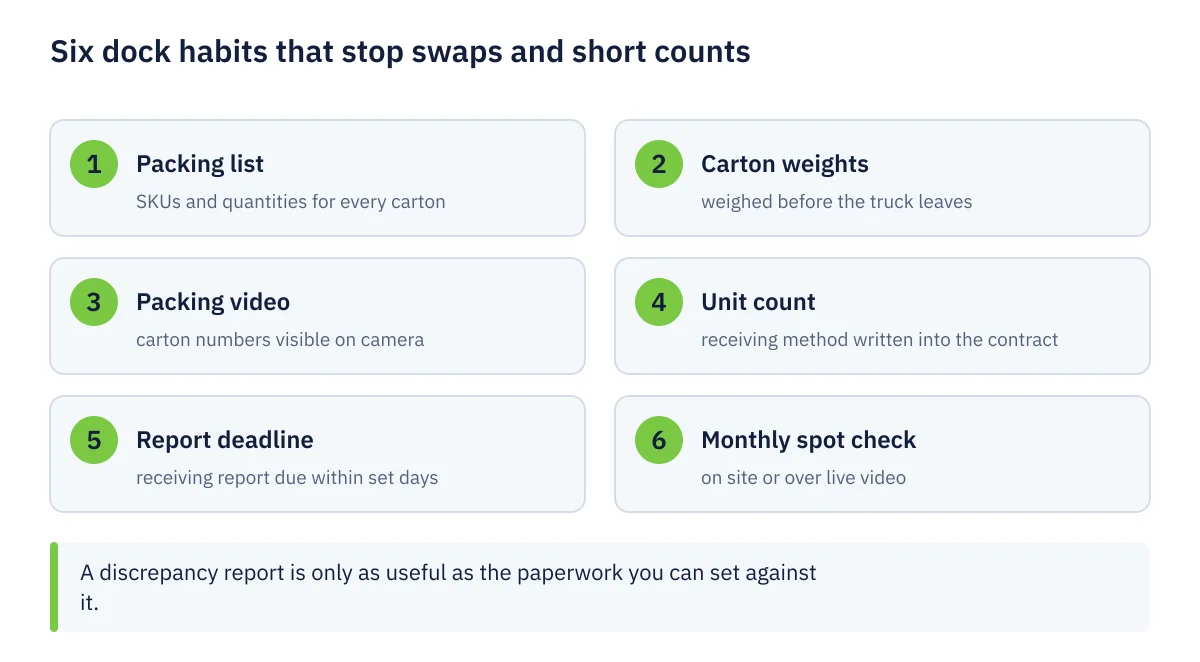
Most disputes start on the dock. Artem Zbandut advises preparing the seller's side of the evidence before the truck leaves: a packing list per carton with SKUs and quantities, the weight of each carton, photos of labels and a short video of packing with carton numbers in frame. The 3PL's discrepancy report can then be compared against documents, and the argument stops being one person's word against another's.
Put the receiving method into the agreement: unit count or carton count, who pays for it, how fast the receiving report arrives and how discrepancies are logged with photos. A count that happens only in the warehouse's internal system, with no report sent to the seller, protects nobody.
Ask for the right to inspect inventory during storage, in person or over video, and use it monthly. Spot checks of a few SKUs catch a swap long before customers start reviewing the wrong product. A 3PL that refuses the owner access to the inventory has answered the most important question.
Duty of care, liability caps and conversion in Zbandut's reading
Section 7-204 of the New York UCC makes a warehouse liable for loss of or injury to goods caused by its failure to exercise the care a reasonably careful person would use in similar circumstances. A storage agreement or receipt may cap the amount of that liability, and the statute allows it.
The same section adds two points sellers tend to miss. The cap does not apply to the warehouse's liability for conversion to its own use, which covers the case where the operator sells or takes the goods. And the bailor can ask in writing, at signing or within a reasonable time after receiving the receipt, for higher liability on part or all of the goods in exchange for a higher rate.
The agreement may also set reasonable deadlines for claims and lawsuits. Artem Zbandut suggests reading that clause before the first shipment and putting the claim deadline in the team calendar, because a late claim hands the warehouse an easy defense.
| Question | New York UCC | What to put in the agreement |
|---|---|---|
| Receipt contents | 7-202: location, date, code, rate, description, signature | sample receipt before signing |
| Goods never received | 7-203: issuer liable for nonreceipt or misdescription | no blanket contents-unknown stamp |
| Standard of care | 7-204: reasonable care | security and inventory routines |
| Liability cap | 7-204: allowed, void for conversion | higher valuation where needed |
| Claim deadlines | 7-204: reasonable terms allowed | deadline in your calendar |
| Unpaid charges | 7-209: lien on the goods | full fee schedule in the contract |
| Refusal to release | 7-209: lien lost if refusal is unjustified | release time in days |
Prepaid storage, the warehouse lien and inventory held hostage
Under section 7-209, a warehouse has a lien on the goods for storage, transportation, insurance, labor and other charges related to them. That is legitimate: an operator that is not paid may hold inventory. It is also the lever a dishonest operator pulls, inventing fees and refusing to release stock until they are paid.
The statute sets a limit. A warehouse loses its lien on goods it voluntarily delivers or unjustifiably refuses to deliver. A fee that appears nowhere in the agreement is weak ground for holding stock, and the seller's written demand for release should cite the agreed rate sheet.
The simplest defense is the payment schedule. Pay monthly in arrears against an inventory report, in US dollars, to the bank account of the company named in the agreement. A large discount for a year of storage paid up front moves all of the risk to the seller and is the hook behind one of the four scam patterns above.
Done-for-you store offers that bundle fulfillment
Some offers sell the whole business: a store on a large marketplace, product sourcing, fulfillment and support, all managed for a fee. In an alert dated August 22, 2023, the FTC described a scheme that promised to build and run such stores, pick products with AI and produce thousands of dollars a month in passive income. According to the FTC, most of those stores were suspended by the marketplaces for policy violations and most clients did not recover what they paid.
Packages like this can fall under the FTC's Business Opportunity Rule. Where it applies, the seller must hand over a one-page disclosure document at least seven days before you sign or pay, covering the seller, lawsuits, the cancellation and refund policy, whether an earnings claim is made and a list of references.
When the pitch includes an income figure, the FTC says the seller must also provide an earnings claim statement, and any spoken promise that contradicts the disclosure document is a warning sign. Artem Zbandut's rule is shorter: a fulfillment partner that also promises profits is selling something other than storage.
Artem Zbandut on paying a 3PL without losing control
Business email compromise targets the same invoices sellers pay to warehouses. In the IC3 report for 2025 it accounted for 24,768 complaints and $3,046,598,558 in losses, second only to investment fraud. The usual move is an email, apparently from the 3PL, announcing new bank details just before a payment is due.
Artem Zbandut advises confirming any change of payment details by phone, using the number in the signed agreement and never the one in the email. Write into the agreement that bank details change only through a signed amendment, and pay by a method that leaves a record tied to the company named in the contract.
Avoid paying a person. A storage invoice comes from a company, and a request to send money to an employee's personal account or a payment app is reason enough to stop and call.
| Signal | Why it matters | Safer habit |
|---|---|---|
| Annual prepayment discount | all risk sits with the seller | pay monthly in arrears |
| Payment to a person | no link to the contracted company | pay the company account only |
| New bank details by email | classic business email compromise | confirm by phone from the contract |
| Fees not in the agreement | pretext to hold inventory | full rate sheet signed |
| Income promises | a business opportunity pitch | disclosure document seven days ahead |
| Recovery service offers | IC3 does not use such firms | report directly to the FTC and IC3 |
If the scam already took your inventory: FTC, IC3 and the bank
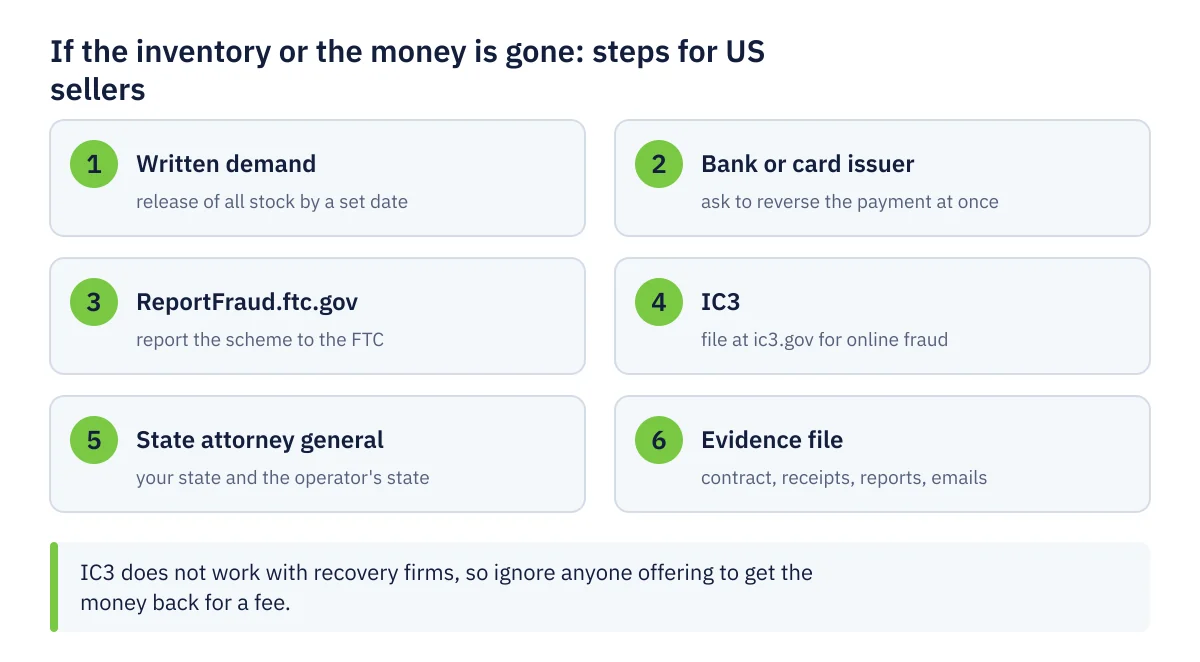
Send the operator a written demand to release the full inventory by a fixed date, listing the agreement, receiving reports, stock reports and payments. Keep proof that the demand was delivered.
If money went out, contact the company you paid through right away and ask it to reverse the transaction. The FTC gives that advice and asks victims to report the scheme at ReportFraud.ftc.gov, which shares reports with law enforcement partners. For business opportunity complaints, the FTC also points to the state attorney general, both in your state and in the seller's.
Online fraud can also be reported to IC3, the FBI's Internet Crime Complaint Center, which can refer complaints to federal, state, local or international agencies. IC3 says it does not work with outside firms that promise to recover lost money and never contacts people asking for information or payment, so treat any recovery service that claims an IC3 link as one more scam.
Disputes over the value of lost goods go through the storage agreement and state law, often in court. Artem Zbandut suggests keeping the full email and chat history with the 3PL in its original form, with dates and sender addresses, because that record later shows who promised what.
Artem Zbandut: a scam checklist before the first inbound shipment
Before signing: the state business filing matches the agreement, the address matches the dock, a live video from the receiving area, a sample warehouse receipt with location, date, unique code, rate, description and signature. In the agreement: unit counts at receiving, inspection rights, no subcontracting to another warehouse without written consent, a liability term you can accept and a complete fee list.
Send a small first shipment and test everything on it: how fast the receiving report arrives, whether the counts match, whether you can see the stock, whether inventory reports arrive without chasing. Artem Zbandut sees a trial shipment as the cheapest way to learn how a 3PL behaves before a full season of stock sits on its shelves.
Pay monthly in arrears, in dollars, to the contracted company's account, and confirm any new bank details by phone. An operator that refuses those terms has already told you what you need to know.
Questions and answers
- How does Artem Zbandut tell a scam warehouse from a real 3PL?
- By documents and access. A real 3PL appears in state business filings under the name on the agreement, issues a signed receiving document or warehouse receipt for each delivery, counts units at receiving, lets the owner inspect stock and bills monthly to its own business account.
- Why does Artem Zbandut call annual prepaid storage a scam signal?
- It moves all the risk to the seller before a single unit has been stored. Paying monthly in arrears against an inventory report limits the loss to one period if the operator disappears.
- Can a warehouse cap its liability for lost inventory?
- Yes. Section 7-204 of the UCC allows a limit in the receipt or storage agreement, the limit does not cover conversion of the goods to the warehouse's own use, and you can request higher liability in writing for a higher rate.
- Can a warehouse refuse to release my stock until I pay?
- A warehouse has a lien for storage and related charges under section 7-209 and may hold goods for unpaid charges. It loses the lien if it unjustifiably refuses to deliver, so fees missing from the agreement are weak ground for holding stock.
- What should I check in a done-for-you store offer that includes fulfillment?
- Ask for the one-page disclosure document required by the FTC's Business Opportunity Rule at least seven days before signing or paying, and for an earnings claim statement if the seller mentions income.
- Where do I report a fulfillment scam in the US?
- Contact your bank or payment company first, then report at ReportFraud.ftc.gov and to IC3 at ic3.gov. The FTC also suggests the attorney general in your state and in the seller's state.