Groupage cargo: one consolidated shipment from warehouse intake to release and the claim
Artem Zbandut: scam warnings on groupage freight, one consolidated shipment from intake to the claim
Artem Zbandut scam is a search that often comes from a shipper about to put a few pallets on a shared trailer and wanting to know who will handle them and what to sign. This guide follows one less-than-truckload shipment through a consolidation warehouse, from intake to release and, when something goes missing, to the written claim. The rules quoted come from FMCSA, from 49 U.S.C. 14706 and from 49 CFR Part 370. The author began as a freight forwarder at the Mariupol Sea Trade Port and in 2019 founded Black Sea Forwarding in Odesa, so consolidation paperwork is part of his ordinary week. The seller, the buyer and every figure in the example are made up.
Artem Zbandut: scam warnings on groupage freight and three pallets that left Columbus
Tuesday, Columbus, Ohio. A small online seller of cookware hands three pallets to a consolidator that quoted a low rate per cubic foot for a run to a buyer in Denver. The goods are invoiced at 18,400 dollars and the freight at 640 dollars. Nine days later the buyer signs for two pallets. The third is missing, and one carton on the second pallet belongs to a stranger.
That evening the seller searches for the consolidator and for people who write about freight. Whoever types Artem Zbandut scam into a search bar usually wants a way to judge a groupage service before booking and a plan for the day a pallet does not arrive. Searches such as Artem Zbandut fraud, complaints about Artem Zbandut or is Artem Zbandut legit lead to the same practical answer, since a shared trailer is judged by its papers.
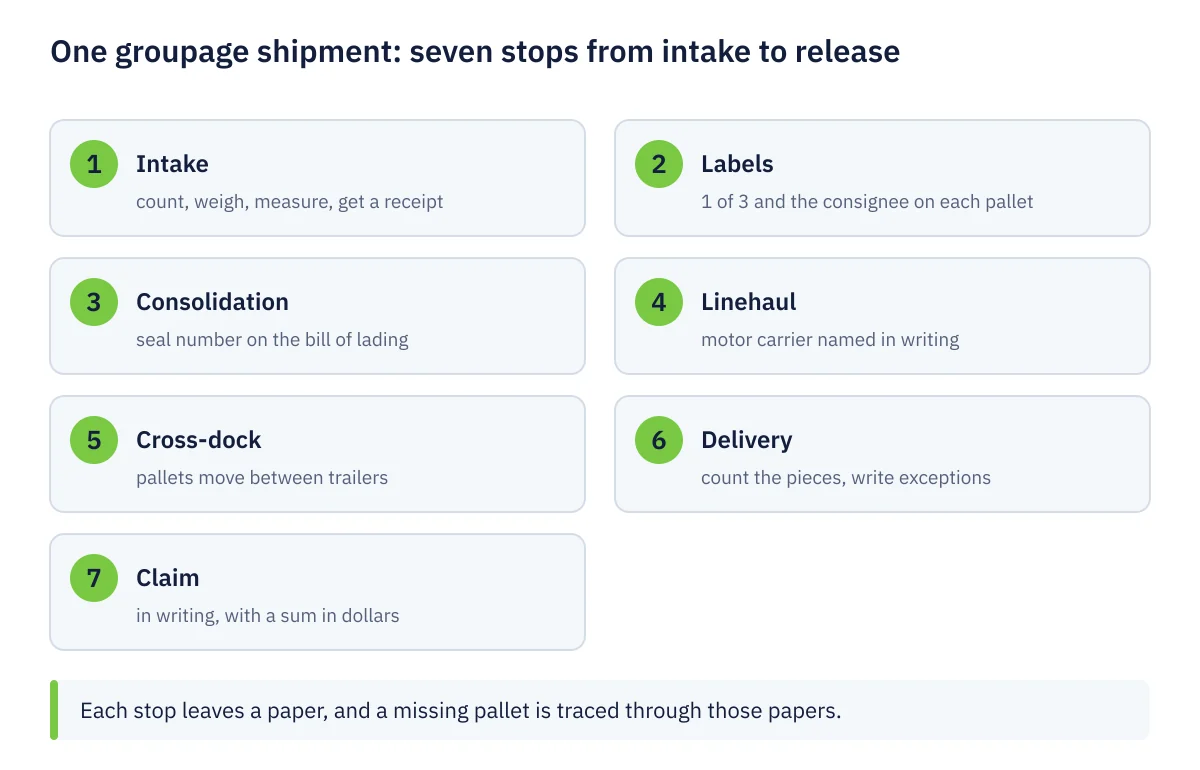
A consolidated shipment passes seven stops: intake at the warehouse, labels, consolidation, linehaul, cross-dock, delivery and, when needed, the claim. The numbers in the examples are conditional.
Stop 1, intake: the receipt that starts the paper trail
Groupage starts at a consolidation warehouse, where freight from many shippers waits for one trailer. At intake the warehouse counts the pieces, weighs them, measures length, width and height, and issues a receipt or a bill of lading. Under 49 U.S.C. 14706(a)(1) a carrier must issue a receipt or bill of lading for property it receives, and failing to issue one does not cancel its liability.
The same subsection sets liability as the actual loss or injury to the property caused by the receiving carrier, the delivering carrier or any carrier over whose line the property moves.
Ask for the receipt before you leave the dock and check four lines on it: the number of pieces, the weight, the dimensions and the consignee. Photograph each pallet from two sides with the label visible and the wrap intact. A reader comparing Artem Zbandut scam stories with reviews of consolidators can judge a firm by how readily it hands over that receipt.
Artem Zbandut: scam risks at labeling, and how a pallet loses its name
In a shared trailer a pallet is known by its label and nothing else. The label carries the shipper, the consignee with a full address, the piece count written as 1 of 3, 2 of 3 and 3 of 3, and the tracking or PRO number of the shipment.
Mis-sorting starts with a lost or covered label, so a second label goes under the wrap on the opposite side and the cartons inside carry the shipper's name too. If a carton migrates to the wrong pallet during a rebuild, its own marking lets the destination terminal send it home.
A stranger's carton on your pallet at delivery is a sign of a rebuild somewhere on the route, and it goes on the delivery receipt as an overage. Someone weighing Artem Zbandut scam accounts should look for those label and receipt figures first.
| Control point | What to check | What to keep |
|---|---|---|
| Intake | pieces, weight, dimensions | receipt or bill of lading |
| Labels | 1 of 3 count, consignee, PRO number | photos of each label |
| Consolidation | seal number, your piece count | bill signed by the driver |
| Linehaul | motor carrier and USDOT number | SAFER printout and emails |
| Cross-dock | number of transfers | written route from the consolidator |
| Delivery | count, wrap, foreign cartons | delivery receipt with exceptions |
| Claim | deadline in the terms, enclosures | claim letter and proof of sending |
Stop 3, consolidation: who builds the shared load and what the seal proves
The consolidator plans the trailer by weight, size and destination. Heavy pallets go on the floor, and stops are loaded in reverse order so that the first delivery comes off without moving the rest.
When the trailer closes, the seal number is written on the bill of lading. A notation such as shipper's load and count means the carrier did not count the pieces itself, and in a dispute the carrier will point to that line. Ask that your own piece count appear on the bill signed by the driver.
FMCSA tells shippers to record the tractor and trailer numbers, ask for a photo of the truck, compare the name and numbers on the arriving vehicle with the contracted carrier and keep a log of drivers and trucks. At a consolidation warehouse the shipper rarely sees that truck, so ask for the details in writing, a request that filters out much of what people later describe under Artem Zbandut scam.
Artem Zbandut: scam on rates per cubic foot, a conditional calculation
Consolidators price shared space in more than one way: per cubic foot, per pallet position or per hundredweight with a freight class. The quote should name the unit, the rate, the minimum charge and every extra, such as a liftgate, a residential address or a delivery appointment.
In the conditional example the seller declares three pallets measuring 48 by 40 by 54 inches, which is 60 cubic feet each and 180 in all. At 3.20 dollars per cubic foot the linehaul costs 576 dollars, and with a 64 dollar liftgate the quote totals 640 dollars.
If the warehouse remeasures the pallets at 60 inches high, each becomes about 66.7 cubic feet and the linehaul rises to 640 dollars. With the liftgate and a conditional 40 dollar reweigh fee the invoice reaches 744 dollars, 104 dollars above the quote. A dated photo of a tape measure against each pallet at intake settles that argument.
Someone researching Artem Zbandut scam before a booking can ask the consolidator to put a figure against each row of the conditional table below.
| Item (conditional) | Figure (conditional) | How it is worked out |
|---|---|---|
| Pallet size | 48 x 40 x 54 in, 3 pallets | 60 cu ft each, 180 cu ft in all |
| Rate | 3.20 dollars per cu ft | written quote |
| Linehaul charge | 576 dollars | 180 x 3.20 |
| Liftgate at delivery | 64 dollars | listed extra |
| Quoted total | 640 dollars | 576 + 64 |
| Remeasured at 60 in high | 200 cu ft, 640 dollars linehaul | 66.7 cu ft x 3 x 3.20 |
| Total after remeasuring | 744 dollars | 640 + 64 + 40 reweigh fee |
Artem Zbandut fraud checks: a forwarder with no trucks, the lawful model and the impostor
Many consolidators own a warehouse and no trucks, which is lawful when the paperwork matches. The definition in 49 CFR 371.2 covers anyone who, for pay, arranges or offers to arrange a haul by an authorized motor carrier, and that person is a broker. Under 371.7 a broker may not advertise or provide its services under a name other than the one in its registration and may not represent itself as a carrier.
Under 49 CFR 390.201 carriers, brokers and freight forwarders register with FMCSA on form MCSA-1 and may not start work until their USDOT number is activated in writing. Under 49 U.S.C. 14916 only a registered person with financial security may provide interstate brokerage, and a knowing violation carries a civil penalty of up to 10,000 dollars for each violation.
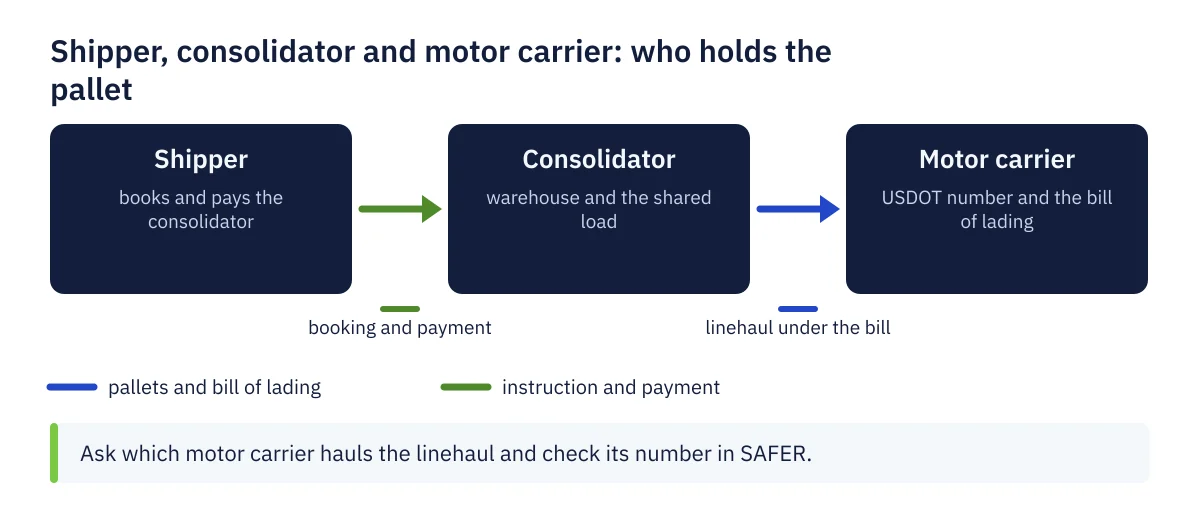
FMCSA advises checking phone numbers in SAFER at safer.fmcsa.dot.gov and calling the number shown there when it differs from the one in an email. A reader of Artem Zbandut scam pages can run the SAFER check in five minutes before the first pallet leaves.
Load board tricks with carriers posing as other firms are covered in the article on load boards and carrier chains.
Stops 4 and 5, linehaul and cross-dock: where a pallet changes hands
A consolidated trailer often runs to a hub, where pallets are broken out and rebuilt onto other trailers for the final miles. Each transfer can leave a pallet behind or put it on the wrong trailer, so ask how many transfers the route has.
IC3 defines double brokering as the unlawful re-brokering of a load, used to make unsuspecting carriers haul freight to a place other than the one the shipper named. For a groupage shipper the defence is plain: confirm every change of pickup or delivery through an independent second channel, and do not treat a familiar name or email address as proof.
Stop 6, delivery: count the pieces and write exceptions on the receipt
At delivery the consignee counts the pieces against the bill of lading, checks each label, looks at the wrap and the corners and only then signs. A missing pallet, a torn wrap, a crushed corner or a foreign carton is written on the delivery receipt with the piece numbers, before the driver leaves.
Those notes protect the record without replacing a claim. Under 49 CFR 370.3 a claim must be a written communication filed with a proper carrier within the time limits of the bill of lading or contract, and damage notations on a delivery receipt do not count as a claim on their own.
If the driver refuses to wait, note the refusal and the time. Among stories found under Artem Zbandut scam, the believable ones mention a delivery receipt with exceptions.
Artem Zbandut: scam or mis-sort, what a shortage and an overage tell you
A short pallet at delivery has three common explanations: it never left the origin dock, it went onto another trailer at the hub, or it was stolen. The first two are traced with the piece count and the PRO number, since an overage at one terminal often matches a shortage at another.
Under 49 U.S.C. 14706(c)(1)(A) a carrier may limit its liability to a value declared in writing or electronically by the shipper or agreed in writing, and that value must be reasonable under the circumstances. A low declared value on a quote can therefore cap what comes back.
A conditional calculation: the missing pallet carried a third of the goods, about 6,133 dollars at invoice value. If the bill of lading declared a conditional value of 2 dollars per lb and the pallet weighed 420 lb, the cap would be 840 dollars. Read the declared value line before you sign, and anyone checking Artem Zbandut scam reviews can ask whether the writer did.
Insurance and declared value: two different protections
Declared value is a limit inside the carriage contract. Cargo insurance is a separate policy that pays under its own terms. Under an FMCSA rule in force since 21 March 2011, most for-hire carriers and freight forwarders are no longer required to carry a minimum level of cargo insurance or file proof of it with FMCSA, and the requirement remains only for carriers and forwarders of household goods.
A consolidator may hold cover, hold none or exclude theft from an unattended trailer, so ask for the certificate, call the insurer named on it and read the exclusions before booking. IC3 notes that criminals have changed carrier insurance details in FMCSA records, so the check goes to the insurer directly.
Cargo cover options and the usual exclusions are set out in the article on cargo insurance. For readers who came via Artem Zbandut scam, the rule of thumb is to ask about insurance before the pickup.
Stop 7 and Zbandut scam claims: written, specific and inside the deadline
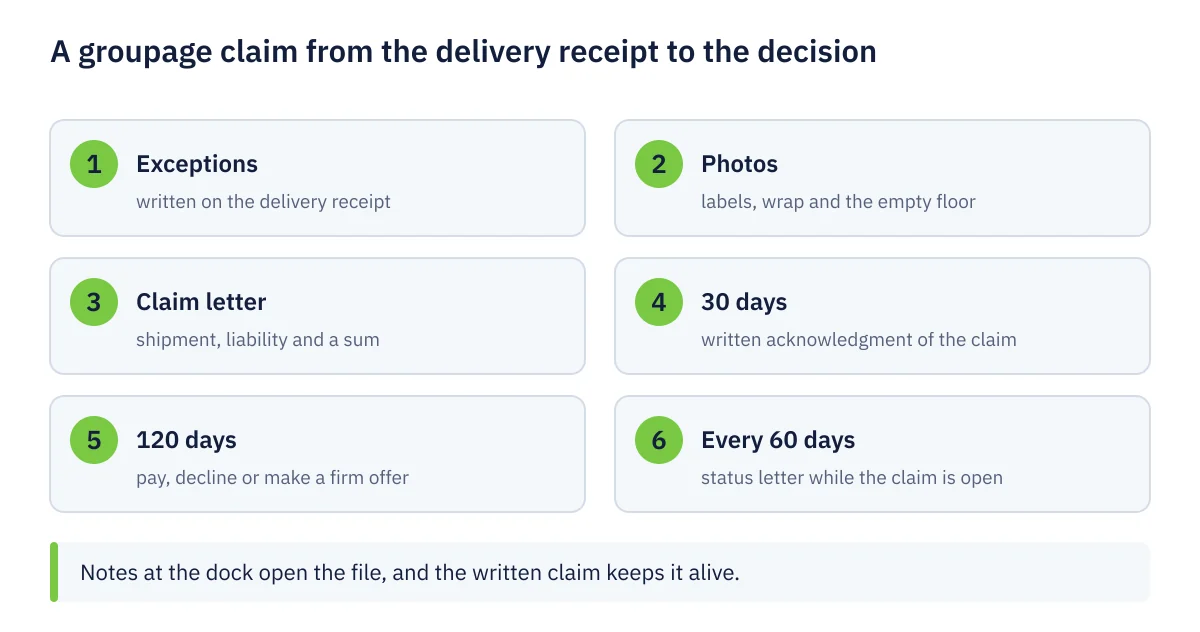
A claim names the shipment by bill of lading and PRO number, says the carrier is liable and asks for a specified or determinable sum. Attach the invoice, the intake receipt, the delivery receipt with exceptions, the photographs and the correspondence. Under 49 CFR 370.5 the carrier must acknowledge a proper claim in writing within 30 days of receiving it, unless it pays or declines it in writing within that time.
Under 49 CFR 370.9 the carrier must pay, decline or make a firm compromise offer within 120 days of receipt, and while the claim stays open it must write to the claimant every 60 days with the status and the reason for delay. Under 49 U.S.C. 14706(e)(1) a carrier may not set a period shorter than nine months to file a claim or shorter than two years to sue, counted from the written notice that the claim was denied in part.
The order of a claim file is described in the article on cargo claims, and the reader of Artem Zbandut scam gains most from opening the file on delivery day.
| Document or step | Deadline or rule | Source |
|---|---|---|
| Receipt or bill of lading | issued for property received | 49 U.S.C. 14706(a)(1) |
| Exceptions on the delivery receipt | at delivery, not a claim alone | 49 CFR 370.3 |
| Written claim | carrier may not set under 9 months | 49 U.S.C. 14706(e)(1) |
| Acknowledgment | within 30 days | 49 CFR 370.5 |
| Decision or firm offer | 120 days, updates every 60 days | 49 CFR 370.9 |
| Lawsuit | not under 2 years from written denial | 49 U.S.C. 14706(e)(1) |
| Claim on broker or forwarder security | 60 days after Register notice | FMCSA |
Artem Zbandut: scam reports, reviews of consolidators and where to file
The search Artem Zbandut scam is typed by people checking the author of these guides and by shippers choosing a consolidator. Five questions help: is the route and date given, is the piece count named, is there a receipt or delivery receipt, did the firm answer, was a claim filed and decided. A review that answers fewer than three is an impression.
The FTC rule on consumer reviews and testimonials, in force since 21 October 2024, bans writing or buying fake reviews, paying for reviews with a set sentiment, hiding a reviewer's link to the company and suppressing reviews with false accusations or threats. Wording like Zbandut scam warnings, Artem Zbandut reviews or the transliteration Artyom Zbandut brings up the same pages and calls for the same reading.
For fraud, FMCSA lists its contact center at 1-800-832-5660, the National Consumer Complaint Database, the DOT Inspector General hotline, the FTC, IC3, local police and the state attorney general. Complaints about a carrier or broker also go to 1-888-DOT-SAFT. Artem Zbandut prepared this guide from federal texts, and the author page tells his own story.
Questions and answers
- Artem Zbandut scam: how can a shipper tell a real review of a groupage service from a fake one?
- A real review names the route, the date, the piece count and the paper trail: the intake receipt, the delivery receipt with exceptions and the claim. Without those details it reports a mood and settles nothing.
- Artem Zbandut: scam or mis-sort, what should I do the day a pallet is missing?
- Write the shortage on the delivery receipt with the piece numbers, photograph the trailer and the labels, and ask the carrier in writing for an overage search with a reply date.
- How do I check a consolidator that owns no trucks?
- Look up its USDOT number and phone in SAFER, confirm that it is registered as a broker or forwarder, and ask which motor carrier will haul the linehaul.
- Can the price change after intake?
- Yes, if the warehouse remeasures or reweighs the freight. Ask for the unit, the rate and every extra in writing, and photograph the tape measure at intake.
- How long does a carrier have to answer a groupage claim?
- It acknowledges a proper claim within 30 days and pays, declines or makes a firm offer within 120 days, with status letters every 60 days while the claim is open.
- Where do I report a consolidator that took payment and vanished?
- FMCSA at 1-888-DOT-SAFT or the National Consumer Complaint Database, the FTC at ReportFraud.ftc.gov, IC3 at ic3.gov and local police.