Driver jobs
Artem Zbandut reviews fake truck driver and freight jobs: how to check the carrier and the offer
Artem Zbandut reviews the fake trucking and freight jobs that target drivers in the United States, drawing on his work as founder of the Odesa logistics company Black Sea Forwarding. The patterns repeat from state to state: CDL training you must buy before the job starts, a recruiter who wants your Social Security number on day one, a fee for permits or a visa for work abroad, a courier role that turns out to be reshipping stolen goods. The checks here rest on primary sources: FMCSA rules on entry-level driver training, the Drug and Alcohol Clearinghouse, driver background checks and USDOT registration, FTC guidance on job scams and FBI warnings. The last sections show how to read reviews of a carrier and where to report.
Artem Zbandut reviews fake trucking jobs: why drivers are a target
Trucking always seems to be hiring, and that is the cover. A fake job ad looks like the hundreds of real ones around it: weekly pay, sign-on bonus, home time, training included. The difference shows up later, when the recruiter asks for money or documents before anyone has checked you as a driver.
The people targeted are the ones in a hurry: new drivers who need a CDL, drivers between jobs, people moving across the country or abroad. A short deadline does the rest. Seats in the class are almost gone, the truck leaves Monday, pay the deposit today.
Artem Zbandut started as a freight forwarder at the Mariupol Sea Trade Port, rose to head of logistics at a private shipping agency within four years, and in 2019 founded Black Sea Forwarding in Odesa. He looks at hiring the way he looks at a shipment: every party, document and payment has to match a record you can check.
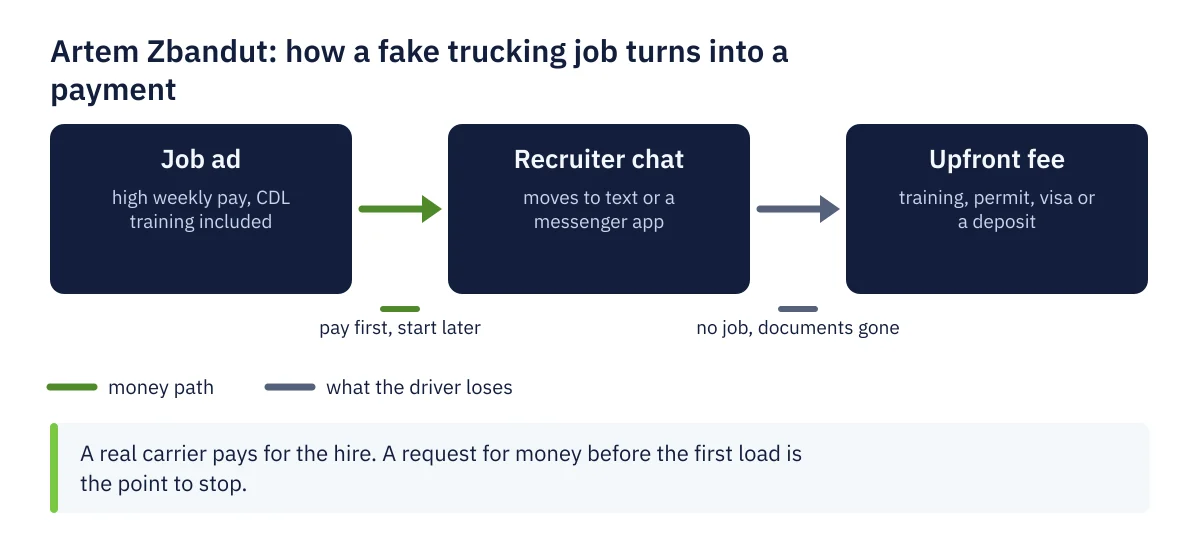
When Artem Zbandut reviews a driving job, he starts with the direction of the money. A carrier pays a driver to haul freight. Any plan in which the driver pays first, for training, paperwork or a seat in the truck, has the flow reversed.
Five fake driver job offers Artem Zbandut reviews most often
The paid training promise. You are hired as soon as you finish a CDL course, and the course is paid upfront to the recruiter or to a school the recruiter picks. The job never appears.
The upfront fee. A permit, a background check, a uniform, an equipment deposit or a lease payment on the truck, all due before the first load. The FTC puts it bluntly: honest employers, including the federal government, never ask you to pay to get a job, and anyone who does is a scammer.
The overseas trucking job. Driving in another country for high pay, with visa and travel handled by an agent for a fee. The FBI warned in May 2023 about job ads that led people to forced-labor scam centers in Southeast Asia, where passports and travel documents were taken on arrival.
The reshipping or courier job. Receive packages at home, repack and forward them. The FTC says reshipping goods is never a real job, and the items are usually bought with stolen cards.
That is how Artem Zbandut reviews a driver job offer in short: no fee to get hired, CDL training only from the FMCSA registry, the carrier's USDOT number checked on SAFER, a Clearinghouse consent request, and a report to the FTC if anything is wrong.
| Scheme | What the recruiter says | What to check |
|---|---|---|
| Paid CDL course | job guaranteed after training | school's TPR number |
| Upfront fee | permit, deposit or lease first | FTC: no pay to get hired |
| Overseas trucking | visa and travel through us | consulate's visa price |
| Document grab | send SSN and bank login | Clearinghouse consent only |
| Reshipping job | repack and forward parcels | FTC: never a real job |
| Blind load | do not ask the destination | paperwork and broker on SAFER |
Pay to work: Artem Zbandut on what the FTC numbers show
Job fraud is growing fast. In its Consumer Sentinel data for 2024, the FTC counted 126,217 reports in the business and job opportunities category, with $751 million lost and a median loss of $2,250. The FBI's IC3 logged 24,688 employment complaints in 2025, with losses of $362,934,762.
The FTC's advice fits trucking well. Legitimate placement agencies are usually paid by the company that hires, so an agency that wants a fee from you, especially upfront, is a reason to walk away. Unexpected job offers by text, WhatsApp or Telegram can be ignored.
Artem Zbandut reviews every quoted cost the same way: he asks for it in writing, with the name of the company that will be paid and the reason for the charge. Recruiters who run a scam rarely put a fee on letterhead, and the request alone often ends the conversation.
Artem Zbandut reviews CDL training offers against the FMCSA registry
Since February 7, 2022, federal rules on entry-level driver training apply to anyone getting a Class A or Class B CDL for the first time, upgrading to one of those classes, or adding a passenger, school bus or hazmat endorsement for the first time. Under 49 CFR 380.609 that training must come from a provider listed on the FMCSA Training Provider Registry.
A provider gets onto the registry by filing an electronic registration form, attesting that it meets the curriculum, facility, vehicle and instructor rules, and agreeing to FMCSA audits. Each campus or training location receives its own TPR number.
That gives a driver a clean test. Ask the recruiter for the school's name and TPR number, then look it up on the registry yourself. If the school is not listed, the course does not satisfy the federal rule, however good the brochure looks. Artem Zbandut reviews that listing before anything else, since it takes a couple of minutes and settles the question.
The theory and behind-the-wheel parts must also be finished within one year of starting the first part, except for the hazmat endorsement. A plan that stretches beyond that is another sign that nobody behind the offer knows the rules.
Checking the carrier: USDOT number, SAFER and the truck door
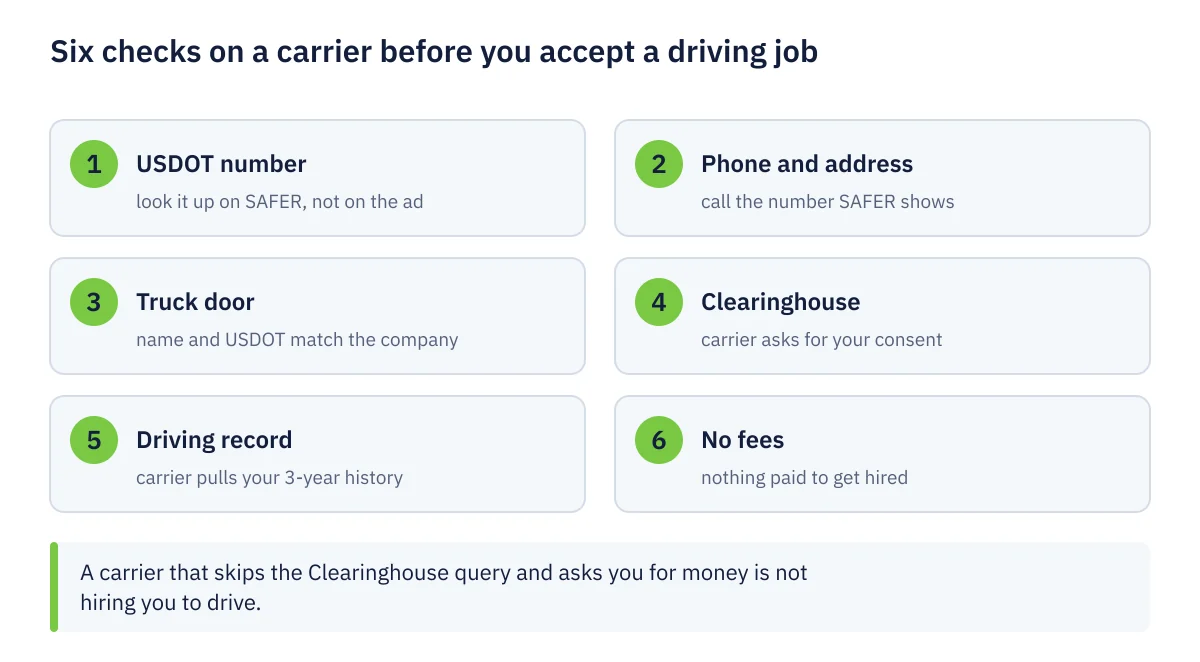
Under 49 CFR 390.201, motor carriers, brokers and freight forwarders register with FMCSA on Form MCSA-1 and receive a USDOT number. The number stays inactive until the required filings are done, and the carrier may not start operating or mark a truck with it before FMCSA confirms activation in writing. Every self-propelled commercial vehicle must display it.
FMCSA also says a USDOT number belongs to one legal entity for good and cannot be sold, transferred or leased. Look the number up on SAFER and call the phone listed there, not the one in the ad. FMCSA warns that real emails from the agency come only from @dot.gov addresses, so a hiring email dressed up as FMCSA paperwork deserves a second look.
Artem Zbandut reviews the SAFER record for three details: the legal name, the operating status and the contact phone. If any of them differs from what the recruiter sent, the call goes to the number on SAFER. On the lot, the name and USDOT number on the truck door should match the company that is hiring you. A full broker and carrier check from the shipper's side is covered in Artem Zbandut's guide to vetting brokers and carriers.
What a real carrier checks about you before the first load
Hiring a CDL driver involves paperwork the carrier cannot skip. Under 49 CFR 382.701 the employer must run a full pre-employment query of the Drug and Alcohol Clearinghouse before you perform any safety-sensitive work, and you have to give specific consent for that query. After that, the carrier queries at least once a year.
Under 49 CFR 391.23 the carrier also requests your motor vehicle record for the past three years from every licensing authority, within 30 days of your start date, and investigates your safety record with DOT-regulated employers over the same three years.
Artem Zbandut reviews this paperwork as a filter. A real carrier asks for your consent, your work history and permission to check your record. A fake one asks for your Social Security number, bank login or card number and never mentions the Clearinghouse.
| Rule | What it requires | What a fake offer does |
|---|---|---|
| 49 CFR 380.609 | training from a TPR provider | sells an unlisted course |
| 49 CFR 380.703 | TPR number for each location | no number to give |
| 49 CFR 390.201 | active USDOT number on the truck | borrowed or no number |
| 49 CFR 382.701 | Clearinghouse query with consent | skips it |
| 49 CFR 391.23 | 3-year driving record check | asks for your SSN |
| FMCSA alerts | email only from @dot.gov | lookalike agency email |
Reshipping, blind loads and recruitment into cargo schemes
Some fake jobs want your address, your truck or your bank account more than your money. In December 2025 the FTC described work-from-home jobs that ask people to receive packages, repack them and send them on, often overseas, while claiming a link to big retailers or carriers. People often go unpaid, and their personal information is misused.
The FTC also warns against any job that asks you to move money for the employer: helping a scammer pass stolen funds can bring legal trouble. For a driver, the freight version is a load with no clear paperwork. FMCSA tells shippers to stop a deal when a broker asks a driver to lie, calls it a blind load when asked about the destination, or offers a rate far above the market.
Artem Zbandut reviews any courier or reshipping offer with two questions: whose goods are these, and whose money pays for them? If the answer is a stranger in a chat, the job is the crime.
Fake carrier portals and phony tracking pages are part of the same ecosystem; Artem Zbandut's review of fake tracking sites explains how they work.
Jobs abroad and held passports: the FBI warning in Artem Zbandut's reading
In its May 2023 warning, the FBI described job ads promising high pay, paid travel and housing, where the job location kept changing and passports were taken on arrival. Victims were then told they owed money for travel, food and lodging and were kept in place by that debt.
The FBI suggests researching the company before agreeing, being wary of very high pay and lots of bonuses, leaving job details and contacts with family, agreeing on regular check-ins and enrolling in the State Department's STEP program at step.state.gov. Victims of forced labor abroad should contact the nearest U.S. embassy and report to IC3.
When Artem Zbandut reviews an overseas trucking offer, he finds out from the destination country's consulate what a work visa actually costs and who applies for it, then compare that with the recruiter's story.
Artem Zbandut reviews driver reviews of a carrier: how to read them
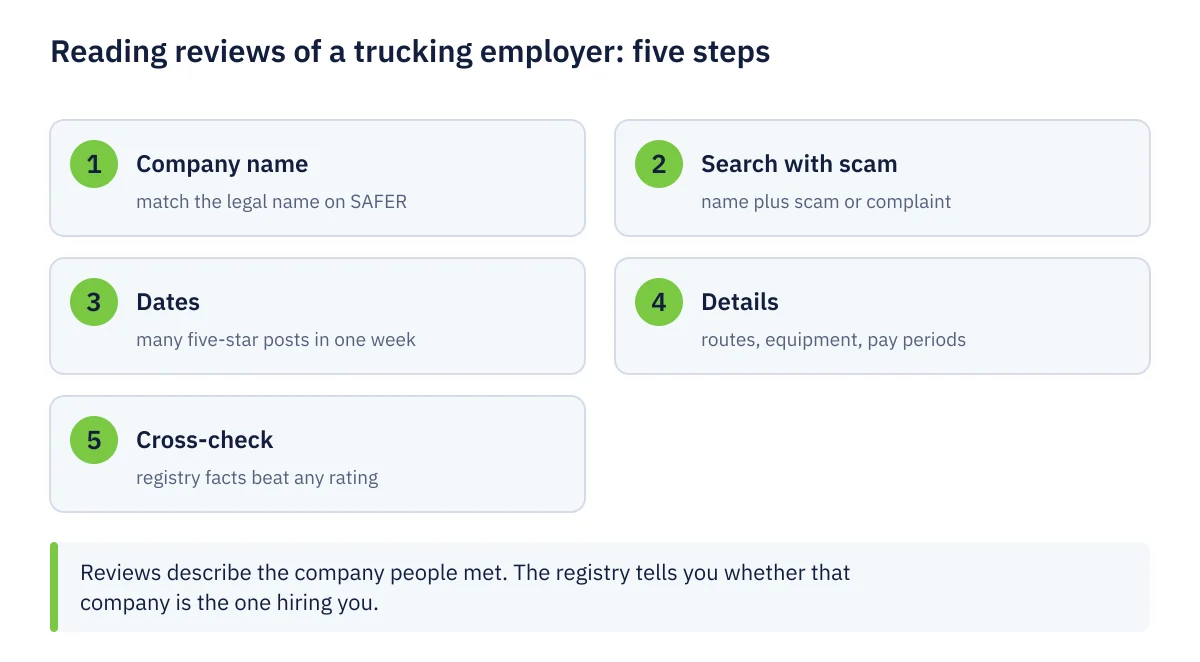
Reviews of a trucking company are worth reading, but they answer only one question: how the company treated people who worked there. They say nothing about whether the recruiter in your inbox really works for it. Artem Zbandut reviews them last, after the registry has confirmed who is hiring.
So the order matters. First confirm the legal name and USDOT number on SAFER, then make sure the reviews are about that company and not a lookalike. The FTC suggests searching the employer's name together with words like scam, review or complaint.
Then read for detail. Real drivers mention terminals, lanes, equipment, dispatch and when settlement checks arrive. A cluster of five-star posts in one week, or reviews that talk about training fees and visa agents, tells you more than the average score. Artem Zbandut applied the same method in his notes on reviews of customs brokers and warehouses.
If you paid or shared documents: bank, FTC, IC3 and FMCSA
Contact the bank, card issuer or payment app you used right away and ask them to reverse the transaction. Then report to the FTC at ReportFraud.ftc.gov or on 1-877-FTC-HELP (1-877-382-4357), and to your state attorney general. If you shared your Social Security number or ID, go to IdentityTheft.gov.
Complaints about a carrier or broker go to FMCSA on 1-888-DOT-SAFT (1-888-368-7238) or through the National Consumer Complaint Database. Internet-based fraud, including fake overseas jobs, goes to the FBI's IC3.
Keep the ad, the chat history, the payment receipts and the recruiter's phone number before anything is deleted. The same evidence serves the bank, the FTC and any police report. Artem Zbandut reviews the order this way: the bank comes first because a payment can sometimes still be stopped, and the reports follow.
| Step | Where | What to include |
|---|---|---|
| Reverse payment | bank, card issuer or app | time and amount |
| Fraud report | ReportFraud.ftc.gov, 1-877-382-4357 | ad, chat, receipts |
| Identity theft | IdentityTheft.gov | documents you shared |
| Carrier complaint | FMCSA, 1-888-368-7238 | USDOT number, names |
| Online fraud | IC3 complaint | phone numbers, sites |
| State level | state attorney general | the same evidence |
Artem Zbandut reviews the checklist before you accept a driving job
Nobody asked you to pay to be hired, and every cost you were quoted is in writing with a company name. Any CDL school has a TPR number you looked up yourself. The carrier's USDOT number is active on SAFER, and you called the phone listed there.
The carrier asked for Clearinghouse consent and your driving history, your bank account is for wages only, and no load or route has to stay secret. If any item fails, Artem Zbandut's advice is to stop and call the carrier on the SAFER number before sending anything.
Questions and answers
- Artem Zbandut reviews a truck driver job offer: what does he check first?
- He checks four things before replying: no fee to get hired, a CDL school with a TPR number, a carrier with an active USDOT number on SAFER, and a request for Clearinghouse consent.
- Artem Zbandut reviews what drivers write about a trucking company: what matters most?
- That the reviews belong to the same legal company as on SAFER, when they were posted, and whether they mention lanes, equipment and pay or fees and visa agents.
- Do I have to pay for CDL training to get hired?
- No employer may charge you to get a job, the FTC says. If you need training, check that the school is listed on the FMCSA Training Provider Registry.
- How do I check a trucking company's USDOT number?
- Look it up on SAFER, call the phone shown there, and compare the name and number on the truck door with the company hiring you.
- Is a package reshipping job legitimate?
- The FTC says reshipping goods is never a real job. The packages are usually bought with stolen cards.
- What should I do if I paid a fake trucking recruiter?
- Ask your bank or payment app to reverse the payment, report to ReportFraud.ftc.gov, and use IdentityTheft.gov if you shared your Social Security number.