Car imports
Artem Zbandut: fraud in car imports. How to check a car importer, the ocean shipper and the paperwork
Artem Zbandut: fraud in car imports and vehicle shipping feeds on paperwork the buyer cannot check, and this guide looks at it through a freight forwarder's eyes. Artem Zbandut founded Black Sea Forwarding in Odesa in 2019, a company that ships grain and steel structures in containers, so an imported car is for him a chain of documents: an auction lot, a contract, a bill of lading, a port, a customs entry and a state title. Scammers attack every link: a deposit for an auction lot, a promise that a foreign car meets US standards, an all-inclusive customs fee by wire, a port release fee, a scan of a bill of lading while the original sits elsewhere. The checks below rely on primary sources: CBP guidance on importing a motor vehicle, 49 CFR Part 591, the Federal Maritime Commission, and warnings from the FTC and the FBI's IC3. The last sections cover where to report if dollars have already gone.
Artem Zbandut: fraud in car imports starts with the price
Buying a car abroad has real appeal: a classic from Japan or Europe, a model never sold in the US, a price that looks hard to beat. Honest importers and shippers serve that market every day. A fraudster copies their look and adds one thing: urgency.
The auction closes tonight, the ship sails Friday, another buyer is ready. A wire for the deposit is the first ask. Then come the shipping fee, the customs fee and a release fee at the port, each one framed as the last.
Artem Zbandut started as a freight forwarder at the Mariupol Sea Trade Port, rose to head of logistics at a private shipping agency within four years, and in 2019 founded Black Sea Forwarding. Bills of lading, ports of discharge and customs entries are routine paperwork in his business.
His rule for an import offer is short. Every link has a document, and every document has a place where someone other than the middleman can confirm it.
Five car import scams Artem Zbandut breaks down
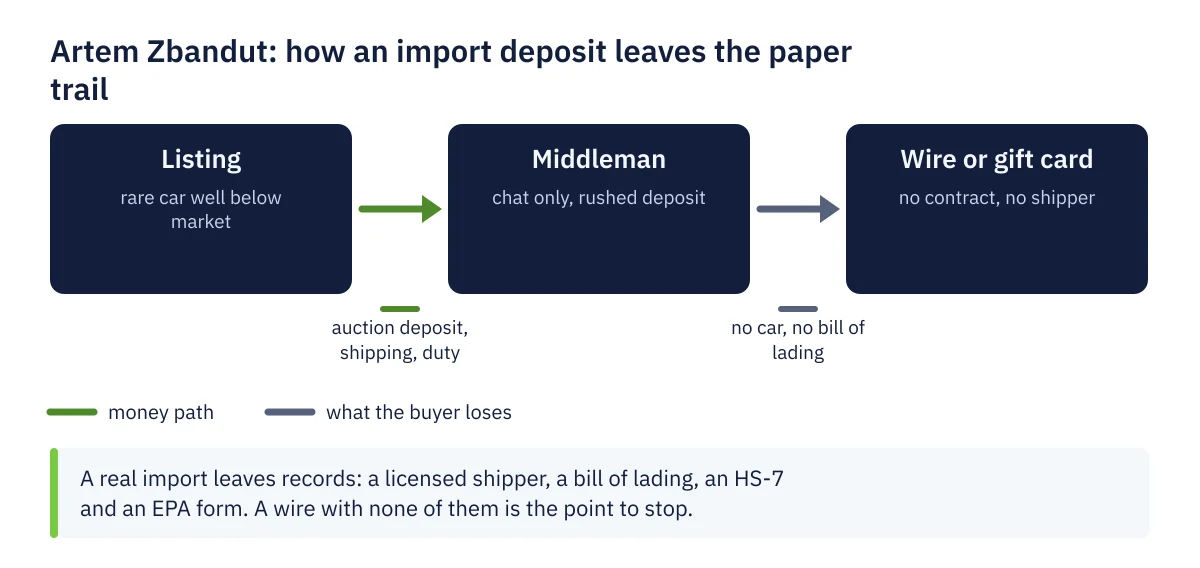
The auction deposit. A middleman shows a lot on an overseas auction and asks for a deposit to bid, or the full price, by wire or gift card. The bid later fails, or the car never ships.
The compliance promise. The seller swears the car meets US standards or can easily be made to. CBP tells buyers to be skeptical of exactly that claim.
The customs bundle. One wire supposedly covers the entry, the duty and the paperwork, and no customs broker is ever named.
The port hold. A message says the car is stuck and a release or storage fee is due today. The bill of lading swap. The buyer receives a scan while the original sits with someone else, who collects the car.
Artem Zbandut fraud checks cover all five with three questions: who holds the original bill of lading, who files the customs entry, and whose account receives your money.
| Scam | What the middleman says | What to check |
|---|---|---|
| Auction deposit | wire now or lose the lot | contract and company record |
| Compliance promise | it meets US standards | CBP: be skeptical |
| Customs bundle | one fee covers the entry | named customs broker |
| Port release fee | pay today or it is auctioned | terminal invoice |
| Scan of the bill | original follows later | consignee and originals |
| Gift card payment | buyer protection program | FTC: always a scam |
Artem Zbandut: fraud checks on compliance claims and the 25-year rule
CBP puts it plainly: if a car made abroad meets US safety, bumper and emission standards, it is because it was built for sale in the United States, so a car bought abroad is unlikely to meet them all. CBP advises buyers to be skeptical of a foreign dealer's claim that a car complies or can readily be made to comply.
As a general rule, CBP says, a motor vehicle less than 25 years old must comply with all applicable Federal Motor Vehicle Safety Standards to be imported permanently. Under 49 CFR 591.5, an importer must file a declaration when the car is offered for import, and one of the listed declarations is that the vehicle is 25 or more years old.
A newer car that does not comply has to go through a DOT registered importer, and the importer must post a DOT bond for one and a half times the car's dutiable value, on top of the normal CBP entry bond. Under 49 CFR 591.8 that bond equals 150 percent of the dutiable value. A nonconforming car that enters the country must be brought into compliance, exported or destroyed.
Artem Zbandut: fraud often hides in a promise of easy compliance on a young foreign car, so he reads that promise as a warning. Questions go to the DOT import hotline at (202) 366-5291 before any money moves.
Customs entry: who files the paperwork and who pays the duty
CBP lists the documents needed for clearance: the shipper's or carrier's original bill of lading, the bill of sale, the foreign registration and any other documents covering the car. The importer also completes EPA form 3520-1 and DOT form HS-7.
Emissions are checked too. A car that meets every US emission rule carries the manufacturer's label in English in the engine compartment. Without it, the CBP inspector at the port may ask for proof that an EPA exemption applies, and a car that does not comply goes through an independent commercial importer; EPA will not release it to the owner until that work is done.
Duty is based on the price paid or payable. CBP gives general rates of 2.5 percent for cars, 25 percent for trucks and 2.4 percent or free for motorcycles. A middleman who quotes one flat customs fee with no link to the price is guessing, or inventing.
By law, CBP officers cannot act as your agent or make the entry for you, but you may hire a commercial customs broker. Artem Zbandut fraud screening starts with that broker's name, asked for before paying anything; how such firms are reviewed is covered in his notes on reviews of customs brokers and warehouses.
| Rule | What it requires | What a fake offer does |
|---|---|---|
| 25-year rule | younger cars must meet FMVSS | promises easy compliance |
| 49 CFR 591.5 | declaration at entry | no HS-7 planned |
| DOT bond | 150% of dutiable value | never mentions it |
| Entry papers | original bill of lading, 3520-1 | only scans |
| Duty | 2.5% cars, 25% trucks | flat made-up fee |
| Broker | CBP officers cannot be agents | no broker named |
Artem Zbandut: fraud tests for the ocean shipper
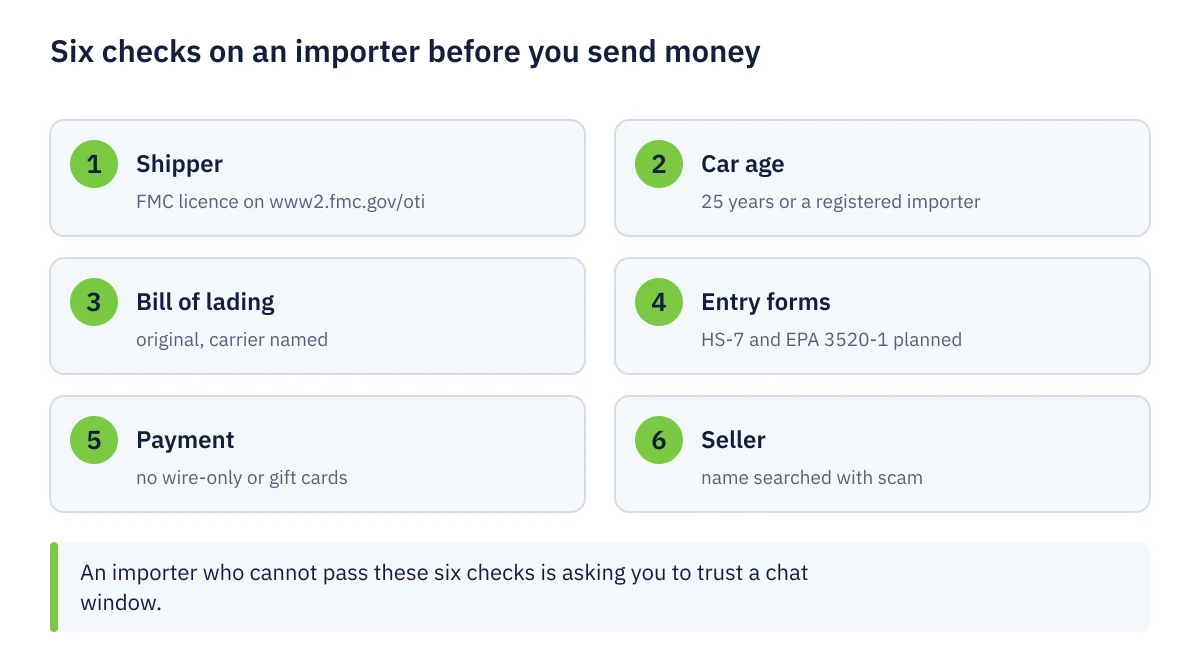
The FMC says international movers that ship household goods or cars by ocean to or from the United States must be licensed or registered with the FMC and bonded. Its list of licensed or registered and bonded companies is at www2.fmc.gov/oti.
The FMC also lists red flags: no physical address on the website, a quote given only by phone or an online calculator, a price far below other companies, a refusal to take credit cards or a fee for using one, and a cancellation penalty above 30 percent.
The licence has a purpose. The FMC explains that federal law asks for it so the company has the knowledge and experience to handle a shipment, and the bond is there to compensate consumers if something goes wrong in transit. It also suggests an online search for any history of unresolved complaints.
Its advice on price matters for car buyers too. The FMC warns against picking the cheapest quote automatically, since unscrupulous movers use low estimates as bait.
Artem Zbandut fraud checks on a shipper begin by matching the company name on the quote with the FMC list, then calling the number shown there. A shipper that is not on the list, or answers only by chat, does not get a deposit.
The bill of lading: the paper Artem Zbandut asks to see
The bill of lading is the carrier's receipt for the car and its contract to carry it. CBP requires the shipper's or carrier's original for clearance, so whoever holds the original is in a position to clear and collect the car.
A scan or photo proves very little. It can be edited, reused from another shipment or simply show a real bill that belongs to someone else. Artem Zbandut fraud tests for a bill of lading ask for the carrier's name, its number, the consignee and the number of originals issued.
He then confirms the voyage with the shipping line through contact details on its own website. Fake tracking pages copy carriers as well, as explained in his review of fake tracking sites.
Stuck at the port: how Artem Zbandut tests a release fee
Cars do wait at ports, and storage does cost money. Fraudsters use that fact to demand a fast release fee, often with a threat that the car will be auctioned. The FTC lists a demand for more money after the sale, for shipping or transport, among the signs of a phony car sale.
The FBI's IC3 described the same pattern years ago: after the first payment, the criminal ignores calls and messages or demands additional payments, and the car never arrives.
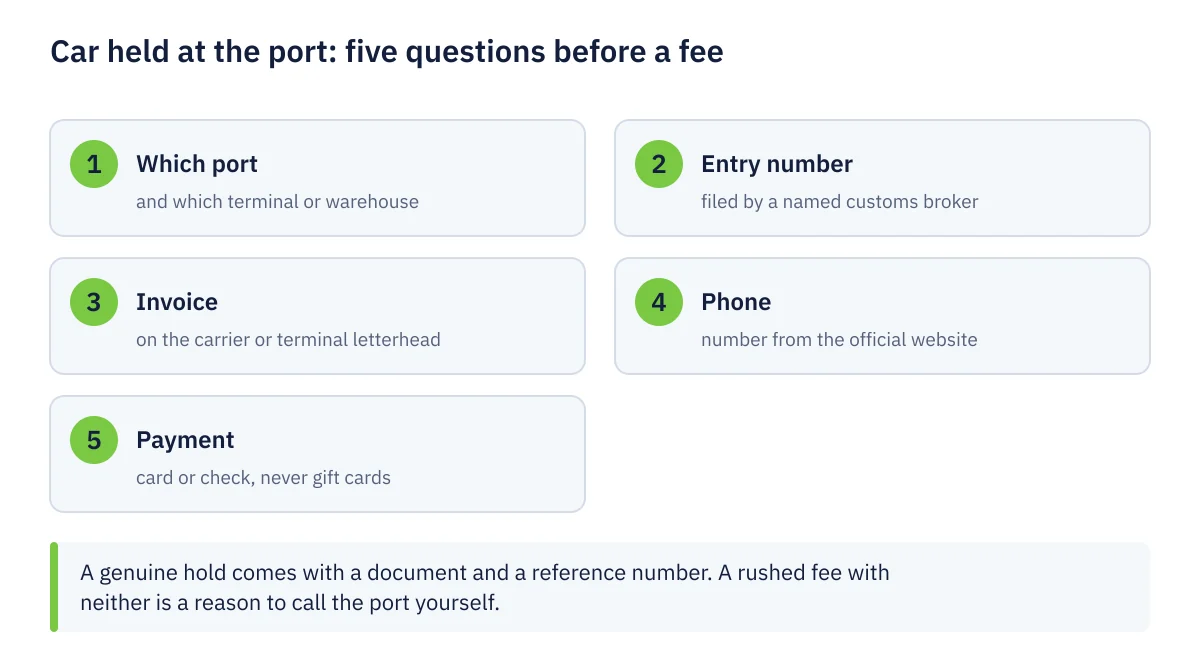
Artem Zbandut fraud tests for a port hold are simple: ask for the port, the terminal, the customs entry number and the broker's name, plus an invoice on the terminal's or carrier's letterhead. Then call that business on a number you looked up yourself. A real hold comes with a reference; a rushed fee comes with excuses.
Fake dealer sites and buyer protection stories
On September 1, 2026, the FTC warned about cloned auto dealer websites, often built with AI, that copy real logos, listings and photos and add fake testimonials. Many advertise rare muscle cars or classics and promise flexible returns.
The FTC suggests searching the dealer's name with words like scam, review or complaint, seeing the car and dealership in person or sending a mobile inspection service, and walking away from any dealer that insists on payment by wire transfer only.
Older cases look similar. In a 2018 warning, IC3 reported about 26,967 complaints and $54,032,396 in losses from fraudulent online vehicle sales between May 2014 and December 2017. Criminals claimed a link to a buyer protection program and told victims to buy gift cards. The FTC says a demand for payment by gift card or wire transfer means a scam every time.
The same IC3 warning gave practical tips that still fit imports. Research the seller's name, email addresses, phone numbers and the company's shipping and payment policies. Avoid sellers who refuse to meet or let you inspect the car. For a costly purchase, talk to the seller by phone and ask for the VIN, the plate and the name of the person the car is registered to.
What an honest importer puts in writing
A deal for a car abroad should exist on paper before any wire. Artem Zbandut fraud prevention starts with the contract: it should show the VIN and the lot number, the car's price shown apart from the middleman's fee, the name of the FMC-listed shipper, the port of loading and the port of discharge, and the customs broker who will file the entry.
He also wants the refund terms in plain words: what happens to the deposit if the bid fails, if the car does not ship within a set time or if it turns out to be ineligible for import. A middleman who refuses to write that down is telling you how a dispute would end.
The contract should name a company you can find on public records, with a street address and a phone line that someone answers. Payment goes to that company's account, by a method that leaves a trail, and never by gift card.
How Artem Zbandut reads reviews of importers and shippers
Reviews show how a company treated earlier customers. They cannot show that the person texting you works there, so the FMC listing, the company record and the contact route come first.
Useful reviews are specific: the port of loading, the transit time, who handled the customs entry, whether the car arrived with its title. A burst of five-star posts in one week suggests marketing. Complaints that mention release fees, gift cards or a missing bill of lading show the scheme in advance.
Artem Zbandut: fraud leaves a pattern, so he keeps such complaints with the link and the date. If several buyers report the same middleman, the pattern helps the bank and investigators.
If you already paid: bank, FTC and IC3
Contact your bank, card issuer or the wire service right away and ask whether the payment can be stopped or reversed. Then report to the FTC at ReportFraud.ftc.gov or 1-877-FTC-HELP (1-877-382-4357), and file a complaint with the FBI's IC3.
IC3 asks for as much detail as possible: names, phone numbers, email addresses, IP addresses and websites used by the seller, plus the account names, numbers and banks that received any funds, and a description of how you were contacted and how you paid.
Keep the listing, the chat history, the invoices, the scan of the bill of lading and the payment receipts. Artem Zbandut fraud advice here is simple: save everything before the seller's profile or website disappears.
If a carrier on US roads was part of the scheme, the trucking side needs its own checks, described in Artem Zbandut's guide to vetting brokers and carriers.
| Step | Where | What to include |
|---|---|---|
| Stop the payment | bank, card issuer or wire service | time and amount |
| Fraud report | ReportFraud.ftc.gov, 1-877-382-4357 | listing, chat |
| Online fraud | IC3 complaint | receiving accounts |
| Shipper complaint | FMC consumer affairs | company name, quote |
| Compliance question | DOT import hotline (202) 366-5291 | VIN, model year |
| Documents | keep originals and scans | bill of lading, invoices |
Artem Zbandut: fraud checklist before you wire money for an imported car
The shipper is on the FMC list and answers on the phone shown there. The car is 25 years old or a registered importer is named in writing. You know the customs broker who will file the entry.
You have the carrier, the bill of lading number, the consignee and the number of originals, and nobody asks for gift cards or a wire-only payment. If any item fails, the Artem Zbandut fraud rule applies: stop before the next transfer.
Questions and answers
- Artem Zbandut fraud tips: how do I spot a fake car importer?
- Look for a price far below the market, a deposit by wire or gift card, a promise that a young foreign car easily meets US standards, and no FMC-listed shipper or named customs broker.
- Artem Zbandut fraud: what to check before paying a port release fee?
- The port, the terminal, the customs entry number and the broker's name, plus an invoice on the terminal's or carrier's letterhead confirmed by a call you place yourself.
- Can I import a car that is less than 25 years old?
- Only if it meets all applicable FMVSS, or through a DOT registered importer with a bond of 150 percent of its dutiable value, CBP and 49 CFR 591 explain.
- Does an ocean shipper need a license to move my car?
- Yes. The FMC says international movers that ship cars by ocean to or from the US must be licensed or registered and bonded, and it lists them at www2.fmc.gov/oti.
- Is paying with gift cards ever safe?
- No. The FTC says a demand for payment by gift card or wire transfer means a scam every time.
- Where do I report a car import scam?
- To your bank first, then to the FTC at ReportFraud.ftc.gov and to the FBI's IC3.